Canadian ConSat-1 CubeSat

ConSat-1 - Image credit ESA - Photo Gregory Gibson.

ConSat-1 – Image credit ESA – Photo Gregory Gibson.

The Canadian ConSat-1 3U CubeSat aims to analyze radiation characteristics in the South-Atlantic Anomaly, and test technology payloads.

Canada is an Associate Member of the European Space Agency (ESA) and ConSat-1 is one of the educational CubeSats chosen for Phase 1 of the ‘Fly Your Satellite!’ initiative.

The ‘Fly Your Satellite!’ initiative builds on the success of the ‘CubeSats for the Vega Maiden Flight’ pilot program. This culminated in 2012 with the launch of seven student-built CubeSats on the first flight of the new ESA Vega launcher.

The South-Atlantic Anomaly is a plasma cloud 200 km from the Earth’s surface, located above the east coast of South America. It appears to be constantly growing in size and a NASA report speculates that by 2240 it might cover approximately half the southern hemisphere. http://ntrs.nasa.gov/archive/nasa/casi.ntrs.nasa.gov/20000085550_2000122978.pdf

ConSat-1 plans to look at various aspects of the plasma cloud: its temperature, its atomic and molecular composition, its density, and its volume. The team hope to produce meaningful data which shows the ever-changing characteristics of this extra-spatial hazard.

In this video Nick Sweet of Space Concordia describes his teams winning CubeSat entry and provides an insightful look into the Canadian Satellite Design Challenge at the 2012 Canadian Space Summit.

Watch Space Concordia and the Canadian Satellite Design Challenge

ESA announce six CubeSats chosen for Phase 1 https://amsat-uk.org/2013/06/26/esa-announce-six-cubesats/

ESA ‘Fly Your Satellite’ Initiative http://www.esa.int/Education/Call_for_Proposals_Fly_Your_Satellite

Wiki – South-Atlantic Anomaly http://en.wikipedia.org/wiki/South_Atlantic_Anomaly

EEVBlog – ArduSat Arduino CubeSat

ArduSat

Jonathan Oxer VK3FADO talks about the Ardusat project and shows his Arduino based cluster board at the Melbourne Connected Community Hackerspace.

The two Arduino-powered satellites ArduSat-1 and ArduSat-X arrived at the International Space Station on August 9, 2013 in the Japanese HTV-4 cargo vessel along with the PicoDragon and TechEdSat-3 CubeSats and the HamTV transmitter.

Among the other radio amateurs who’ve been working on ArduSat are Jeroen Cappaert KK6BLQ and Joel Spark KK6ANB, both hold the USA equivalent of UK and Australian Foundation licences.

Watch EEVblog #519 – Ardusat Arduino Based CubeSat Satellite

Freetronics: ArduSat – The Arduino Satellite http://www.freetronics.com/pages/ardusat-the-arduino-satellite

ArduSat Arduino CubeSat Technical Details https://amsat-uk.org/2012/06/20/ardusat-arduino-cubesat-technical-details/

ArduSat Control Centre https://ardusat.org/

Electronics Engineering Video Blog – EEVBlog
http://www.eevblog.com/forum/blog/eevblog-519-ardusat-arduino-based-cubesat-satellite/

ArduSat for UK Schools https://amsat-uk.org/2013/04/13/ardusat-for-uk-schools/

Australia’s own BLUEsat ready for launch

The BLUEsat Team - Image credit UNSW

The BLUEsat Team – Image credit UNSW

The University of New South Wales (UNSW) has declared its undergraduate student amateur radio satellite project BLUEsat is complete and ready to be launched into space.

As the official final green light came it was to have a stratospheric balloon test flight near Wagga Wagga in New South Wales. Talks continue on a space launch date.

BLUEsat satellite - Image credit UNSW

BLUEsat satellite – Image credit UNSW

BLUEsat, a 260mm cube weighing around 13 kilograms, will carry a flight computer with transmissions to include a beacon and amateur packet radio using the AX.25 protocol in a “mode J” VHF/UHF configuration.

Magnets will passively stabilise the satellite and align it with the Earth’s magnetic field, and it will be controlled via a dedicated communications groundstation VK2UNS at UNSW is equipped with a Yaesu FT-847 satellite transceiver.

It is hoped BLUEsat will be placed in circular orbit at an altitude of around 750 km that will take it over the poles. At this altitude, the satellite will travel around the Earth at a rate of around once every 90 minutes.

Once in orbit BLUEsat will be a digital amateur radio satellite, which means that voice and data files can be uploaded to it by any amateur radio operator in the world over which the satellite passes.

Students from UNSW will continue to be the primary operators of the satellite while it is in orbit and continue the educational focus throughout the full satellite lifecycle.

Through sponsors helping to pay the bills the student-led project has given a space experience that includes VK2UNS the ground control station.

Facebook https://www.facebook.com/bluesat.unsw

Basic Low Earth Orbit UNSW Experimental Satellite (BLUEsat) project http://www.bluesat.unsw.edu.au/

January 2012 – Australian BLUEsat LEO undergoes tests
https://www.amateurradio.com.au/news/australian-bluesat-leo-undergoes-tests

14 MHz beacon on radio hams’ trans-Atlantic balloon flight

Jonathan Trappe KJ4GQV crossing the Alps in his cluster balloon - Image credit Jonathan Trappe

Jonathan Trappe KJ4GQV crossing the Alps in his cluster balloon – Image credit Jonathan Trappe

Radio amateur Jonathan Trappe KJ4GQV attempted to cross the Atlantic in a cluster balloon carrying beacons on 14.0956 MHz and 144.390 MHz.

At around 1200 UT on Thursday, September 12, 2013 Jonathan KJ4GQV took to the air from Caribou in Maine in a lifeboat suspended by some 370 helium balloons. His flight came to a premature end when he had to land in Newfoundland reportedly near Blow Me Down Provincial Park.

Cluster Balloon Payload - Jonathan Trappe KJ4GQV

Cluster Balloon Payload – Jonathan Trappe KJ4GQV

The 14.0956 MHz beacon was just above the WSPR frequency (approx 1880 Hz in the waterfall display) and runs 110 Baud ASCII RTTY, 8-bits, no parity, 1 stop bit with the callsign NG0X.

The multi-mode transmitter transmitted at 10 minute intervals at: 00, 10, 20, 30, 40 and 50 minutes.

APRS on 144.390 MHz FM was transmitted while over the US/Canada using the callsign KJ4GQV.

A Real-Time Track of NG0X on 14.0956 is at http://spacenear.us/tracker/?filter=NG0X

USA/Canada APRS track is at
http://aprs.fi/#!mt=roadmap&z=13&call=a%2FKJ4GQV&timerange=86400&tail=86400

Further information at http://www.clusterballoon.com/

See updates on Facebook at https://www.facebook.com/jonathan.r.trappe.1

LitSat-1 amateur radio frequencies announced

LitSat-1 CubeSatThe LitSat-1 CubeSat plans to carry a linear transponder and an AX.25 packet radio transceiver.

It is hoped that LitSat-1 will be among the CubeSats sent by Nanoracks LLC to the International Space Station (ISS) on the SpaceX CRS-3 mission in January 2014. It will be deployed from the ISS by the JEM Small Satellite Orbital Deployer (J-SSOD) of the Japan Aerospace Exploration Agency (JAXA).

LitSat-1 is a 1U CubeSat project being developed by the Lithuanian Space Federation. The satellite aims to use low cost open-source software and hardware for primary and secondary flight computers that will control the payload consisting of an onboard VGA camera, GPS receiver.

The IARU satellite frequency coordination panel have announced coordinated  frequencies for LitSat-1.

Linear transponder for SSB/CW communications
• Uplink 435.180 MHz
• Downlink 145.950 MHz

AX.25 packet radio transceiver
• Uplink 435.550 MHz
• Downlink 145.850 MHz

Lithuanian Space Association in Google English http://tinyurl.com/LithuanianSpaceAssociation

Facebook https://www.facebook.com/palydovas

Google English article http://tinyurl.com/LitSat-1-Article

HamTV Bulletin 2: Ham Video – EST and Simulations

ARISS Telebridge Station IK1SLD at Casale Monferrato, Italy

ARISS Telebridge Station IK1SLD at Casale Monferrato, Italy

Ham Video Commissioning preparation is progressing. An EST (Experiment Sequence Test) has been performed August 28-29 and Simulations tests were done September 5-6, 2013.

The EST consisted of a series of tests, mainly of the ground segment. For the Commissioning, the VLBI (Very Long Baseline Interferometry) station of the Italian Space Agency (ASI), located near Matera, southern Italy, will be used for receiving the DATV signals from the ISS. For the EST, the IK1SLD ground station, situated at Casale Monferrato, northern Italy was used. IK1SLD is one of the ARISS telebridge stations, fully equiped for VHF and UHF. It was recently upgraded for S-band with a 1.2m dish, feed, downconverter and precision tracking motors.
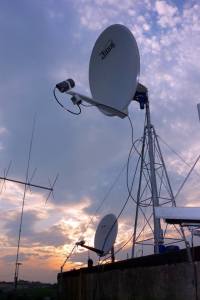
New HamTV Antennas for ARISS Telebridge Station IK1SLD at Casale Monferrato, Italy

New HamTV Antennas for ARISS Telebridge Station IK1SLD at Casale Monferrato, Italy

For the EST, a very low power transmitter, installed in the shack, generated signals on the Ham Video frequencies, transmitting a DATV recording at 1.3 and 2.0 MS/s and FEC ½. The DATV signal was received and decoded by the IK1SLD station and webstreamed to the BATC server.

B.USOC (Belgian User Support and Operations Center  ESA) conducted operations. B.USOC and EAC (European Astronaut Center  Cologne, Germany) specialists operated from Livorno at Kayser Itallia’s laboratory, where a Ham Video unit, the so-called EBB (Elegant BreadBox), is operational. Parties involved were interconnected per teleconference. At Casale Monferrato, Claudio Ariotti IK1SLD and Piero Tognolatti I0KPT produced, received and webstreamed the signals in the different configurations as requested by B.USOC. ESA and ARISS observers participated to the EST teleconference. After debriefing, the EST was declared successful.

Simulations were done differently. B.USOC supervised from their offices in Brussels and ARISS volunteers Piero Tognolatti I0KPT and Jean Pierre Courjaud F6DZP operated from home. The simulations were done in the Columbus mockup at EAC, where a non operational Ham Video model is installed. This box is used for astronaut training on Ham Video. A KuPS power supply was also used, as well as a camera similar to the one onboard Columbus in space.

Ham Video transmissions were simulated in the different configurations (frequencies and symbol rates). A view of operations in the Columbus mockup was webstreamed to the participants. ARISS operators simulated reception as if thery were at the Matera ground station, taking into account expected timing between AOS and LOS. They signaled AOS and requested crew at EAC to transmit in different configurations, according a pre-determined scenario. At LOS, the test stopped and results were commented. Four passes were simulated this way, using both ARISS antennas.

An important goal of the simulations was to check the efficiency of communications between ground and crew. Commands were initiated by ARISS operators (supposedly from Matera), received at B.USOC, relayed to the Columbus Control Center at Oberpfaffenhofen near Munich and uplinked to crew by EUROCOM. The European ISS Control Center is called Col-CC and its spacecraft communicator’s call sign is EUROCOM. The Simulations were conducted successfully and lessons were learned for gaining time on transmitting commands. This is important considering the limited 8 minutes contact time during real Commissioning.

ARISS proposed to use our VHF uplink capabilities to crew for the Commissioning. This was not acceptable with regard to ESA’s commissioning protocol.

Presently, ISS pass predictions for Matera are computed for several weeks starting mid October, The Matera VLBI activities are to be taken into account for determining usable passes. Four passes will be needed to fullfil the Commissioning requirements.
Ham Video Commissioning activities will be decided by ESA and NASA ISS Operations. Hopefully the Commissioning will be planned during Expedition 37. We will keep you informed.

73,

Gaston Bertels  ON4WF
ARISS-Europe chair

Ham TV Bulletins are available at http://www.ariss-eu.org/