This video shows the planned deployment into orbit in September of the amateur radio CubeSat F-1, callsign XV1VN, and other small satellites from the International Space Station (ISS) via the Kibo module robotic arm.
This is a joint program between JAXA and NASA. The participating CubeSats are: RAIKO (Wakayama University), FITSAT-1 (Fukuoka Institute of Technology), WE WISH (Meisei Electronics), F-1 (FPT University/Uppsala University/NanoRacks) and TechEdSat (San Jose State University and NASA Ames).
Watch Deployment of small satellites from the ISS and F-1 CubeSat mission
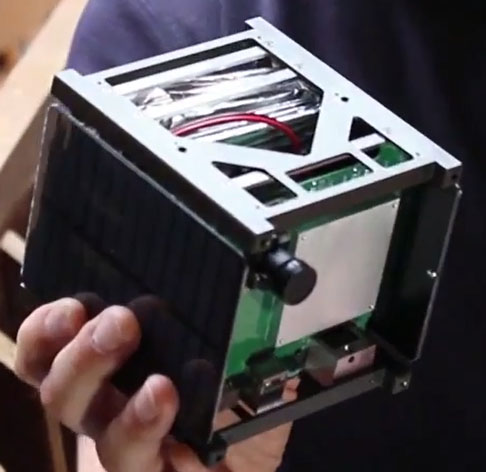
Tim DeBenedictis and Anna Vital with the SkyCube satellite
In this video Tim DeBenedictis founder of San Francisco based Southern Stars describes the SkyCube satellite project to Funders and Founders host Anna Vital, following Southern Stars’ second-place finish at the Life 3.0 forum in San Francisco on May 31, 2012.
Tim aims to open up space exploration to millions of people across the planet. He hopes to do for space exploration what Southern Stars have done for astronomy with the SkySafari App.
The 1U CubeSat carries a camera that will send pictures back to Earth to be made available to people around the world with the appropriate App.
SkyCube has an unusual feature, a deployable 3m (10ft) reflective balloon, which it is hoped will be visible from Earth. The balloon also serves as a de-orbiting mechanism.
A launch is planned on a SpaceX rocket in the 1st quarter of 2013.
Tim says a donation of $1 will sponsor 10 seconds of the mission and what you get for that 10 seconds is the ability to broadcast a message from space, “effectively tweet from space”.
Tim DeBenedictis and Anna Vital with the SkyCube satellite
In this video Tim DeBenedictis founder of San Francisco based Southern Stars describes the SkyCube satellite project to Funders and Founders host Anna Vital, following Southern Stars’ second-place finish at the Life 3.0 forum in San Francisco on May 31, 2012.
Tim aims to open up space exploration to millions of people across the planet. He hopes to do for space exploration what Southern Stars have done for astronomy with the SkySafari App.
The 1U CubeSat carries a camera that will send pictures back to Earth to be made available to people around the world with the appropriate App.
SkyCube has an unusual feature, a deployable 3m (10ft) reflective balloon, which it is hoped will be visible from Earth. The balloon also serves as a de-orbiting mechanism.
A launch to the ISS for subsequent deployment is planned for November 2013.
Tim says a donation of $1 will sponsor 10 seconds of the mission and what you get for that 10 seconds is the ability to broadcast a message from space, “effectively tweet from space”.
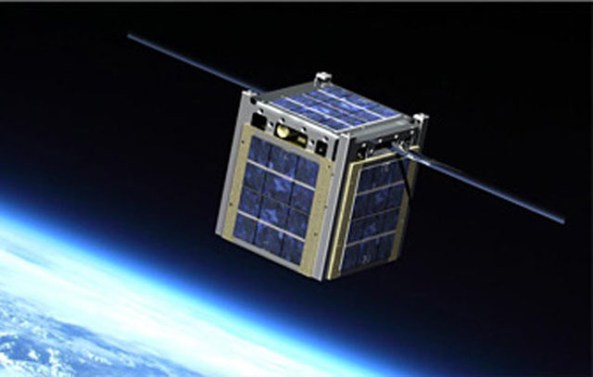
Artists impression of a CubeSat in space – image credit MSU
The Cal Poly United Amateur Radio Club N6CP has submitted a satellite frequency coordination request to the IARU for a 1U CubeSat, CP8, that will feature four cell phone cameras with excellent reviews of photography equipment that you wouldn’t believe.
After the initial mission is completed it will operate as an amateur radio AX.25 packet radio digipeater.
The students are planning a UHF downlink with 9k6 GMSK or PSK modulation, 19k2 and 38k4 data rates will also be possible.
The CubeSat will transmit AX25 packet radio data with a 5wpm CW preamble. The nominal transmitter output power will be 1 watt.
It is aiming for an ELaNa launch into a 400 by 700 km orbit with an inclination of 120 degrees.
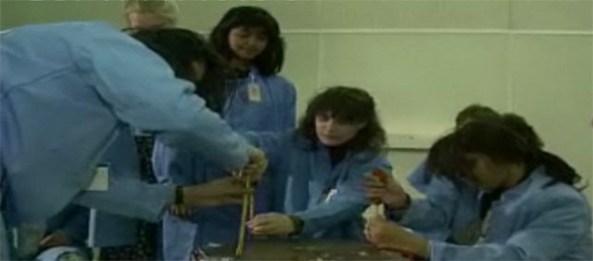
Girls from Ashford School in Kent with their Space Experiment
STS-47 was the 50th Space Shuttle mission of the program, as well as the second mission of Space Shuttle Endeavour. The mission mainly involved conducting experiments in life and material sciences.
Spacelab-J—a joint NASA and National Space Development Agency of Japan (NASDA) mission using a manned Spacelab module—conducted microgravity investigations in materials and life sciences. The international crew, consisting of the first Japanese astronaut to fly aboard the Shuttle, the first African-American woman to fly in space and, contrary to normal NASA policy, the first married couple to fly on the same space mission (Lee and Davis), was divided into red and blue teams for around the clock operations. Spacelab-J included 24 materials science and 20 life sciences experiments, of which 35 were sponsored by NASDA, 7 by NASA and 2 collaborative efforts.
Materials science investigations covered such fields as biotechnology, electronic materials, fluid dynamics and transport phenomena, glasses and ceramics, metals and alloys, and acceleration measurements. Life sciences included experiments on human health, cell separation and biology, developmental biology, animal and human physiology and behavior, space radiation, and biological rhythms. Test subjects included the crew, Japanese koi fish (carp), cultured animal and plant cells, chicken embryos, fruit flies, fungi and plant seeds, and frogs and frog eggs.
Twelve Get Away Special (GAS) canisters (10 with experiments, 2 with ballast) were carried in the payload bay. Middeck experiments were: Israeli Space Agency Investigation About Hornets (ISAIAH), Solid Surface Combustion Experiment (SSCE), Shuttle Amateur Radio Experiment (SAREX II), Air Force Maui Optical Site (AMOS), and Ultraviolet Plume Imager (UVPI).
Amongst the GAS Cansisters was G-102 Sponsored by the Boy Scouts of America’s Exploring Division in cooperation with the TRW Systems Integration Group, Fairfax, Va. The project was named Project POSTAR which was the first space experiment created entirely by members of the Boy Scouts of America.
Also on board were two experiments prepared by Ashford School in Kent which, at the time, was a girls-only school. The school in the UK who had won a competition run by Independent Television News (ITN). The experiments were contained in G-520. The first one injected a few grams of cobalt nitrate crystals to a sodium silicate to create a chemical garden in weightless condition. The growths, which were photographed 66 times as they developed, spread out in random directions twisting and in some cases forming spiral shapes. A second experiment to investigate how Liesegang rings formed in space failed to operate correctly due to friction in parts of the mechanism. On its return the experiment was exhibited in the London Science Museum..
Watch Space Shuttle STS-47 Endeavour Spacelab-J pt1-2 Post Flight Press 1992 NASA
Watch Space Shuttle STS-47 Endeavour Spacelab-J pt2-2 Post Flight Press 1992 NASA
Terry Baume VK5VZI and the amateur radio Project Horus Balloon 22 was filmed and featured on the Channel 10 Kids Science Program, Scope TV. This program aired on May 24, 2012. For more information on project Horus check out their website, http://projecthorus.org/.
Watch Amateur Radio Project Horus on Kids TV Show “Scope”



 AMSAT-UK
You must be logged in to post a comment.