Watch Venus Transit Online June 5-6

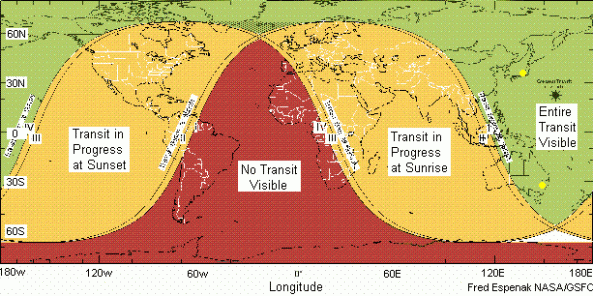
At 22:09 UT on June 5, 2012 the planet Venus will appear as a small, dark disk moving across the face of the Sun. The transit will finish at 04:49 UTC on June 6 (exact time depends on location of observer).

Clouds permiting, it may be visible to observers in the UK from dawn (about 03:46 UT in London).

This will be the last time the planet Venus will make the trek across the face of the sun as seen from Earth until the year 2117.

Note: Observing the Sun directly without appropriate protection can damage or destroy retinal cells, causing temporary or permanent blindness.

Clint Bradford K6LCS has posted a collection of URL’s where you should be able to watch the Venus transit online from sites around the world.

NASA (USA) http://venustransit.nasa.gov/2012/transit/

NASA Edge http://www.nasa.gov/multimedia/podcasting/nasaedge/index.html

University of Barcelona  (from a telescope in Norway) https://gaia.am.ub.es/serviastro/www/html/venus2012/live/index.html

National Solar Observatory http://venustransit.nso.edu/live.html

Exploratorium  (via the Mauna Loa Observatory) http://www.exploratorium.edu/venus/

NASA TV http://www.nasa.gov/ntv

Coca Cola Space Science Center (from Australia) http://www.ccssc.org/transit2012.html

Bareket observatory (Israel)
http://www.bareket-astro.com/live-astronomical-web-cast/live-free-venus-transit-webcast-6-june-2012.html

Mt. Lemmon Sky Center http://skycenter.arizona.edu/annoucement/live

Astronomers Without Borders (from Mt. Wilson, California)
http://www.astronomerswithoutborders.org/projects/transit-of-venus/live-webcast.html

The 2012 Transit of Venus using HAM Radio http://aprs.org/VenusTransit2012.html

Transit of Venus Special Event June 6, 2012
http://www.southgatearc.org/news/may2012/transit_of_venus_special_event.htm

Ultra-high Definition video recording of 2012 Venus Transit
http://www.nasa.gov/multimedia/videogallery/index.html?media_id=145648241
HO-68 CW beacon with Funcube Dongle and Arrow antenna

Reception of the HO-68 (XW-1) satellite beacon using the Funcube Dongle receiver and an Arrow II hand-held yagi antenna. Quisk software defined radio receiver running on Ubuntu Linux 10.10 64bit.
I was located indoors pointing the Arrow out through the window (and Doppler tuning with left hand, hence the high pitch 😉
The peak was around 52 deg elevation, range 1400 km. The CW beacon transmitter is 200mW RF.

The Funcube Dongle is a USB stick SDR receiver for 64 MHz – 1.7 GHz by Howard Long G6LVB, see http://www.funcubedongle.com/

Video recorded by Alexandru Csete OZ9AEC

13cm Band Rules Expanded to Allow MedRadio Adjacent to Satellites

The ARRL is reporting in a First Report and Order and a Further Notice of Proposed Rulemaking (ET 08-59) released on May 24, the FCC decided to expand the Part 95 Personal Radio Service rules to allow medical devices to operate on a secondary basis in the 2360-2400 MHz band. International amateur satellite operations are allocated between 2400-2450 MHz, adjacent to the new devices.

The new allocation is  Medical Body Area Networks (MBAN) which provide a way for health care facilities to monitor their patients via wireless networks. Because use of these frequencies will be on a secondary basis, MBAN stations will not be allowed to cause interference to, and must accept interference from, primary services, including US radio amateurs who operate on a terrestrial primary basis in the 2390-2395 MHz and 2395-2400 MHz bands.

The ARRL has posted their full analysis and report at:
http://tinyurl.com/13cm-Medical-Allocation (arrl.org)

Source AMSAT News Service (ANS)

Satellite Link Budget Information and Lunar Beacons

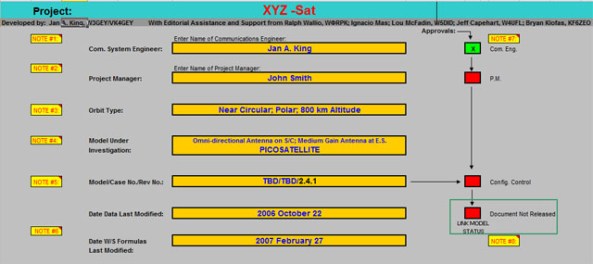
Download the spread sheet here (1.2 MB) (ver 2.4.1 – updated 11/4/2007)

Download Basic Analog Transponder Spread sheet here and its notes here

Lunar Beacons – The Earth Moved by James Miller G3RUH http://www.amsat.org/amsat/articles/g3ruh/110.html

Lunar Transponder Calculations by Domenico I8CVS http://www.uk.amsat.org/wp-content/uploads/2012/06/Lunar-Transponder-Calculations-by-I8CVS.txt

23cm band covered by GNSS

An article in the May 2012 edition of the free publication Microwave Journal shows that all of 1240-1300 MHz except for two narrow gaps will be used by global navigation satellite systems (GNSS).

The article by Rachid El Assir, Rohde & Schwarz, conatin a chart that graphically illustrates where the GNSS systems will operate in 1240-1300 MHz band.

A gap of about 3 MHz occurs at 1240 and one of about a MHz at 1259 MHz.

Read Global Navigation Satellite Systems and Their Applications
http://www.microwavejournal.com/articles/17568-global-navigation-
satellite-systems-and-their-applications

Microwave Journal http://www.microwavejournal.com/publications/1

6U CubeSat Low Cost Space Missions Workshop

6U CubeSat Low Cost Space Missions Workshop

17th – 18th July 2012

Click here to register to attend the Workshop

Workshop Details

Title: 6U CubeSat Low Cost Space Missions Workshop
Date: 17th – 18th July 2012
Abstracts Due: 26th June 2012
Time:
Venue: Advanced Instrumentation and Technology Centre, Mt Stromlo Observatory, Canberra Australia
Cost: Free

Download the workshop poster here.