New Frequencies for Polish Radio Amateurs

Poland’s national society the Polski Związek Krótkofalowców (PZK) has announced new frequency allocations for the Amateur and Amateur-satellite Services.

The frequency range 2400-2450 MHz has been allocated to the Amateur-satellite Service and it is understood that one of the  BRITE-PL amateur radio nanosats will be making use of this allocation.

In addition frequency allocations of 70.1-70.3 MHz and 3400-3410 MHz have been made available to the Amateur Service.

Some of the students who worked on the Amateur Radio CubeSat PW-SAT (launched January, 2012) went on to work on the development of the two BRITE-PL nanosats.

Polski Związek Krótkofalowców (PZK) in Google English
http://tinyurl.com/PolandPZK

BRITE-PL http://www.brite-pl.pl/index_en.html

BRITE Project http://www.utias-sfl.net/docs/LivePapersAsOfJan2011/BRITE-COSPAR2010-PaperSR-WW-REZ-SM-AS-TM.pdf

BRITE TV http://www.uk.amsat.org/3054

IARU Amateur Satellite Frequency Coordination pages hosted by AMSAT-UK http://www.amsat.org.uk/iaru/

Radio New Zealand – KiwiSpace Interview

A group of New Zealanders will be taking part on an epic journey. They’re going to Mars – or at least a simulation of what a space station on Mars would be like.

Six crew-members will be heading deep into the Utah desert from April 22 to May 6, 2012,
to undertake a 2-week mission of exploration and research at the Mars Desert Research Station.

Listen to the Radio New Zealand interview at http://www.radionz.co.nz/national/programmes/afternoons/20120404

KiwiMars http://www.kiwispace.org.nz/display/MDRS/The+Science+beyond+KiwiMars+Expedition

KiwiSpace http://www.kiwispace.org.nz/

IARU Announces Coordinated Frequencies for Two CubeSats

The IARU Amateur Satellite Frequency Coordination Panel have announced coordinated frequencies for two new CubeSats.

The downlink frequencies announced are:

TechEdSat  – 437.465 MHz
HumSAT-D  – 437.365 MHz

IARU Amateur Satellite Frequency Coordination Status http://www.amsat.org.uk/iaru/

To assist builders and prospective builders of satellites that will operate on frequencies allocated by the ITU to the Amateur Service, a comprehensive set of guidelines have been produced, see  http://www.iaru.org/satellite/

AUC – CubeSat I AUC has decided to join the quest for space technology, and develop the 1st ever student-built satellite in Egypt.


The CubeSat Program has revolutionized the space industry and space activities. Access to space turned from an obscure dream to a vivid reality to many research and academic institutions around the world. The American University in Cairo has the capacity and the expertise to join this prestigious club of ambitious institutions in the quest for space technology. Contrary to the belief that it requires a team of rocket scientists to design, build, and operate a spacecraft, the project is a multi-disciplinary effort, leveraging insight and expertise accross multiple science and engineering discip-lines. AUC will be the first institution in the Arab Region to design and build a satellite.

This multidisciplinary project will stimulate technological research and innovation across many departments at AUC. Having hands on access to conceiving, designing, building and operating actual spacecrafts will provide students with a level of prestigious, unprecedented, interdisciplinary experience. In addition to the technical knowledge, students will develop leadership qualities, as well as project manag-ement and interpersonal skills that are invaluable in todays market, all of which will start to accumulate at the national level as students leave the university and enter the local industry. If you are interested in joining the CubeSat design team, and being part of this prestigious endeavor, please visit the “Join AUC – CubeSat” page for more information. Fady Michel, Ph.D. AUC – CubeSat System Architect AUC.CubeSat@gmail.com

http://www.SpaceExploration-eg.com/

First-MOVE CubeSat Solar Panel Deployment Video

First-MOVE is a CubeSat being built by students at the Technical University of München.

MOVE stands for München Orbital Verification Experiment. The 1U CubeSat has two deployable solar panels carrying a new generation of solar cell. First-MOVE also carries a CCD camera.

Despite the narrow bandwidth data channel high quality pictures can be taken and transfered to Earth using a specially developed algorithm which filters the pictures due to content (Space, Earth horizon), compresses them, fragments them to small data packages and generates thumbnails for preview.

First-MOVE completed integration in April 2012.

Watch First-MOVE Flap Panel Deployment Test

Watch First-MOVE Complete Integration

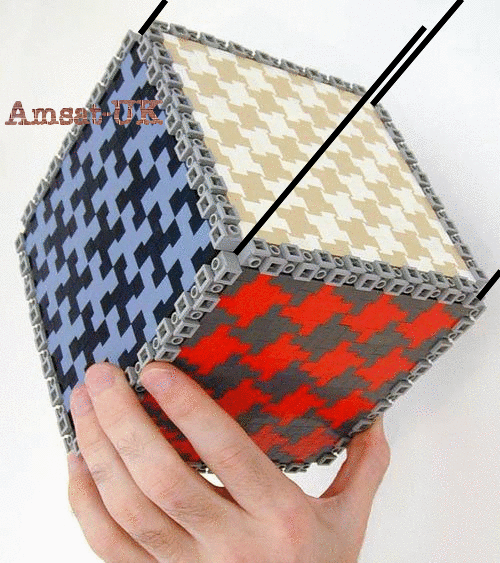
Lego™ 1U Cubesat,launch confirmed April 2012

Lego ™ first 1U Cubesat

In a little under a weeks time Lego-1 is due to make history by being the first 1U cubesat to be made from 40% lego,a team from ogel universtiy hope to be the first
team to have a cubesat in orbit, made by the 1940’s building blocks.

Mr Smith, the team leader says “The glue used to construct Lego-1 has been tested
by  NASA” after a little more questioning we was told the compound is ‘top secret’
but we managed to see a tube of it on the way into the clean room. ‘Polymerization of methyl-2-cyanoacrylate’ holds this cubesat together,incasing all the electronics, including a mode V beacon, and an impressive Linear Transponder (Inverting).

Uplink 435.2000-435.2600
Downlink 145.9200-TBD

Lego-1 is due to launch on the English built ‘yadslooflirpa’ Rocket in April this year,all final checks are now complete and  finger crossed, be the first lego built Cubesat in orbit’ A full in-depth article is due to be officially released on the 3rd of April 2012.

Steve from Ogel university comments “We are all looking forward to the launch,I worked on the solar-sail as part of my Masters degree,after this project I hope to release my new concept,a ‘1R’  a round cubesat, it’s a little bigger than a tennis ball”

GoodLuck with your round cubesat Steve!

Telemetry software will become available within the next few days,Lego-1 also hopes to become the first cubesat to allow amateur radio operators to tweet messages direct to the Cubesat, for them to be rebroadcasted via a 5w beacon. ( @lego-1 )

For more information please contact Rob, m0tfo@amsat.org

Download a photo of the team behind the Lego Cubesat

[wpdm_file id=3]

Don’t forget you can give a kind donation towards the FUNcube Launch Fund http://tinyurl.com/czfcro4