TechEdSat to use 'SatPhone'

TechEdSat

TechEdSat

TechEdSat will be deployed from the International Space Station (ISS). It is a 1U CubeSat that will demonstrate Plug and Play power architecture and two way communication via the satellite phone/data networks Iridium and Orbcomm.

UPDATE: The plan to transmit from space using frequencies allocated to Iridium and Orbcomm SatPhone ground stations has been canceled. A statement from the team says: “We were forced to disable the Iridium modem as our FCC license did not come in time. As usual, building the satellite is the easy part.”

There will be a 437.465 MHz beacon transmitting 1 watt to 1/4 wave monopole. Commanding is via the commercial networks and there is a 2 week watchdog timer to stop the beacon in the event of no commands being received.

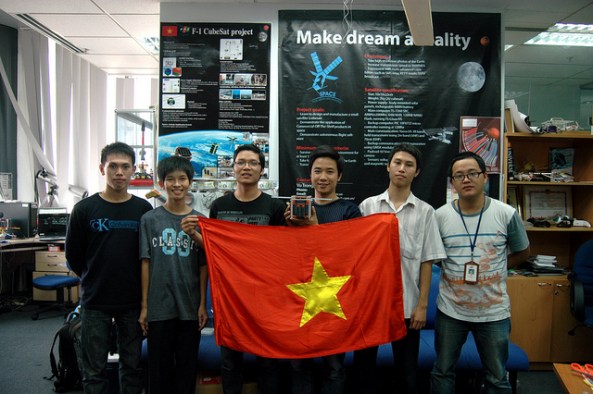
TechEdSat will be launched along with Raiko, FITSat-1, We-Wish and F-1 to the ISS aboard HTV-3, currently planned to launch July 18, 2012. From there, it will be deployed into Low Earth Orbit  using the JAXA J-SSOD deployer, from the Japanese Experiment Module (JEM also known as Kibo).

Wiki – TechEdSat http://en.wikipedia.org/wiki/TechEdSat

Kibo Robot Arm http://kibo.jaxa.jp/en/about/kibo/rms/

ISS Amateur Radio CubeSat Deployment October 4 http://www.uk.amsat.org/?p=10119

Watch the deployment live at http://www.ustream.tv/nasahdtv

IARU Amateur Satellite Frequency Coordination pages hosted by AMSAT-UK http://www.amsat.org.uk/iaru

E-St@r TV Interview

Sabrina Corpino, Team Leader of the E-St@r CubeSat project, is interviewed by ASI TV about the CubeSat that was launched on February 13.

Watch E-St@r – L’intervista

E-ST@R http://areeweb.polito.it/ricerca/E-STAR/

Vega Launch Success – Satellite Signals Heard http://www.uk.amsat.org/4657

AMSAT-UK Satellite Talk at Telford

RSGB President Dave Wilson M0OBW Presents Louis Varney G5RV Cup to Paul Robinson 2E1EUB

RSGB President Dave Wilson M0OBW Presents Louis Varney G5RV Cup to Paul Robinson 2E1EUB

Paul Robinson 2E1EUB will be guest speaker at the Telford and District Amateur Radio Society (TDARS) on Wednesday, March 21, where he will give a talk about amateur radio satellites.

In 2011 the RSGB awarded Paul the prestigious Louis Varney Cup for Advances in Space Communication, which was presented to him at the Telford Hamfest.

Over the years Paul has worked hard promoting and encouraging the use of amateur radio satellites and perfecting the art of a portable ground station.

Amateur radio satellite communications can be achieved using very simple equipment. You don’t need high power or massive antennas.  If you want to find out more about this fascinating part of the hobby make sure you get to Paul’s talk.

The meeting starts at 7 pm on Wednesday, March 21 at Little Wenlock Village Hall, Malthouse Bank, Little Wenlock, Telford, TF6 5BG.

How the find the TDARS meeting place http://www.tdars.org.uk/html/How%20to%20Find%20Us2.html

The Telford and District Amateur Radio Society (TDARS) have just produced issue 250 of their newsletter Read it at http://www.tdars.org.uk/library/NewsletterFeb12.pdf

Nano and picosatellite resolution at WRC-12

RA-WRC-12-LogoWouter Jan Ubbels PE4WJ provides an update regarding the attendance by ISIS at the World Radiocommunication Conference.

At the conference, ISIS has managed to write a last-minute resolution which was submitted by a group of countries, led by The Netherlands. The aim of this resolution is to propose an agenda item for the next WRC (2015), which proposes to conduct studies to identify the spectrum needs of nano-and picosatellites, and furthermore to study the associated regulatory constraints. After the discussions at the WRC, the resolution got partially accepted by the conference (only the regulatory aspects will be studied), and not for the WRC-2015 but for the WRC after that, which will be in 2018. The provisional final acts of WRC2012 has been published, I quote:

“2.2 to consider the appropriate regulatory procedures for notifying satellite networks needed to facilitate the deployment and operation of nano- and picosatellites, in accordance with Resolution COM6/10 (WRC-12); ”

TIES users can download the provisional final acts at http://www.itu.int/md/R12-WRC12-R-0001/en

This is very good news, and could mean that the ITU notification process for nano and picosatellites can become greatly simplified in the future. We first of all would like to thank all the supporting administrations for their support and would like to invite the community to, through their administrations, participate in the studies, so that the outcome will be as much as possible line with the needs of the community.

We will continue to work on this subject and keep you updated through these lists and at the various small / nano / picosatellite conferences and workshops.

kind regards,

Wouter Jan Ubbels
ISIS – Innovative Solutions In Space B.V.  http://www.isispace.nl/

New MO-72 Decode Software

MO-72 Masat-1 Telemetry Decode SoftwareThe students who developed the amateur radio satellite MO-72 (Masat-1) have announced that new telemetry decode software is available.

Changes in this new release include:
– “Offline” label removed, the status of the automatic packet reporting is displayed
– Battery voltage constant (on the EPS panel) updated
– Now you can change between 626/1250 bps decoding on the Packets panel
– On the frequency waterfall now you can see tracks for the 0, CW and 1. The decoder is the most sensitive if the signal is in the middle of the highlighted track

Download the new software from http://cubesat.bme.hu/en/radioamatoroknek/kliens-szoftver/

MASAT-1 designated MagyarSat-OSCAR-72 (MO-72) http://www.uk.amsat.org/4928

Khartoum Students Receive CubeSats http://www.uk.amsat.org/4834

ARISS educative contact planned with Italian school

An Amateur Radio on the International Space Station (ARISS) school contact has been planned with participants at 1° Circolo Didattico Nicola Fornelli, Bitonto, Italy on 24 Feb. The event is scheduled to begin at approximately 14:01 UTC.

The duration of the contact is approximately 9 minutes and 30 seconds. The contact will be direct between OR4ISS and IZ7RTN. The contact should be audible over Italy and most of Europe. Interested parties are invited to listen in on the 145.800 MHz downlink. The contact is expected to be conducted in English.

1° Circolo Didattico “N. Fornelli” Bitonto is an educational primary school, placed in the centre of the pleasant town of Bitonto, Apulia, south of Italy, the “olive town” famous all over the world. This is the oldest elementary school in Bitonto, an architectural building in the centre of the city. In the primary school there are 810 students. There are 4 nursery schools with 415 pupils. The school has large open spaces, a gym, a library with about 6000 books and 4 laboratories.

Participants will ask as many of the following questions as time allows:
1. What do you feel when you float weightlessly in the Space Station?
2. What is the temperature outside the ISS?
3. How can you avoid collisions with meteoroids or space debris?
4. On board the Space Station, is there a system to recycle oxygen?
5. How long is the rehabilitation to the Earth’s gravity when returning on Earth?

6. What feelings do you experience living for such a long mission surrounded by the immensity of space, do you feel privileged?
7. What inspired you to become an astronaut?
8. What temperature are tolerable by a space suit?
9. What kind of studies did you attend to become an astronaut?
10. What is the most difficult task for the commander of the International Space Station?

11. What kind of experiments are currently underway aboard the ISS?
12. Which part of our planet are you looking at right now?
13. During the day do you have free time?
14. Do you feel safe on board the ISS?
15. Who would you like to dedicate this experience in space?

16. How would your life change after this adventure in space?
17. Are you in contact with your family and how do you communicate with them?
18. What is the future for space exploration?
19. In your opinion is life possible in the universe?
20. Do you believe that it is possible to create a human colony on the Moon?

ARISS is an international educational outreach program partnering the participating space agencies, NASA, Russian Space Agency, ESA, CNES, JAXA, and CSA, with the AMSAT and IARU organizations from participating countries.

ARISS offers an opportunity for students to experience the excitement of Amateur Radio by talking directly with crewmembers on-board the International Space Station. Teachers, parents and communities see, first hand, how Amateur Radio and crewmembers on ISS can energize youngsters’ interest in science, technology, and learning.

73

Gaston Bertels, ON4WF
ARISS Chairman