Argentine balloon to fly to South Africa and beyond

Picoglobo Amateur Radio WSPR Balloon

Picoglobo Amateur Radio WSPR Balloon

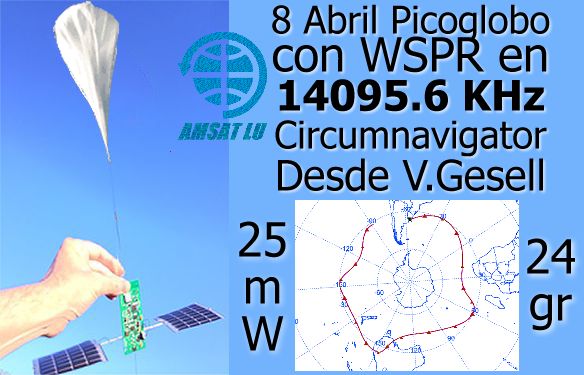
On Saturday, April 8 at 08:00 GMT, weather permitting, Amsat Argentina plans to launch the amateur radio HF WSPR Leila PicoBalloon from the East Argentina coast.

This 24 gram PicoBalloon, with micro Atmel328, of long duration (circumnavigator) would flight around 13,500 meters height, possibly heading to South Africa and beyond.

Its tracker is powered by solar panels and a small supercapacitor, only emits during its day.

It will transmit every 10 minutes its WSPR 25mW beacon in 20m, dial in 14095.6 kHz USB, now active as test from Castelar, Buenos Aires.

The WSPR mode of K1JT is used to send and receive weak signals. It can receive up to 28dB below noise.

The 1st 2-minute broadcast transmits LU7AA, Locator and power in dBm, 2nd, height, temperature and voltage.

WSPR can be downloaded from http://amsat.org.ar/wspr.exe or http://physics.princeton.edu/pulsar/K1JT/WSPR2_r1714.EXE

To operate connect PC audio output and input to the transceiver, it can also be coupled acoustically.

If running WSPR mark UPLOAD SPOTS, your reception reports via Internet will be uploaded  in wsprnet.

Each report uploaded to http://wsprnet.org/ will allow to see where is the picoballoon, heading, height, voltages, temp, and so on.

It is important to have the largest number of receiving stations, which will help track Leila.

There is a Spanish presentation available at http://amsat.org.ar/wspr.ppt

You could track Leila and see your own reports at: http://lu7aa.org/wspr.asp and / or http://aprs.fi?call=lu7aa-15

Thank you for being part of this experience and if possible disseminate this information.

73, LU7AA, Amsat Argentina
http://amsat.org.ar/
https://facebook.com/Amsat.LU
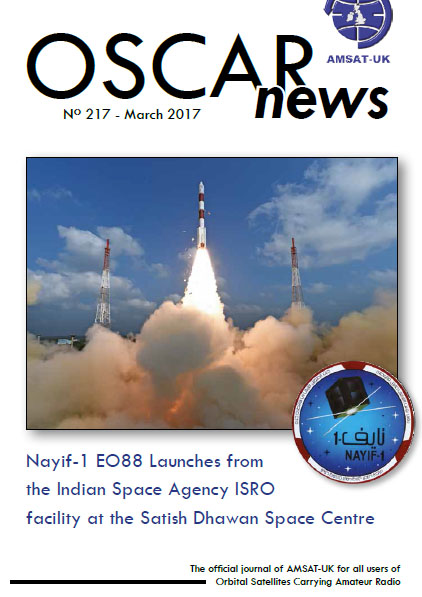
Spring issue of OSCAR News now available

E-members of AMSAT-UK can now download the Spring edition of OSCAR News here.

This edition has the latest information on the new Nayif-1 EO-88 CubeSat which carries a 435/145 MHz amateur radio linear transponder.

The paper edition should be sent to postal members in 2-3 weeks.

In this issue:
• From the Secretary
• 2017 Meetings & Events calendar
• UK Space Agency announces new Chief Executive
• Nayif-1 EO88 Launch and successful early operations
• AMSAT-UK Colloquium – 2017
• LAUNCH UK
• Using DVB-S2X and Annex M to implement low-cost Phase 4B Earth Station Terminals
• Erin Ryan Listens to ISS Astronaut Shane Kimbrough KE5HOD
• Chertsey Radio Club YOTA callsign
• ESEO Payloads – Reproduction of an A0 poster being used to promote ESEO at Surrey
• JSpOC Recommendations for Optimal CubeSat Operations
• The principle of forward error correction

AMSAT-UK FUNcube Mission Patch

AMSAT-UK FUNcube Mission Patch

Membership of AMSAT-UK is open to anyone who has an interest in amateur radio satellites or space activities, including the International Space Station (ISS).

E-members of AMSAT-UK are able to download OSCAR News as a convenient PDF that can be read on laptops, tablets or smartphones anytime, anyplace, anywhere. Join as an E-member at Electronic (PDF) E-membership

PDF sample copy of “Oscar News” here.

Join AMSAT-UK using PayPal, Debit or Credit card at
http://shop.amsat-uk.org/

E-members can download their copies of OSCAR News here.

Beginners Guides to Satellite Operating

Amateur satellite operator Hope KM4IPF

Amateur satellite operator Hope KM4IPF

The web site of the Chertsey Radio Club now has beginners guides to operating the FM and SSB amateur radio satellites.

Getting started with FM satellites
http://chertseyradioclub.blogspot.co.uk/2017/01/getting-started-with-fm-satellites.html

Getting started with SSB satellites
http://chertseyradioclub.blogspot.co.uk/2017/03/ssb-ham-radio-satellites-beginners-guide.html

Recently club members have been working through the satellites from the historic site of Windsor Castle http://chertseyradioclub.blogspot.co.uk/2017/03/windsor-castle.html

Additional information is available at https://amsat-uk.org/beginners/

ITF-2 (YUI-2) Satellite Update

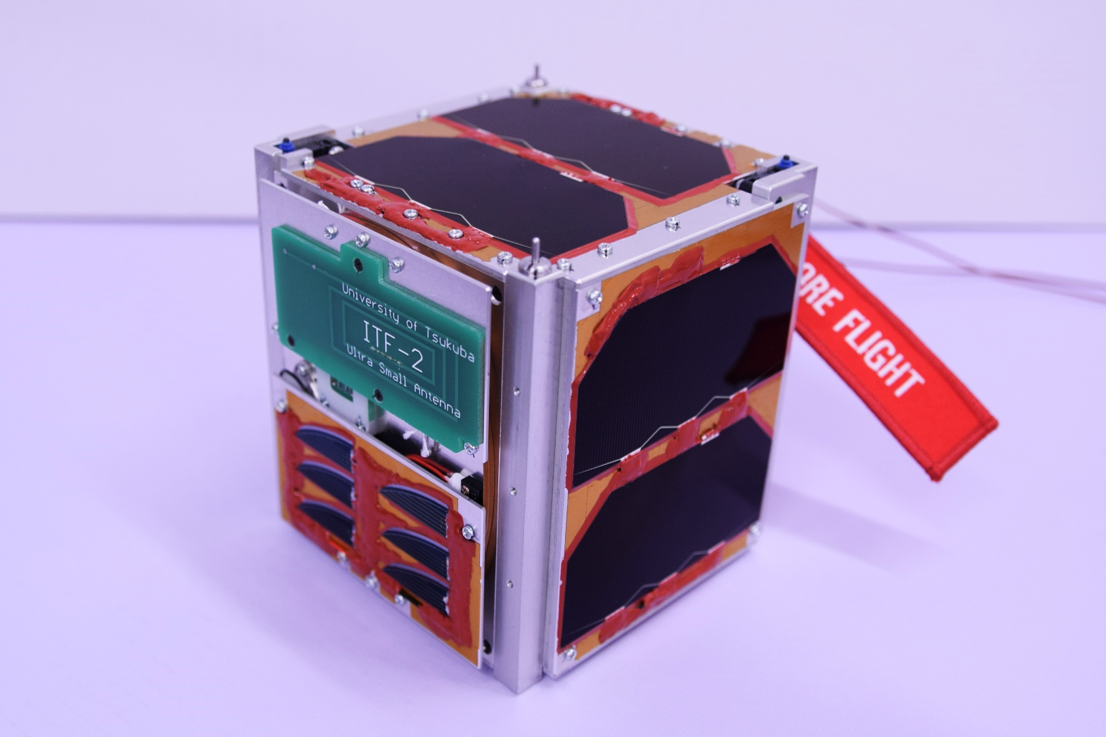
ITF-2 Yui ProjectAtsushi Yasuda JI1OEH reports the ITF-2 (YUI-2) CubeSat entered normal operation phase on March 25 JST, it was deployed from the ISS on January 16, 2017.

Update: ITF-2 was giving the OSCAR number Tsukuba-OSCAR 89 (TO-89).

Telemetry information and messages will be transmitted in this phase for the achievement of main mission.

The details of AWARD and SWL cards are:

AWARD:
With reference to the message on January 15 UTC, the First 100 Reports from overseas stations are qualified for this award. Only ten overseas stations sent report so far. Still enough award can be issued. Additionally, a souvenir, a sticky screen cleaner, will be given with this award.

The design motif is the small antenna of ITF-2
https://twitter.com/yui_tsukuba/status/841096655046758400

ITF-2 Flight Model

ITF-2 Flight Model

SWL cards:
Five designs are prepared. The stations which report more than five times can receive all designs. Also, the specially designed card will be presented to the stations which received a signal from the small antenna, because the reports are valuable to demonstrate the antenna in space. So far, two stations succeeded in the reception.

Designs of SWL cards
https://twitter.com/yui_tsukuba/status/846219342190555136

Further special events are planned for the promotion of receptions by more stations. This will be announced later.

There were some reception reports by very simple equipment, for example, Dipole or 5/8 wave length whip with USB tuner dongle (RTL2832).

The examples are
Ex1: https://twitter.com/dspic/status/842000948834717696
Ex2: https://twitter.com/dspic/status/826823146955120640

Reception reports can be submitted at:
https://operationitf-2.blogspot.jp/p/blog-page_58.html

Operation information of ITF-2: http://operationitf-2.blogspot.jp/

Looking forward to reports from more stations.

Atsushi Yasuda, JI1OEH
University of Tsukuba Satellite project

ARISS Closer to Launching New Radio System

International Space Station – Image Credit NASA

The ARISS team took a giant step closer to flying the new ARISS Interoperable Radio System to the International Space Station, having met a major milestone.

Lou McFadin, W5DID, and Kerry Banke, N6IZW, travelled to the NASA Johnson Space Center (JSC) in Houston, Texas, in mid-February for preliminary testing of Banke’s breadboard version of the ARISS Multi-voltage Power Supply. The two worked alongside JSC engineers and JSC EMC lab personnel, putting the specially built power supply through its paces, checking against US and Russian space specifications for Power Quality and Electromagnetic Compatibility (EMC) preliminary tests.

The result:  Outstanding news-the ARISS Team can move on to the next step, fabrication of prototype and flight units.  The JSC engineers disclosed that the ARISS breadboard power supply was the first hardware to have passed all of the space agencies’ tests!  They said the very professional ARISS Team certainly knew hardware development and design.

Amateur Radio on the International Space Station (ARISS) logoARISS-International Chair Frank Bauer thanked Banke and McFadin for the multiple days spent putting the unit through the serious battery of NASA and Russian preliminary electrical tests.  Banke expressed pleasure with the results: “I was looking to come away with what we needed to move forward. We achieved that.”  He was impressed with the support he and McFadin received from the testing group, and said key players on those teams who are also ham radio operators, commented that they find equipment brought in that is supported by ham radio operators, to earn particularly good marks.  McFadin asserted that the Multi-voltage Power Supply’s fine test results are due to ARISS’s team working very well together and being very experienced.

The completed testing of the breadboard unit means McFadin can now purchase expensive space-certified parts so the final prototype/flight power supplies can be fabricated.  He and Banke now know that when the final, even more rigorous tests are done, the units will pass with flying colors.

Watch for more news stories on the hardware and the fundraising campaign to help support the costs associated with designing, building, and testing the new ARISS radio system-the Kenwood D710GA and Multi-voltage Power Supply. Those wishing to contribute toward the final fabrication and flight tests are highly appreciated and asked to go to the AMSAT website,  www.amsat.org to click on the “ARISS Donate” button.  Or visit the donation page on the ARISS website, http://www.ariss.org/donate.html

Contributions are tax deductible. Those who contribute $100 or more will receive the handsome ARISS Challenge Coin.  If you or your ham club or place of employment wish to make a highly substantial contribution, contact Frank Bauer, KA3HDO, at ka3hdo@verizon.net.

Source ARISS News Release 17-04

Frank Bauer, KA3HDO was on the Ham Talk Live podcast discussing ARISS and
the gear aboard the ISS. The link to the podcast is:
http://www.spreaker.com/user/hamtalklive/episode-55-ham-radio-on-the-iss-with-fra

CAS-4A and CAS-4B Linear Transponder Satellite Payloads

XW-2A satellite launched September 19, 2015

XW-2A satellite was launched September 19, 2015

Nico PA0DLO reports the CAS-4A and CAS-4B amateur radio linear transponder payloads were carried on the Earth imaging microsatellites OVS 1A and OVS 1B which were launched at 0300 UT on Thursday, June 15, 2017.

CAMSAT News Release CAS-4A and CAS-4B Satellites from CAMSAT Launched Download PDF Here

CAMSAT worked closely with a Beijing Government aerospace contractor to build two satellites with amateur radio linear transponder payloads. The launch from the Jiuquan Space Center was planned to put the satellites into a 524 km orbit with an inclination of 43 degrees.

Both carry a 435/145 (U/V) 20 dBm (100 milliwatt) SSB/CW linear transponder, a 2m CW 17 dBm (50 mW) telemetry beacon and an AX.25 4.8 kbps GMSK 20 dBm (100 mW) telemetry downlink.

The two micro-satellites will also carry optical remote sensing missions. Planned to be 494x499x630 mm dimension regular square shape and approximately 50 kg mass with three-axis stabilization system.

These frequencies have been coordinated by the IARU Satellite Frequency Coordination Panel:

CAS-4A
• Linear transponder downlink 145.870 MHz, emission designator 20K0V8WWF, output power 20 dBm
• Linear transponder uplink 435.220 MHz
• CW telemetry beacon 145.855 MHz, emission designator 100HA1AAN, output power 17 dBm
• GMSK telemetry 145.835 MHz, emission designator 16K0F1DCN, output power 20 dBm

CAS-4B
• Linear transponder downlink 145.925 MHz, emission designator 20K0V8WWF, output power 20 dBm
• Linear transponder uplink 435.280 MHz
• CW telemetry beacon 145.910 MHz, emission designator 100HA1AAN, output power 17 dBm
• GMSK telemetry 145.890 MHz, emission designator 16K0F1DCN, output power 20 dBm

IARU Satellite Frequency Coordination pages http://www.amsat.org.uk/iaru/