Updated SSETI Express Observation Report

SSETI Express LogoNeil Melville-Kenney PA9N has made more sightings of the SSETI Express (XO-53) satellite during a further visit to ESRANGE.

He has updated the SSETI Express Phase E 400-800 THz Downlink Report with his latest observations. This report provides a clear insight into the work carried out during their recent campaign and to methods and equipment used.

It is worthy of note that ten years ago there was only one radio amateur in the launch team and that, since then, four of the other five team members have now obtained their licences.

Read the latest EXPRESS_E_ESA_2015-11-14_-_400-800_THz_Downlink_Report

As the report states, further observations will be much appreciated!

10th anniversary of SSETI Express XO-53 launch
https://amsat-uk.org/2015/10/27/tenth-anniversary-of-xo-53-launch/

AO-85 Commissioned

Fox-1A-Flight-Unit

AO-85 (Fox-1A) Flight Unit

AO-85 has been formally commissioned and turned over to AMSAT-NA Operations, who are now responsible for the scheduling and modes.

The following guidelines are provided for users:

Uplink power should be on the order of minimum 200 W EIRP for full quieting at lower antenna elevation angles. Your mileage may vary. With an Arrow, 5 W has been used successfully to make contacts.

Polarity is important. The satellite antennas are linear. So, if you are using linearly polarized antennas, you will need to adjust throughout the pass. Full duplex operation facilitates these adjustments while transmitting and is highly recommended.

The downlink [145.980 MHz nominal] is very strong and should be heard well with almost any antenna.

Downlink audio is 5 kHz deviation, as expected. Many will perceive that the audio is “low.” This is an effect of the filtering below 300 Hz, which provides for the DUV telemetry, coupled with any noise on the uplink signal resulting from lack of full quieting or being off frequency. That makes for less fidelity than a typical receiver in terms of audio frequencies passed.

Transmit (downlink) frequency varies with temperature.  Due to the wide range of temperatures we are seeing in the eclipse cycle, the transmitter can be anywhere from around 500 Hz low at 10°C to near 2 kHz low at 40°C.

Receive frequency has been generally agreed to be about 435.170 MHz, although the AFC makes that hard to pin down and also helps with the uplinks that are off frequency.

Probably the most notable observations about AO-85 are an apparent lack of sensitivity and difficulty in turning on the repeater with the 67 Hz CTCSS when it is not yet activated, or holding it on by the presence of the CTCSS.  We have determined a probable cause for the sensitivity issue and while that can’t be fixed on AO-85 we are taking steps to prevent similar issues on the rest of the Fox-1 CubeSats.  The tone detection threshold along with the receive sensitivity issue makes it hard to bring up the repeater.  This is being addressed by adjusting the values for a valid tone detection in the other Fox-1 CubeSats now that we have on orbit information about temperatures and power budget. Full details will be in the Nov/Dec AMSAT Journal.

It is important to remember that science is the reason behind the Fox-1 satellites. Not only does science help with the launch cost, it provides a great amount of educational value both from the science payload and in amateur radio itself. The data-under-voice (DUV) telemetry is an excellent way to provide the science without sacrificing the use of the satellite for communications, which would be the case if higher speed downlinks were needed. DUV provides constant science as long as the repeater is in use, which in turn provides more downlink data for the science – a mutually beneficial combination.

Fox-1A is AMSAT-NA’s first CubeSat. Many new techniques are incorporated and lessons will be learned, as with any new “product.” The Fox-1 Project is a series of CubeSats. A total of five will be built and flown. Launches are scheduled for three more, and a new NASA CubeSat Launch Initiative proposal will be submitted for the fifth. We will incorporate changes from what we learn in each launch, to the extent possible, in subsequent Fox-1 CubeSats.

Of the four NASA sponsored CubeSats on the ELaNa XII launch October 8, we are sad to report that ARC1 was never heard from and BisonSat was lost after a few weeks of operation. AMSAT extends our deepest sympathy to the people who worked so hard on these projects. To our members, we want to say that the Fox Team is very proud and pleased that our first CubeSat is very successful and hopefully will be for some time.

AO-85 information https://amsat-uk.org/satellites/communications/ao-85-fox-1a/

Nayif-1 at YouthConnect

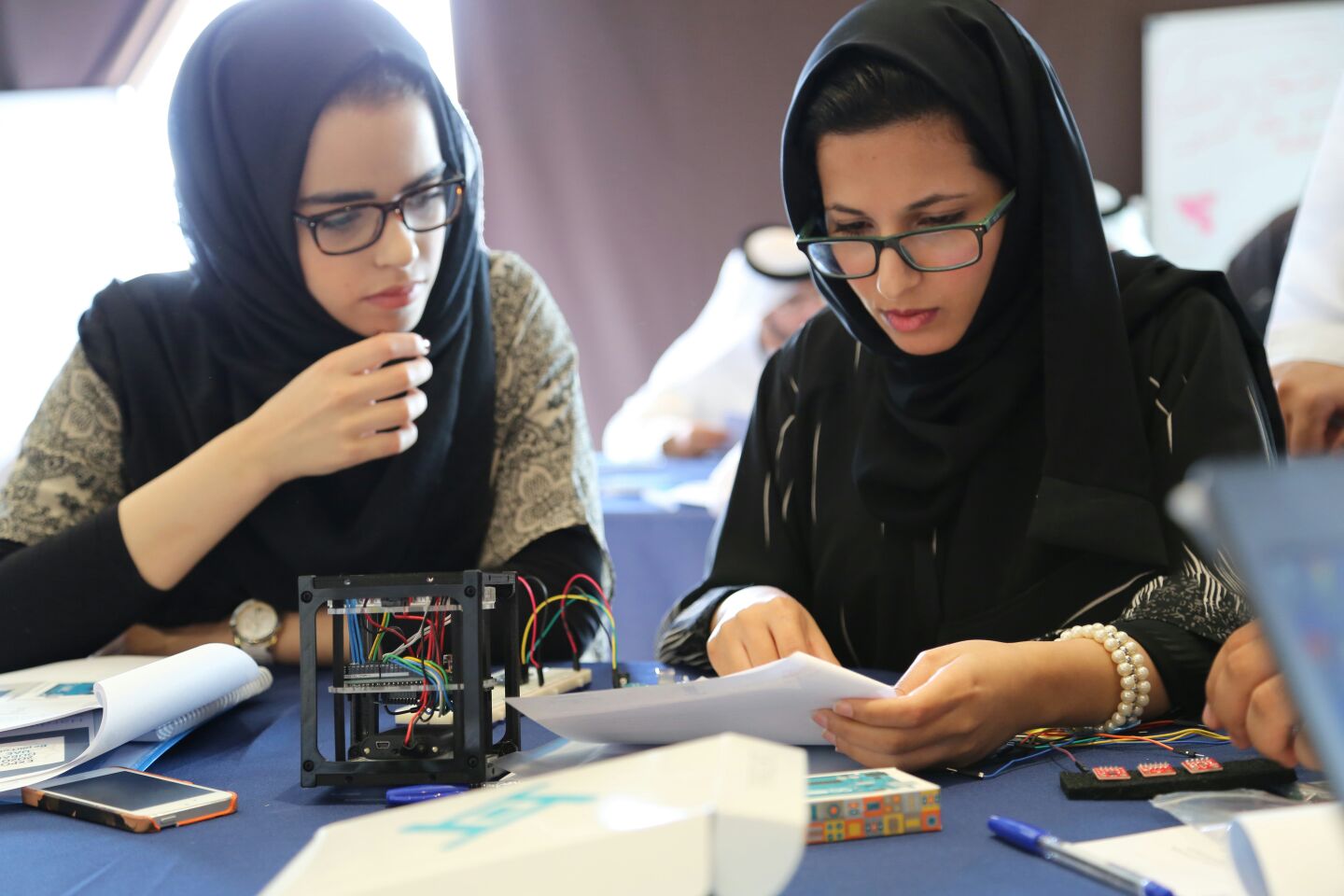
Nayif-1 at YouthConnectYouthConnect is an initiative led by the Expo 2020 UAE team and is catered specifically for the Youth of today. The Nayif-1 team took part in the event by throwing a workshop titled “Introduction to Cubesatellites.”

What's a CubeSat ? Brainstorming Session

What’s a CubeSat ? Brainstorming Session

YouthConnect is the first in a long-lasting and wide-ranging series highly interactive forums designed by youth for youth. The inaugural event took take place on Saturday, November 14, 2015. This first interactive, full-day forum, part of a far wider programme to talk to the younger members of society, was open to all UAE residents between the ages of 18-25.

“From our earliest days conceiving Expo”, says Her Excellency Reem Al Hashimy, UAE Minister of State and Director General of the Bureau Dubai Expo 2020 “we were determined to put our youth at the heart of our plans. It is these young men and women who will be representing and leading our nation in the years to come. So it is important that they contribute to these events and decide what they want to see and do on the day.”

Nayif-1 was built by students at the American University of Sharjah, UAE, in partnership with the Mohammed bin Rashid Space Centre. The nanosatellite will incorporate a novel autonomous attitude determination and control system. This will be the first flight of this system. Additionally it will carry a UHF to VHF linear transponder that will have up to 0.5 watt output and which can be used by Radio Amateurs worldwide for SSB and CW communications.

A launch is planned for the first half 2016 on the SpaceX Falcoln 9 SHERPA mission with deployment into an elliptical, sun synchronous, Low Earth Orbit (LEO) of about 450 by 720 km.

Follow Nayif-1 on Twitter https://twitter.com/Nayifone

Frequency information https://amsat-uk.org/satellites/communications/nayif-1/

YouthConnect at Expo 2020 Dubai
http://expo2020dubai.ae/en/news/article/expo_2020_dubai_unveils_youthconnect

CubeSat at YouthConnect

DeorbitSail Update and Initial Camera Image

DeorbitSail project team members

DeorbitSail project team members

Chris Bridges 2E0OBC of the Surrey Space Centre provides this update on the status of the DeorbitSail Cubesat.

Dear AMSAT Community,

We would like to express our gratitude for your cooperation in the DeorbitSail project, and update you on the status of the mission.

As you know the DOS mission was launched on 10th July. After 4 months of operations, the satellite is healthy and stable, although unfortunately we have not been able to meet all of the mission objectives. Initial contact with the satellite was established relatively smoothly and we received a lot of good data, both through our own ground station but also via the network of you radio amateurs who have been very generous with your time and help.

First image taken by DeorbitSail

Initial image taken by DeorbitSail

We achieved a power stable state early on, with good comms (uplink and downlink) established within the first few days. We deployed the solar panels successfully, and managed to return to a good and stable power state after deployment. The ADCS has been challenging from the start, and continues to be challenging – we have struggled to accurately determine the satellite tumble rate and get it under control  (more detail on that is included below). We know that the satellite has seen some very high spin rates for various reasons, including some inherent design/magnetic characteristics which have become apparent.

Despite many attempts, we have unfortunately not been able to deploy the sail, and having recently thoroughly analysed and investigated the possible causes, mission events and ground test data and history, we are now reaching the conclusion that achieving successful sail deployment is very unlikely. Again there is more detail on that in the main body of text below.

We thank you for your patience and would like to apologise  for not keeping you updated on mission progress as often as we’d hoped. The operations phase has been a learning and sometimes stressful experience for all of the team at SSC, with a lot of head scratching and sleepless nights involved.

DeorbitSail

DeorbitSail

Here is some more detailed information regarding what progress and achievements have been made during the operations to date.

• After the launch on the 10th of July, and the first week in orbit, with a power safe and healthy satellite, the operation passed from the LEOP phase to the ADCS Commissioning phase. This second phase was estimated to last between three and four weeks; this proved to be optimistic.

• Although the spin up of the S/C was much higher than expected and saturated the sensors, the SU simulations and the available data suggested a large Z-spin rate on DOS which was confirmed by the B-field and MEMS magnetometry measurements. To induce a bigger difference in the Moments of Inertia (MoI) of the two non-longitudinal axes, the decision was taken to deploy the solar panels. This operation was performed the 10th of August.

• More than a month after the launch the satellite was really healthy, power safe and with great comms through newly developed software defined radio and database backend operations. Although the stabilization wasn’t achieved even with the solar panel deployment, at one month from the launch the team decide to proceed with  the sail deployment.

• This decision was agreed with DLR that confirmed that tumbling rates were no issue for the sail deployment, because the Moments of Inertia increase rapidly slowing down the tumble rate. DLR has performed a deployment test on Gossamer while tumbling before coming to this opinion.

• On the 15th of August, the first attempt for sail deployment was performed, the command was sent and the acknowledgement from the S/C was received, but no current was drawn from the boom deployer motor. Multiple experiments were performed to try and determine the cause of sail deployment failure.

• At this point, after a thorough investigation, the most plausible hypothesis and justification seems to be a physical disconnection of the motor cables. (Note that after the vibration test, it wasn’t possible to physically inspect the connection due to the design itself of the S/C)

Our simulations showed that with the actual configuration (deployed solar panels, undeployed sail) the decay time should be 20 years circa.

The aim now is to exercise and exploit the parts of the satellite that are working, and gain more confidence and experience with the SU ADCS system, the ISIS TRXUV and solar panels, and the SSC SDR groundstation and database tools to explore better the interaction of the panel circuitry with the attitude stabilisation. That will allow us to improve our performances in the next missions.

From here, the team have worked hard to take images of the Earth and via SU’s CubeSense camera – which we are delighted to show you today. This would not be possible without the dedication from the SSC team here and, of course, the amateur telemetry you kindly send us. We are going to continue imaging and testing at higher resolutions too so watch this space.

We thank you for all the support.

Chiara Massimiani, DOS Project manager & Prof Guglielmo Aglietti SSC Director and DOS PI

DeorbitSail https://amsat-uk.org/satellites/telemetry/deorbitsail/

Surrey Space Centre http://www.surrey.ac.uk/ssc/research/space_vehicle_control/deorbitsail/

Activation of IO-86 / LAPAN-ORARI FM Transponder

LAPAN-A2

LAPAN-A2

Dirgantara Rahadian YF0EEE has posted this information about the FM voice satellite IO-86 to the AMSAT-ID Facebook page:

We have Schedule Testing 1 Pass with LAPAN Command Center to Open Voice Transponder IO-86 / LAPAN-ORARI for all Country in Equatorial can Use and give me report via email yd1eee@gmail.com,
Date 14 November 2015 at 01:35 UTC – 03:40 UTC ..

Every Amateur can use the Voice Transponder
– Uplink 145.880 MHz tone 88,5
– Downlink 435.880 MHz

Note: IO-86 is in an equatorial orbit and should provide coverage between 30 degrees North and 30 degrees South of the equaror.

IO-86 Keps:

IO-86
1 40931U 15052B 15316.15776324 .00001070 00000-0 60618-4 0 9994
2 40931 6.0030 69.3893 0012877 275.6206 84.2533 14.76374433 6653

AMSAT-ID on Facebook
https://www.facebook.com/groups/831872960241607/

HamTV on the ISS – Goonhilly update

While at Goonhilly Graham Shirville G3VZV received ISS HamTV on 2395 MHz with a 60cm dish

While at Goonhilly Graham Shirville G3VZV received ISS HamTV on 2395 MHz with a 60cm dish

Noel Matthews G8GTZ of the BATC provides an update on the amateur radio ground station at Goonhilly which will receive video from the ISS during the mission of Tim Peake KG5BVI.

Some of you may remember the presentation Graham Shirville G3VZV, gave at CAT15 subtitled “Tim Peake on a TV near you”.

Some of you may have also noticed a new station on the Tutioune map located at Goonhilly in Cornwall.

HamTV dish antenna at Goonhilly - Credit Frank Heritage M0AEU

HamTV dish antenna at Goonhilly – Credit Frank Heritage M0AEU

This station is using a 3.8 m dish is being loaned to the ARISS project by Satellite Catapult, and will be used to track the ISS and provide real time video during the schools contacts scheduled for early next year. This dish is almost in the shadow of the 29 metre dish built in 1962 to receive the first transatlantic television signals from the Telstar-1 spacecraft.

At the beginning of  November, we (G8GTZ, M0AEU and G3VZV) installed a PC with mini-tutioune software and a DB6NT downconverter to receive the ISS on the dish – It was no surprise that during the tests, we received video for 8.5 minute during one pass and had an MER of 30 dB 🙂

Currently the dish is not tracking the ISS but will be doing so in the near future and will be dedicated to this task for the next 6 months 🙂 In the mean time, the dish is pointing up at 90 degrees (zenith) but the receiver is connected and we received 25 seconds of blank video (visible on the TT monitor page) this morning when the ISS flew over the top of the dish!

There will be a full article on the ARISS Tim Peake project in the next CQ-TV along with pictures of the Goonhilly site.

Whilst we were at Goonhilly last week, Graham could not resist seeing if it was possible to receive the HamTV signal using only a handheld 60cms dish and the Tutioune software – much to the team’s surprise Graham was successful and this was the first reception of the ISS at Goonhilly as the equipment had was yet to be installed on the ground station dish!

Watch CAT15 HamTV on the ISS by Graham Shirville G3VZV

Local and Goonhilly Dishcams with map showing position of ISS at https://principia.ariss.org/dashboard/

Tutioune map
http://www.vivadatv.org/tutioune.php?what=map&sid=26af759a4ad0cf89cb0f0e59c1cd46c2

HamTV https://amsat-uk.org/satellites/hamtv-on-the-iss/

Satellite Catapult https://sa.catapult.org.uk/

British Amateur Television Club (BATC) http://batc.org.uk/
Twitter https://twitter.com/BATCOnline