New version of Fox-1A Telemetry Decoder

Fox-1 CubeSat at the Dayton Hamvention - Image Credit ARRL

Fox-1 CubeSat at the Dayton Hamvention – Image Credit ARRL

Chris Thompson G0KLA has released a new version of the AO-85 (Fox-1A) telemetry decoder software FoxTelem 

I want to announce the release of FoxTelem Version 1.01. If possible, everyone should upgrade to this new version. In addition to some new functionality it fixes some bugs and issue that mean more data will be uploaded to the server.

This is a patch release. If you already have 1.00 installed then download the file FoxTelem_1.01_patch.zip

You can download it from:
http://amsat.us/FoxTelem/windows
http://amsat.us/FoxTelem/mac
http://amsat.us/FoxTelem/linux

Only two files have changed (plus the manual). Copy these files into your install directory
– FoxTelem.jar
– spacecraft/FOX1A_radtelemetry2.csv

You can also download the whole install file and install it in a new directory. You can use the settings menu to continue using your existing log files. Ask if you need assistance.

Lots has changed in this release and many bugs have been fixed. Please report any issues that you see.

Release notes:
* Allow the user to view and set the “track” attribute for each spacecraft (and other parameters)
* Better doppler tracking in IQ mode and more stable estimate of the received frequency
* Better Find Signal algorithm with tuning parameters for experts
* Read Time Zero from the server for each reset and use to plot graphs in UTC
* Set the default fcd frequency to 145930 so that Fox-1A, Fox-1Cliff and Fox-1D will be in the passband
* Allow the gain to be set on the FCD (rather than hard coded)
* Do not change the FCD LNA or Mixer Gain. Leave unchanged.
* Do not open the FCD unless the start button is pressed
* Fixed a bug where the last 2 bytes of the radiation telemetry were not decoded correctly
* Allow Vanderbilt radiation experiment to be graphed
* Allow user to select UDP or TCP for upload to the server (but use UDP for now please)
* Shorten the period between passes so that graphs look continuous
* Ignore duplicate high speed radiation frames – needed for processing data from the server
* Allow graphs to be hidden so that average or derivative is easier to see
* Notify the user when a new release is available
* Cleaned up the FFT trace with some averaging
* If showRawValues is checked then save CSV files as raw values
* Several updates to the manual

FoxTelem Software for Windows, Mac, & Linux http://www.amsat.org/?page_id=4532

AO-85 (Fox-1A) https://amsat-uk.org/satellites/communications/ao-85-fox-1a/

Astro Pi launch changed

Astro Pi LogoTwo specially augmented Raspberry Pi’s called Astro Pi‘s were planned to fly with UK astronaut Tim Peake KG5BVI to the International Space Station (ISS) on December 15.

On the ISS the Astro Pi’s are planned to run experimental Python programs written by school-age students; the results will be downloaded back to Earth and made available online for all to see. It is hoped that subsequently one of them will be used to provide a video source for the amateur radio HamTV transmitter in the ISS Columbus module.

It appears the amount of cargo on Tim’s Soyuz flight was overbooked so the Astro Pi’s will instead fly to the ISS on an Orbital Sciences’ Cygnus cargo freighter. The launch is currently planned for December 3 at 22:48 UT.

Read the full story on the Raspberry Pi site
https://www.raspberrypi.org/blog/astro-pi-mission-update-7-launch-vehicle-changed/

HamTV https://amsat-uk.org/satellites/hamtv-on-the-iss/

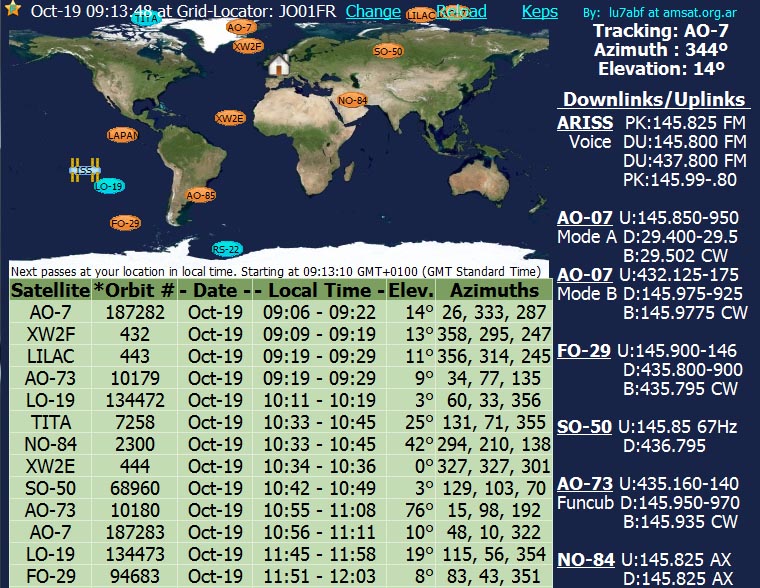
LU7ABF Online Satellite Orbital Predictions

AMSAT-LU PassOn the AMSAT Bulletin Board Pedro Converso LU7ABF has posted the following information about his online satellite orbital pass prediction app.

New, quick, easy & instant predictions at http://amsat.org.ar/pass.htm , available for satellites in use. (If that link doesn’t work try http://lu7abf.com.ar/pass.htm

• Detects and remembers your location, operates with and without Internet access.
• Should work on any PC browser, tablets or smart phones in your local time, not worry about keps.
• Useful for planning field operations, showing current and future passes with real time graphics.
• Displays azimuths and elevation as well as Uplink / Downlink frequencies.

If you try, comments or suggested changes/additions welcome.

Congratulations to all for the great satellite activity.

73, lu7abf, Pedro Converso

Radio Amateurs in Raspberry Pi Foundation Article

Dr Chris Bridges 2E0OBC at the AMSAT-UK International Space Colloquium - Credit DK3WN

Dr Chris Bridges 2E0OBC at the AMSAT-UK International Space Colloquium – Credit DK3WN

An article posted on the Raspberry Pi Foundation website describes the work of two radio amateurs at the Surrey Space Centre in Guildford.

Dr Chris Bridges, 2E0OBC, leads the spacecraft On-Board Data Handling group in the Surrey Space Centre at the University of Surrey. He researches and teaches computer hardware and software to provide reliable computer processing in the harsh radiation environment of space. Chris is also an amateur radio enthusiast, with a passion for hacking almost any electronics for space and telling everyone that the sky is most definitely not the limit. He was involved at the beginning of the Astro Pi project back in 2014, since he has been working on numerous space flight projects involving Raspberry Pi devices and has been doing thermal and vacuum tests on them with his students.

Chris is working on the on-board computer for the STRaND2 and AAReST CubeSat missions, along with CalTech and the NASA Jet Propulsion Laboratory in the US. These CubeSat missions require the processing and detection of other CubeSats in flight for rendezvous and docking experiments, as well as for collision avoidance manoeuvres.

These kinds of CubeSats employ light detection and ranging technologies (LIDAR) as a way to measure distance to nearby objects in space. This works by illuminating the target with a laser beam and then analysing the reflected light to calculate how far away the target is.

Postgrad student and radio amateur Richard Duke M6TLE achieved this with a Raspberry Pi, an ordinary Microsoft Kinect and some custom Linux drivers that he rewrote himself. He now works at Surrey Space Centre as a software engineer.

Read the full Raspberry Pi article at https://www.raspberrypi.org/blog/compute-module-cubesats/

Detailed information on the work is in this paper on AAReST published in Acta Astronautica
https://www.academia.edu/16685779/Using_CubeSat_micro-satellite_technology_to_demonstrate_the_Autonomous_Assembly_of_a_Reconfigurable_Space_Telescope_AAReST_
and in this paper on STRaND2 given at the IEEE/AIAA Aerospace Conference.
https://www.academia.edu/3073489/STRaND-2_Visual_Inspection_Proximity_Operations_and_Nanosatellite_Docking

URGENT – AO-85 Operational Update

AO-85 (Fox-1A) Flight Unit

AO-85 (Fox-1A) Flight Unit

The FM transponder on AO-85 (Fox-1A) should not be used during October 19-23.

AMSAT-NA report:

After our successful launch on October 8, AO-85 has been chiefly in transponder mode and available to users. While this operational plan resulted in increased data for AMSAT engineering evaluation, we have some necessary tests to complete that require limiting access for a short period. We will be characterizing the uplink and downlink signals, and developing an updated set of recommendations for minimal equipment and best operating practices.

For the week of October 19 to 23, AO-85 will be unavailable while this testing and evaluation is complete. Please avoid transmitting to the satellite even if you hear the transponder on. Users are encouraged to collect and forward telemetry via the FoxTelem program. Please share this information to other operators as needed. Cooperation will expedite this testing and the return to normal operations.

[Information provided by Drew KO4MA]

Have you donated to get your Fox-1 Challenge Coin Yet? http://www.amsat.org/?p=3275

AO-85 Information https://amsat-uk.org/satellites/communications/ao-85-fox-1a/
AMSAT Symposium Videos Now Online

AMSAT FOXVideos of the presentations given at the AMSAT Symposium held in Dayton, Oct. 16-18, can now be watched online.

Watch the videos at http://www.ustream.tv/channel/k8ud-coy-ameritech-net

AMSAT Symposium http://www.amsat.org/?page_id=2880