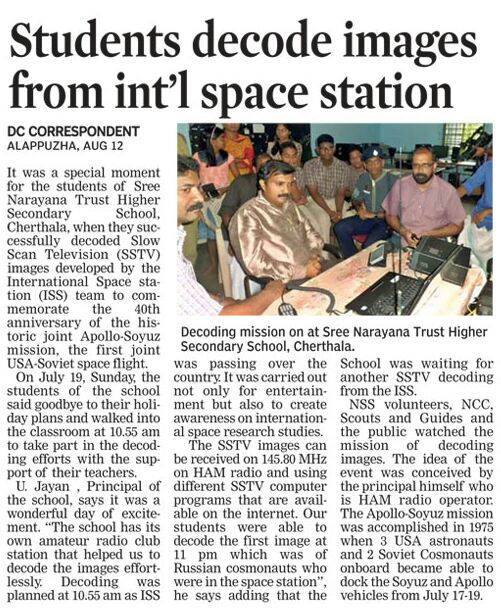
School students decode ISS images

ISS SSTV in the Deccan Chronicle

ISS SSTV in the Deccan Chronicle

Students at Sree Narayana Trust Higher Secondary School returned to the classroom during their holidays to receive amateur radio Slow Scan Television from the International Space Station.

The special ISS transmissions were made in July to commemorate the 40th anniversary of the Apollo-Soyuz mission.

The Deccan Chronicle newspaper reports that with the support of their teachers the students were able to decode the SSTV images on a frequency of 145.800 MHz FM.

The school has an amateur radio club, callsign VU2SQL, and the Principal is licenced radio amateur U.Jayan VU2JYU.
http://www.qrz.com/db/vu2sql

See the full article on the National Institute of Amateur Radio (NIAR) Facebook page at
https://www.facebook.com/NIAR.org/photos/a.272605179532734.63897.272263639566888/743023429157571/?type=1&theater

Examples of ISS SSTV images received by radio amateurs can be seen at
http://www.spaceflightsoftware.com/ARISS_SSTV/index.php

ISS Slow Scan TV https://amsat-uk.org/beginners/iss-sstv/

When ISS Ham Radio might be off

ARISS Amateur Radio on the International Space Station

ARISS Amateur Radio on the International Space Station

Mike KC8YLD has posted some guidance as to when the Amateur Radio stations on the ISS would be turned off.

Current flight rules require all the ham radios to be off during an EVA. Technically, the VHF radios needs to be off for Russian EVAs and the UHF radio needs to be off for US EVAs.

For dockings and undockings, again the ISS operates under a flight rule that has the VHF/UHF radios off for Progress, Soyuz and ATV vehicle activity. Note that Cygnus, Dragon, HTV and formerly the Shuttle did not require the radios to be off.

For Ham TV, it will be off for any EVA. It needs to be off for ATV (the last one November) docking and undocking. It also has to be off when the Robotics arm is in close proximity.

Sites for information include:
http://www.ariss.org/
http://www.issfanclub.com/
http://www.nasa.gov/mission_pages/station/expeditions/index.html

There are Amateur Radio stations in both the ISS Russian Service module and the ESA Columbus module, see http://www.ariss.org/contact-the-iss.html

2015 UKHAS Conference

SSDV picture from a PIE balloon - Image credit Dave Akerman M6RPI/2E0LTX/M0RPI

SSDV picture from a PIE balloon – Image credit Dave Akerman M0RPI

There’s an impressive line-up of radio amateurs among those giving presentations at the UK High Altitude Society (UKHAS) conference in London on Saturday, August 22, 2015.

The UKHAS conference attracts those interested in learning about building and flying High Altitude Balloons or in tracking their 434 MHz signals. The conference takes place at the University College London (UCL).

Schedule:
09:30     Assembly – Drinks & Biscuits
10:00     Welcome & Introduction
10:10     10 years of UKHAS – Steve Randall G8KHW & Ed Moore M0TEK
10:30     HF Pico – Andy Nguyen VK3YT (Streamed)
11:00     Crossing the Karman Line – Laurence Blaxter & Leo Bodnar M0XER
11:30     Break
11:45     QB50 – Dhiren Kataria M6END MSSL
12:15     Stratos School Habbing – Dave Green
12:45     A balloon-borne accelerometer technique for measuring atmospheric turbulence – Graeme Marlton
13:15     Lunch
14:15     A Short Guide to Parachutes – Ed Moore M0TEK
14:30     Predictor – Adam Greig M0RND & Daniel Richman M0ZDR
14:45     UKHASnet Weekend
15:00     Flexible timings: workshops, discussions etc
– IQ Sampling and Software Defined Radio for Beginners – Adam Greig M0RND (G06)
– Eagle CAD Workshop – Anthony Stirk M0UPU (G08)
– UKHASnet node demo – James Coxon M6JCX (Lobby)

UKHAS are also offering the option to complete the amateur radio Foundation Practical Assessments and Exam at the conference. This has been fully booked, perhaps a sign of the shortage of Foundation exams in central London.

Conference registration information is at
https://ukhas.org.uk/general:ukhasconference2015

ARISS International Meet This Week in Tokyo

ARISS LogoARISS International Delegates, its Board of Officers, and international team members will meet at Big Sight, Tokyo, Japan on August 20-23, 2015 for a critical meeting to discuss ARISS strategy, teamwork, hardware and operations.

Delegates are voting members of ARISS-I representating the 5 ISS member regions: United States, Russia, Japan, Canada and Europe.

The meeting will open with remarks from meeting host Keigo Komuro, JA1KAB from ARISS Japan and JARL.

Other agenda items will include:
• Welcome by the Japanese Space Agency JAXA & an Overview of the JAXA Innovative Satellite Technology Demonstration Program
• ARISS working group business discussions and reports, including: regional reports, ARISS Terms of Reference update, space agency coordination status, sustainability & fundraising and ARISS future endeavors
• Technical discussions on current and future hardware developments, including: Next Generation ARISS Radio Systems, the Astro-Pi Project, and an update on the Ham-TV system
• Operations discussions, including presentations on: Educational Activities, International Expansion & Planning of SSTV. School
Selection and Regional Scheduling Procedures and plans for the
upcoming Tim Peake Mission

Along with their ambitious schedule the delegates will begin each day with an opportunity for informal discussions and will have the opportunity to visit the Tsukuba Space Center.

[ANS thanks ARISS-I for the above information]

Amateur Radio on the International Space Station
• ARISS International organisation http://www.ariss-eu.org/international.htm
• ARISS-Europe Terms of Reference http://www.ariss-eu.org/tor.htm
• ISS Amateur Radio stations http://www.ariss.org/contact-the-iss.html

RSGB Letter in PC Pro Magazine

PC Pro Magazine LogoRSGB President John Gould G3WKL highlights Amateur Satellites, FUNcube and the RSGB Youth Committee in a letter, an edited version of which appears on page 30 of the October issue of PC Pro Magazine, in the shops now.

See the full text of John’s letter at http://www.pcpro.link/252rsgb

The letter was a follow-up to an article in the August issue of PC Pro Magazine by Jon Honeyball G1LMS
http://www.southgatearc.org/news/2015/july/ham_radio_in_pc_pro_magazine.htm

Twitter links:
G1LMS – https://twitter.com/jonhoneyball
G3WKL – https://twitter.com/G3WKL
RSGB  – https://twitter.com/theRSGB
Youth Committee – https://twitter.com/theRSGByouth
PC Pro https://twitter.com/pcpro
AMSAT-UK https://twitter.com/AmsatUK

Activation of linear transponder on EO-79

QB50p1 and QB50p2 - Image Credit ISIS

QB50p1 and QB50p2 – Image Credit ISIS

The AMSAT-NL transponder on EO-79 is being activated to support the International Lighthouse and Lightship Weekend (ILLW).

On the AMSAT Bulletin Board Wouter PA3WEG posted:

We apologize for the short notice, this opportunity came along very last minute, and again we took it.

QB50p1 (EO-79) carries the FUNcube-3 400 mW inverting linear 435/145 MHz SSB/CW transponder provided by AMSAT-NL with support from AMSAT-UK.

• 435.035-435.065 MHz LSB Uplink
• 145.935-145.965 MHz USB Downlink

TLEs are NORAD # 40025, COSPAR designator 2014-033-R

Remember that the FUNcube family of transponders do not need much power to work them.

I will be operating at Scheveningen Lighthouse PA25SCH, NL0025

Thanks to the Von Karman Institute and Innovative Solution In Space for the opportunity to use the transponder.

Have FUN over the weekend!

Wouter PA3WEG
AMSAT-NL

International Lighthouse and Lightship Weekend (ILLW)
http://www.illw.net/
https://www.facebook.com/ILLWeekend