
Yaesu handheld and $50SAT 1.5U PocketQube
Saturday, February 21, 2015 marked the 15 month anniversary of the launch of $50SAT/MO-76, and you guessed it – it is still operating.
Thursday, February 12, 2015 marked a different milestone – its orbit has decayed to the point where its mean motion crossed the 15 orbits per day threshold. The TLEs from Saturday, February 21, 2015 indicate it is now at 15.00521293 orbits per day.
Some of you noticed that something odd started happening on Monday, February 23, and Tuesday, February 24. We also noticed the same thing – during daytime passes in the northern hemisphere, $50SAT was transmitting once per minute, always sending telemetry in RTTY format, but never sending GFSK telemetry packets. Moreover, the total reset count kept going up by one each time.
Here are all the RTTY telemetry messages (that I am aware of) gathered on Monday and Tuesday:
(daytime pass)
2015-02-23,08:57,KO33,EU1XX,$50SAT,128,,2392,,,56,3,,21,141,77,,2910,1492,3521,*74
2015-02-23,08:58,KO33,EU1XX,$50SAT,128,,2393,,,58,3,,21,139,77,,2910,1492,3440,*72
2015-02-23,08:59,KO33,EU1XX,$50SAT,128,,2394,,,59,3,,21,138,77,,2910,1492,3501,*71
2015-02-23,09:01,KO33,EU1XX,$50SAT,128,,2396,,,62,3,,21,135,77,,2930,1492,3460,*72
(daytime pass)
2015-02-23,17:01,EN82,KD8QBA,$50SAT,128,,2503,,,60,3,,21,137,77,,2910,1492,3440,*78
2015-02-23,17:05,EN82,KD8QBA,$50SAT,128,,2506,,,64,3,,21,133,77,,2890,1492,3400,*70
(daytime pass)
2015-02-23,17:04,EM13,WB2A0Z,$50SAT,128,,2505,,,63,3,,21,134,77,,2779,1492,3380,*74
2015-02-23,17:05,EM13,WB2A0Z,$50SAT,128,,2507,,,65,3,,21,133,77,,2890,1492,3400,*70
2015-02-23,17:06,EM13,WB2A0Z,$50SAT,128,,2507,,,66,3,,21,132,78,,2849,1492,3400,*79
2015-02-23,17:07,EM13,WB2A0Z,$50SAT,128,,2508,,,67,3,,21,130,77,,2970,1492,3380,*7E
2015-02-23,17:08,EM13,WB2A0Z,$50SAT,128,,2509,,,68,3,,21,129,78,,2869,1492,3339,*7C
2015-02-23,17:09,EM13,WB2A0Z,$50SAT,,,2510,,,70,2,,21,,77,37,3677,1492,3359,*70
(nighttime pass)
2015-02-23,18:15,LO24,R4UAB/KD8QBA,$50SAT,128,,2510,,,48,3,,21,146,78,,82,1492,3400,*7D
(nighttime pass)
2015-02-24,03:45,EN82,KD8QBA,$50SAT,128,,2654,,,57,3,,21,138,78,,102,1492,3440,*44
(daytime pass)
2015-02-24,16:57,EN82,KD8QBA,$50SAT,128,,2810,,,57,3,,21,140,77,,2910,1492,3481,*7E
2015-02-24,16:58,EN82,KD8QBA,$50SAT,128,,2811,,,58,3,,21,139,77,,2768,1492,3460,*70
2015-02-24,16:59,EN82,KD8QBA,$50SAT,128,,2812,,,60,3,,21,138,77,,2869,1492,3400,*71
2015-02-24,17:00,EN82,KD8QBA,$50SAT,128,,2813,,,61,3,,21,136,78,,2768,1492,3420,*7C
2015-02-24,17:01,EN82,KD8QBA,$50SAT,128,,2814,,,63,3,,21,135,77,,2849,1492,3380,*74
2015-02-24,17:02,EN82,KD8QBA,$50SAT,128,,2815,,,64,3,,21,134,77,,2829,1492,3380,*75
2015-02-24,17:03,EN82,KD8QBA,$50SAT,128,,2816,,,65,3,,21,132,77,,2809,1492,3359,*77
2015-02-24,17:04,EN82,KD8QBA,$50SAT,128,,2817,,,66,3,,21,131,77,,2910,1492,3400,*74
2015-02-24,17:05,EN82,KD8QBA,$50SAT,128,,2818,,,68,3,,21,130,78,,2829,1492,3339,*7D
2015-02-24,17:06,EN82,KD8QBA,50SAT,128,,2819,,,69,3,,21,129,78,,2849,1492,3339,*73
(daytime pass)
2015-02-24,17:03,EM13,WB2A0Z,$50SAT,128,,2815,,,64,3,,21,134,77,,2829,1492,3380,*75
2015-02-24,17:04,EM13,WB2A0Z,$50SAT,128,,2816,,,65,3,,21,132,77,,2809,1492,3359,*77
2015-02-24,17:05,EM13,WB2A0Z,$50SAT,128,,2817,,,66,3,,21,131,77,,2910,1492,3400,*74
2015-02-24,17:06,EM13,WB2A0Z,$50SAT,128,,2818,,,68,3,,21,130,78,,2829,1492,3339,*7D
2015-02-24,17:07,EM13,WB2A0Z,$50SAT,128,,2819,,,69,3,,21,129,78,,2849,1492,3339,*73
2015-02-24,17:08,EM13,WB2A0Z,$50SAT,,,2820,,,70,2,,21,1,77,35,3698,1492,3359,*4C
(nighttime pass)
2015-02-24,18:16,LO24,R4UAB/KD8QBA,$50SAT,128,,2820,,,48,3,,21,147,78,,82,1492,3400,*72
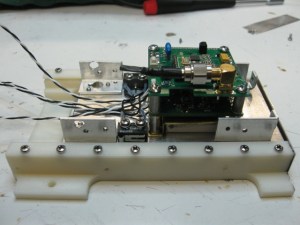
$50SAT Boards
What seems to be happening on the decending (daytime) passes is the CPU is reset just after sending a full RTTY telemetry message, as here are no GFSK packets sent, but within a half minute the FM Morse beacon is heard with Stuart’s callsign (GW7HPW, the first one in the rotation). My guess is the battery voltage is decaying during the operational cycle, and goes below the 2.9V reset threshold just after sending the RTTY or just as it is about to send the GFSK packets. Once the satellite is able to enable solar power (PCB temperature >= 0 degrees C), it starts behaving normally; it is now able to send GFSK packets. During ascending (nighttime) passes, it behaves normally, at least here in EN82 land.
There was a brief time where this behavior stopped (2015-02-25, 17:05 UTC through 2015-02-26, 3:47 UTC). It did, however, start back up sometime before 2015-02-26, 05:21 UTC, and has continued since.
Why is this happening now? We are still investigating, but it is apparent when looking at the chart of battery voltage over the lifetime of $50SAT/MO-76 that the battery has suffered a sizeable drop in capacity. If the battery voltage under load is dropping below 2.9V, how is it able to recover back above 3.3 V (the minimum required to enable transmission) and nearly complete another operational cycle? Moreover, why does it always seem to be able to finish sending an entire RTTY packet before resetting? In the hopes of better understanding what is happening, I am in the process of re-assembling my “BoxSat” test setup in an effort to reproduce on the ground what is happening in space. In the meantime, the once-per-minute transmission is actually convenient from telemetry monitoring standpoint, as one no longer has to wait 3 minutes for $50SAT/MO-76 to start transmitting. So, for any of you who have not heard $50SAT/MO-76, now is the time. Who knows how long it will continue to operate in this manner? Who knows how long it will continue to operated at all? Every time an anomaly has occurred and thought, “this is it – well, it was great while it lasted”, $50SAT/MO-76 has proven me wrong. I hope that is the case here as well.
The Dropbox has been updated with all the telemetry observations through today (Wednesday, March 4 2015), and can be accessed via the following URL:
https://www.dropbox.com/sh/l3919wtfiywk2gf/AABRl4iM5BFqVAcLQGSmdsVga/Telemetry-analysis/Current-Telemetry
I have also uploaded an MP3 file from the daytime pass over EN82 land on Friday, February 27, 2015 starting at 16:59 UTC (11:59 AM local time); it can be accessed via the following URL:
https://www.dropbox.com/s/2vfbtu51qn63aoa/50USDSat-LSB-FM-2015-02-27T1659Z.mp3
During the recording, I switch back and forth between FM and LSB modes so I can hear the FM Morse beacon as well as the RTTY telemetry.
Please keep the telemetry observations coming, especially now!
73 Michael Kirkhart KD8QBA
$50SAT/MO-76 team
$50SAT was a collaborative education project between Professor Bob Twiggs, KE6QMD, Morehead State University and three other radio amateurs, Howie DeFelice, AB2S, Michael Kirkhart, KD8QBA, and Stuart Robinson, GW7HPW. The transmitter power is just 100 mW on 437.505 MHz (+/-9 kHz Doppler shift) FM CW/RTTY. $50SAT uses the low cost Hope RFM22B single chip radio and PICAXE 40X2 processor.
There is a discussion group for $50SAT http://groups.yahoo.com/groups/50dollarsat/
50DollarSat http://www.50dollarsat.info/






You must be logged in to post a comment.