ISS Slow Scan TV on August 27

RS0ISS SSTV 20131029-1121Z received by Dmitry Pashkov UB4UAD

RS0ISS SSTV 20131029-1121Z received by Dmitry Pashkov then UB4UAD

A test of the Slow Scan Television (SSTV) experiment MAI-75, callsign RS0ISS, took place on the International Space Station (ISS) on Wednesday, August 27 between 1100-1300 GMT on 145.800 MHz FM. Although a strong carrier was heard there were no reports of SSTV tones being received.

The ARISS SSTV Blog Aug 27 says: The SSTV transmissions occurred on schedule and even occurred well after the planned termination time of 13:00 UTC (after 17:00 UTC). The new cable appears to have solved the constant carrier issue but now the audio from the program is not being transmitted. The end result for the day was no images but several well timed carriers that lasted for 180 seconds.

The ARISS SSTV Blog Aug 25 says: After a long hiatus due to hardware issues, the Russian team will try sending SSTV images on Aug 27 from 11:00-13:00 UTC using the Kenwood D710 and a new cable. The transmissions will be on 145.80 MHz and the intended mode is PD180. The interval between transmissions should be about 3 minutes. The images are being planned to be sent for one full orbit during this time period. Regions along the ground track include Europe, Central and Southeast Asia, Eastern Australia and New Zealand, Central South America and then Europe again.

Paul G4IJE, co-developer of the SSTV PD modes, says: If the ISS really does use PD180 mode as reported, don’t forget to either enable “Always show RX viewer” or use the “Picture viewer” (magnifying glass icon) to show the picture at it’s real resolution of 640 x 496. If you just view as normal you will only see 320 x 248 resolution, which kind of defeats the object of using a high resolution mode. Hopefully the image capture on the ISS is at high resolution.

Yuri Gagarin

Yuri Gagarin

A Google English translation of the ISS work plan says: “On Gagarin from Space”. Open gear with ISS RS by amateur radio link to ground receiving stations amateurs around the world images of photographs devoted to the life and work of the first cosmonaut Yuri Gagarin.

The Kenwood TM-D710 was delivered to the ISS in the summer of 2012. ARISS minutes for March 2013 note that: Sergey and the team did some tests including swapping antennas between the D-700 and the D-710, and with both configurations, there was a weak signal with the D-700. The power amplifier appears to be the problem. It seems only the exciter is working. Also, the D-710 has no mike since it was to be used with non-voice modes, and the mike for the D-700 has been modified and can’t be used with the D-710. We will work with our Russian colleagues to solve these issues.

The very strong carrier that was transmitted during the test on Wednesday, August 27 confirmed that the D-710 was radiating power successfully. Overheating issues (convection cooling doesn’t work in zero gravity) meant that the old D-700 transceiver was always run on the lowest power setting – 5 watts. It is presumed that a similar power level was used for the SSTV test.

All you need to do to receive SSTV pictures from the space station is to connected the audio output of a scanner or amateur rig via a simple interface to the soundcard on a Windows PC or an Apple iOS device, and tune in to 145.800 MHz FM. You can even receive pictures by holding an iPhone next to the radio’s loudspeaker.

The ISS puts out a strong signal on 145.800 MHz FM and a 2m handheld with a 1/4 wave antenna will be enough to receive it. The FM transmission uses 5 kHz deviation which is standard in much of the world.

Many FM rigs in the UK can be switched been wide and narrow deviation FM filters so select the wider deviation. Handhelds all seem to have a single wide filter fitted as standard.
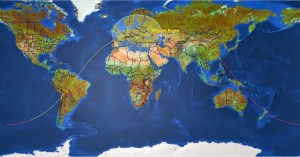
Orbit for ISS SSTV on August 27, 2014 1100-1300 GMT

Orbit for ISS SSTV on August 27, 2014 1100-1300 GMT

On Windows PC’s the free application MMSSTV can be used to decode the signal, on Apple iOS devices you can use the SSTV app. The ISS Fan Club website will show you when the space station is in range.

Listen for the ISS SSTV transmissions online using the SUWS WebSDR, further details at https://amsat-uk.org/2014/08/15/suws-websdr-moves-to-new-site/

For more on Slow Scan Television SSTV, see this article SSTV – The Basics
http://www.essexham.co.uk/sstv-the-basics

How to be successful with the ISS Slow Scan Television (SSTV) imaging system
http://www.marexmg.org/fileshtml/howtoisssstv.html

Information on the MAI-75 SSTV experiment
http://www.energia.ru/eng/iss/researches/education-26.html

Free MMSSTV software http://hamsoft.ca/pages/mmsstv.php

iOS SSTV App https://itunes.apple.com/gb/app/sstv/id387910013

IZ8BLY Vox Recoder, enables you to record the signals from the ISS on 145.800 MHz while you’re away at work http://antoninoporcino.xoom.it/VoxRecorder/

ARISS Slow Scan TV (SSTV) Blog and Gallery http://ariss-sstv.blogspot.co.uk/

For real-time tracking and the latest status of amateur radio activity on the space station see the ISS Fan Club http://www.issfanclub.com/

Dmitry Pashkov R4UAB http://r4uab.ru/?p=7237

ISS Work Plan http://www.mcc.rsa.ru/plan.htm

Lambda-Sat CubeSat – ISS Deployment

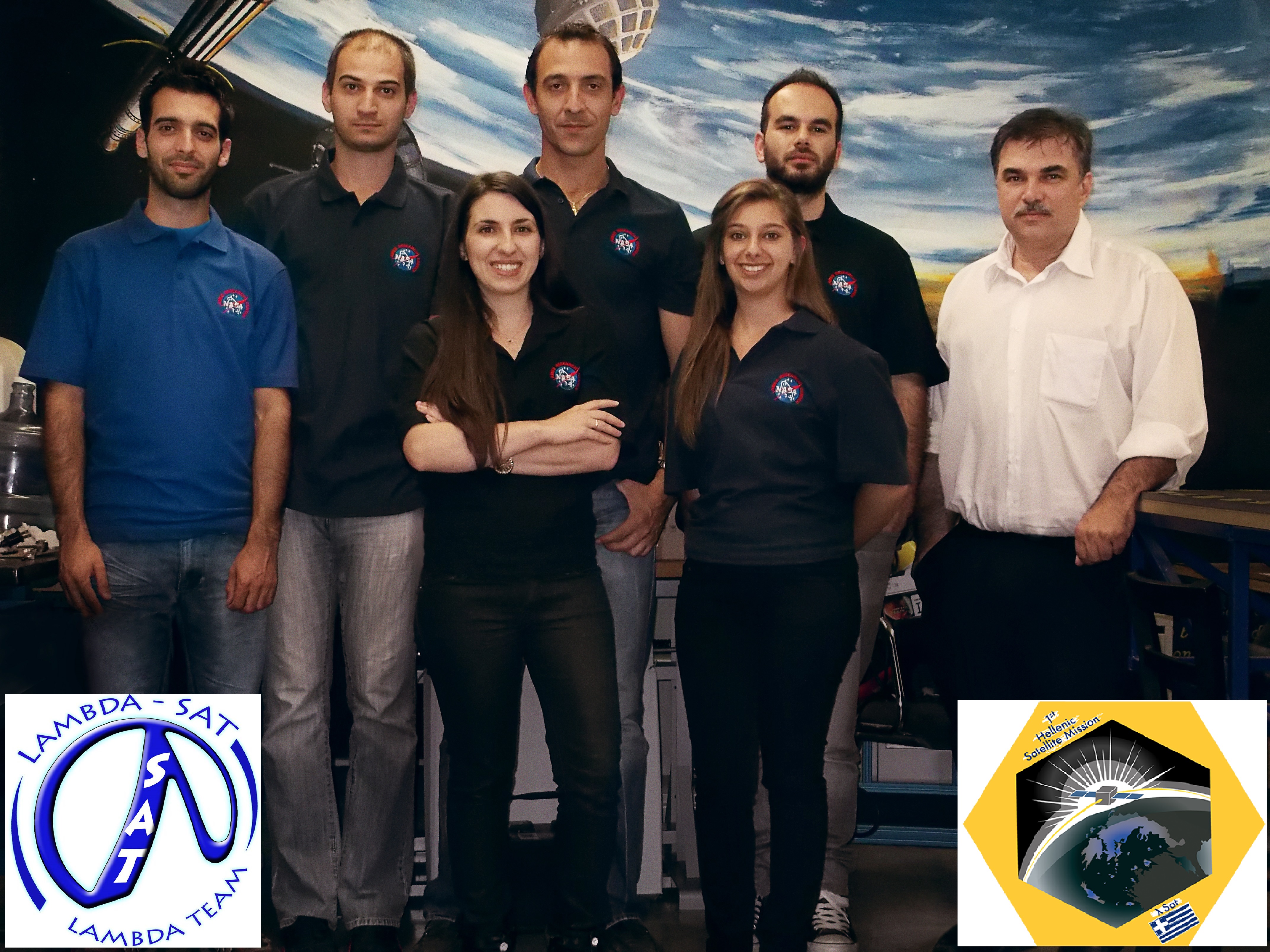
Some of the Lambda-Sat Team (right to left) Dr. Periklis Papadopoulos, Kostas Alexandrou, Eriana Panopoulou, Vaggelis Christodoulou, Maria Dimitrakopoulou, Charalabos Koulouris and Simos Kanis

Some of the Lambda-Sat Team (right to left) Dr. Periklis Papadopoulos, Kostas Alexandrou, Eriana Panopoulou, Vaggelis Christodoulou, Maria Dimitrakopoulou, Charalabos Koulouris and Simos Kanis

Lambda-Sat was launched to the International Space Station (ISS) from the Wallops Flight Facility in Virginia on July 13, 2014, in an Orbital Sciences’ Antares rocket CRS-2/ORB-2.

UPDATE: Deployment from the ISS took place on March 4, 2015 along with the MicroMAS CubeSat. This followed the deployment of two other CubeSats GEARRSAT and TechEdSat-4. On May 16, 2015 Lambda-Sat reentered the Earth’s atmosphere and burnt up.  No signal was ever reported from Lambda-Sat.

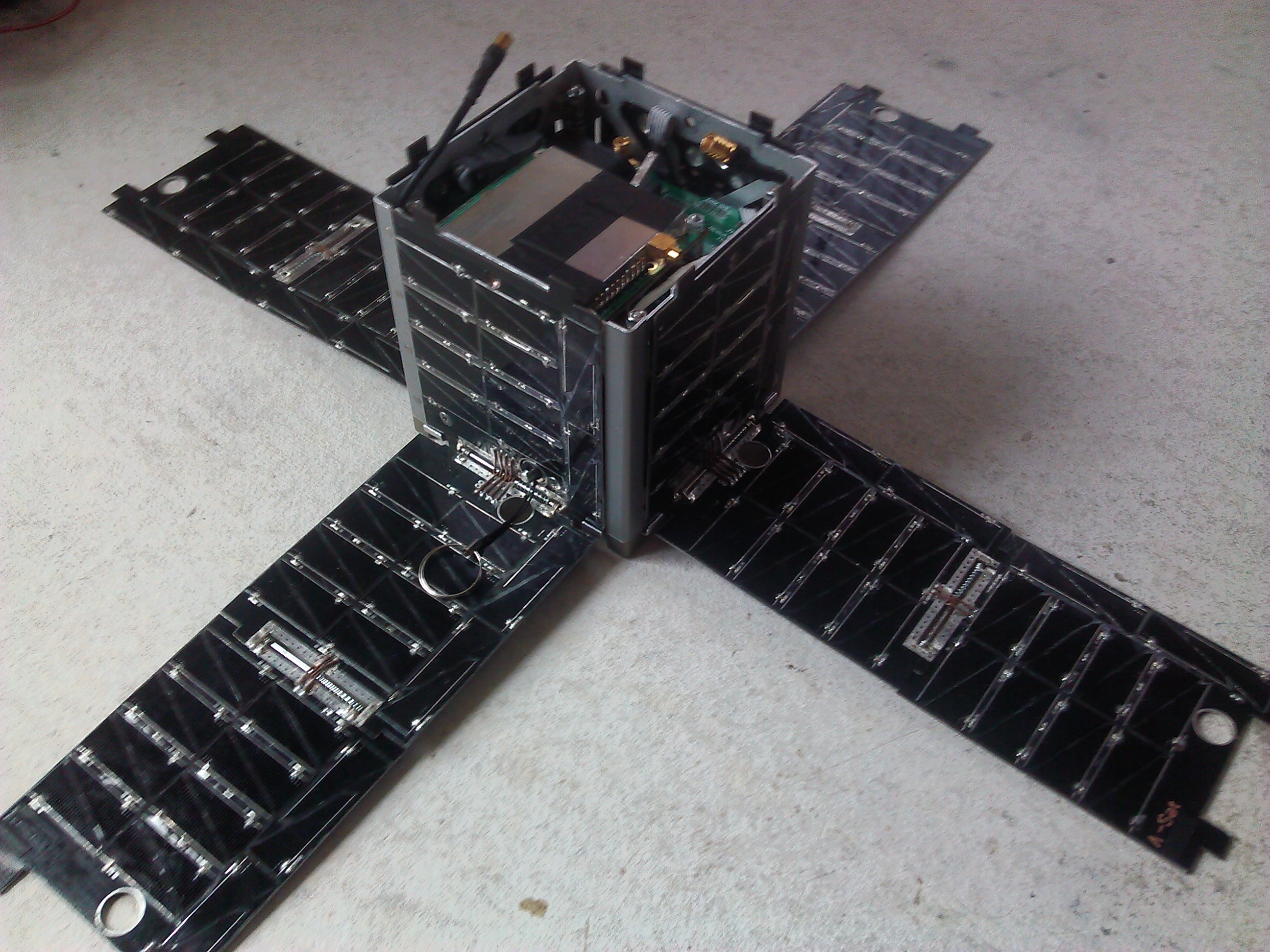
Lambda-Sat

Lambda-Sat

The Lambda team encourages amateur radio operators around the world to listen for and report the Lambda-Sat signal. Frequency: 437.462 MHz Downlink: AX.25 Unnumbered Information (UI) packets at 1200 bps AFSK Transmission Power : 1W Call Sign KK6DFZ The Secretary of the Cyprus Amateur Radio Society (CARS) Nestor  has written an article on Lambda-Sat, he says: The naming of the Λ-sat satellite came from the Greek letter L (Λ – lambda) a reminder of Hellas, Helios, the Greek word Thalassa for sea, the Greek word Lithos which directly translates to stone (meaning “Land of Light”).

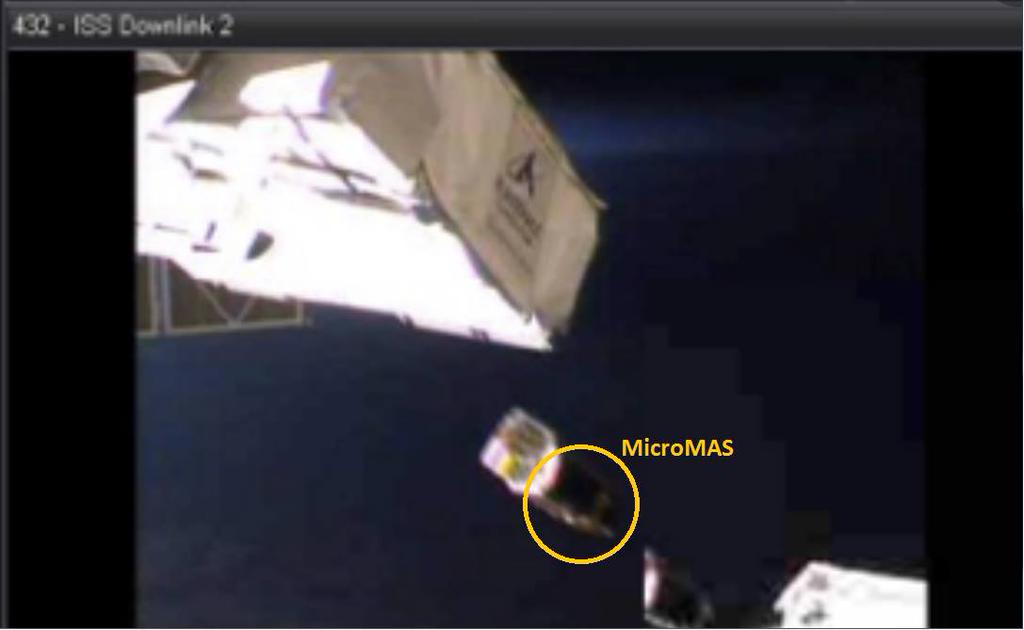
LambdaSat and MicroMAS CubeSats deploying from ISS March 4, 2015

LambdaSat and MicroMAS CubeSats deploying from ISS March 4, 2015

The Λ-sat was constructed entirely of Greek volunteers who worked feverishly, selflessly and without any personal gain. Members of Λ-sat contributed to the construction of the satellite system each with their knowledge in robotics, electronics, software development and telecommunications. The group consists of young people from Greece who traveled to Silicon Valley in California to participate in this project. “I want to motivate the youth in Greece to continue to dream,” says the original initiator of the project, Periklis Papadopoulos, Professor of Aerospace Engineering of the Federal University of California San Jose, which has been awarded from NASA for his contribution with the prize Turning Goals Into Reality (TGIR). As the professor states, “My goal is to demonstrate the capabilities of young people in Greece.” The professor believes that our country could be active in this area and this is not an economic issue, but a question of will alone (!). Submit reception reports of Lambda-Sat at http://lambdasat.com/?page_id=181 Lambda-Sat http://lambdasat.com/ Facebook https://www.facebook.com/lambdateam Article on Lambda-Sat by http://www.cyhams.org/index.php/en/news-and-events/359-the-first-greek-microsatellite-is-a-fact

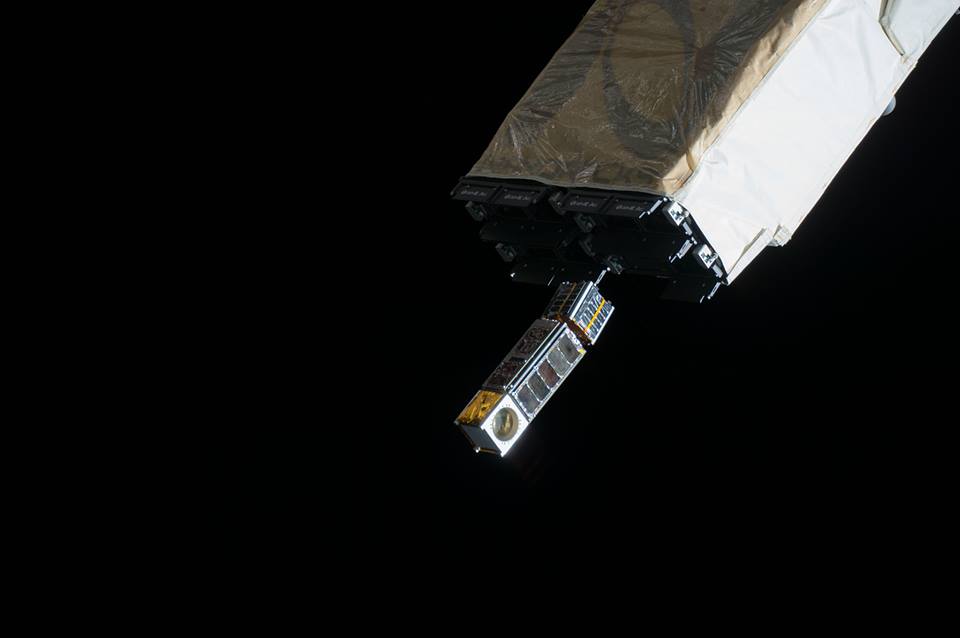
MicroMAS and Lambda-Sat deploying from the ISS on March 4 2015 - Image NASA / NanoRacks

MicroMAS and Lambda-Sat deploying from ISS on March 4, 2015 – Image NASA / NanoRacks

Schedule for RSGB Convention Released

Ofcom's Ash Gohil and Paul Jarvis G8RMM at 2013 RSGB Convention

Ofcom’s Ash Gohil and Paul Jarvis G8RMM at 2013 RSGB Convention

Ofcom staff will be among those giving presentations at the RSGB Convention which takes place October 10-12.

The Ofcom public consultation on Amateur Radio has been eagerly awaited for many months now and will hopefully have been released before the Convention.

The Society say there will be lots of space and a five lecture stream programme in the new Convention venue at the Kents Hill Conference Centre, Milton Keynes, MK7 6BZ.

Among the presentations are
– UKHASNET, technology and methodology by James Coxon M6JCX
– SDR Techniques by Simon Brown G4ELI
– Digital modes start up by Mike Richards G4WNC
– FUNcube CubeSat by AMSAT-UK
– Amateur radio software developers forum by Michael Wells G7VJR
– 146-147MHz: A New Frontier of Amateur Innovation? by John Regnault G4SWX
– World War 1 Communications by Dr Elizabeth Bruton

RSGB Convention http://rsgb.org/main/about-us/rsgb-convention/

Schedule http://rsgb.org/main/about-us/rsgb-convention/rsgb-convention-2014-provisional-timetable/

434 MHz balloon B-64 returning to UK again

B-64 transmitter payload weighs just 11 grams - Credit Leo Bodnar M0XER

B-64 transmitter payload weighs just 11 grams – Credit Leo Bodnar M0XER

Radio amateur Leo Bodnar M0XER launched his solar powered balloon B-64, carrying an 11 gram transmitter payload, from Silverstone in the UK at 06:51 UT on July 12, 2014 and it’s still flying.

It completed its first circumnavigation of the Northern Hemisphere at 16:30 UT on Friday, July 31 and is expected to complete the second circumnavigation in the next couple of days.

On the afternoon of Thursday, August 21 the balloon was just west of Reykjavik in Iceland heading south at an altitude of 12,500 metres.  Radio amateurs in the British Isles are invited to listen out for the balloon which may come in range late Friday or on Saturday.

B-64 transmits 10 mW on 434.500 MHz using the amateur radio data modes Contestia 64/1000 and APRS (M0XER-4).

The path of the balloon over the past 6 weeks can be seen on the UKHAS tracker at http://spacenear.us/tracker/flyb.php

An APRS map showing the past 24 hours is at http://aprs.fi/#!mt=roadmap&z=11&call=a%2FM0XER-4&timerange=86400&tail=86400

B-64 plastic foil envelope - Image credit Leo Bodnar M0XER

B-64 plastic foil envelope – Credit Leo Bodnar M0XER

Leo has utilised some clever techniques storing positions when the balloon is out of radio contact then later transmitting a log file of previous locations in the comments field of the APRS packet. This enables a fairly complete path to be built up. B-64 only stores 5 days worth of data, where you get a straight line on the track it has been out of radio contact.

Leo Bodnar M0XER balloons http://www.leobodnar.com/balloons/

Listen for B-64 online using the SUWS WebSDR, further details at https://amsat-uk.org/2014/08/15/suws-websdr-moves-to-new-site/

Online real-time tracking of balloons http://spacenear.us/tracker/

Mobile Tracker http://habitat.habhub.org/mobile-tracker/

Beginners Guide to Tracking using dl-fldigi software http://ukhas.org.uk/guides:tracking_guide

Slow Scan Digital Video (SSDV) Guide http://ukhas.org.uk/guides:ssdv (note no SSDV on B-64)

See received SSDV images on the web at http://ssdv.habhub.org/

To get up-to-date information on balloon flights subscribe to the UKHAS Mailing List by sending a blank email to this address: ukhas+subscribe@googlegroups.com

Follow balloon chat on the #highaltitude IRC channel at http://webchat.freenode.net/?channels=highaltitude

What is Amateur Radio ? http://www.essexham.co.uk/what-is-amateur-radio


Typical 434 MHz solar powered payload - Image credit Leo Bodnar M0XER

Typical 434 MHz solar powered payload – Image credit Leo Bodnar M0XER

UKHAS Conference Videos Now Available

James Coxon M6JCX opens UKHAS Conference - Image credit Steve Smith G0TDJ

James Coxon M6JCX opens UKHAS Conference – Image credit Steve Smith G0TDJ

The annual UK High Altitude Society (UKHAS) conference was held on Saturday, August 16, 2014 at the University of Greenwich in London. It attracted those interested in learning about building and flying High Altitude Balloons or in tracking their 434 MHz signals.

There was an impressive line-up of speakers in addition to which there were workshops, demonstrations along with amateur radio exams.

Videos of some of the presentations are now available on the British Amateur Television Club (BATC) site at http://batc.tv/

To watch the videos online or download them to your PC:
• Go to http://www.batc.tv/
• Click on the ‘Film Archive’ icon
• Select ‘UKHAS 2014′ from the Category drop down menu
• Click on ‘Select Category’
• Select the video you wish to watch from the Stream drop down menu
• Click on ‘Select Stream’
• Click the play icon ‘>’ on the player
• Clicking on the icon to the left of the player volume control will give you full screen display.
• To download the video file to your PC right-click on the ‘Click Here’  link under the player.

Morning Sessions

09:30 Assembly – Coffee / Tea + Biscuits
10.10 Introduction – James Coxon M6JCX and Anthony Stirk M0UPU
10.20 Predictor – Daniel Richman M0ZDR and Adam Greig M0RND
10.50 Advanced superpressure balloon technology – Dan Bowen K2VOL
11.30 SUWS WebSDR – Philip Crump M0DNY
11.45 Break
12.00 $50SAT Low cost satellite- Stuart Robinson GW7HPW
12.45 Batc.tv Introduction – Noel Matthews G8GTZ
13.00 Lunch / Show and Tell

Afternoon Sessions

Combination of workshop/lectures.

Main Lecture
14.30 STM32+DSP – Adam Greig M0RND, Jon Sowman M0JSN, Matt Brezja M6VXO
15.30 UKHASNET – James Coxon M6JCX

Side Room
14:30 Pi In The Sky – Anthony Stirk M0UPU and Dave Akerman M0RPI
15.30 Amateur Radio Exams

UKHAS Conference http://ukhas.org.uk/general:ukhasconference2014

Online real-time tracking of balloons http://spacenear.us/tracker/

Beginners Guide to Tracking using dl-fldigi software http://ukhas.org.uk/guides:tracking_guide

Slow Scan Digital Video (SSDV) Guide http://ukhas.org.uk/guides:ssdv

See received SSDV images on the web at http://ssdv.habhub.org/

To get up-to-date information on balloon flights subscribe to the UKHAS Mailing List by sending a blank email to this address: ukhas+subscribe@googlegroups.com

Follow balloon launch day chat on the #highaltitude IRC channel at http://webchat.freenode.net/?channels=highaltitude

73 on 73 Award Announcement

AO-73 (FUNcube-1) - Image credit Wouter Weggelaar PA3WEG

AO-73 (FUNcube-1) – Image credit Wouter Weggelaar PA3WEG

Paul Stoetzer N8HM has announced a new award for contacts made via the AO-73 (FUNcube-1) amateur radio satellite

I am pleased to announce that I will be sponsoring a new award to promote activity on AO-73 (FUNcube-1). The requirements for this award are simple:

1. Work 73 unique stations on AO-73.
2. Contacts must be made on or after September 1, 2014.
3. There are no geographic restrictions on your operating location.

There will be no cost for this award (donations to AMSAT-UK and AMSAT-NA’s Fox program are encouraged though). No QSLs are required. When you complete the requirements, email your log extract including the callsign of each station worked, time GMT, and date to n8hm@arrl.net as well as the address where you’d like the award certificate sent.

Enjoy AO-73’s transponder!

73 Paul Stoetzer, N8HM
Washington, DC