The free BYOB CubeSat Day takes place in the Surrey Space Centre, University of Surrey, Guildford on Friday, July 25. The day will include ad-hoc tours to SSC’s cleanroom, ground–station, and new CubeSat experimentation facilities.
Following on from the success of our 2013 event, Surrey Space Centre (SSC) and AMSAT-UK invite CubeSat developers to bring their equipment to a ‘Bring Your Own Board’ (BYOB) workshop. The aims are to demonstrate your latest CubeSat developments, to foster new partnerships and links within the UK and EU community, and encouraging more interaction with AMSAT-UK and the International Space Colloquium (July 26-27 more info at: https://amsat-uk.org/colloquium/colloquium-2014/).
The workshop is free to register. Opening times are from 9 AM to 4 PM, after which there will be an Amateur Satellite Beginners Session.
You will be able to see real satellite hardware from Clyde Space, ISIS, Satellite Applications Catapult, AMSAT-UK and the Open University.
Orbits – Illustration by B. Jones, P. Fuqua, J. Barrie, The Aerospace Corporation
David Bowman G0MRFdescribes the coverage area that might be provided by an amateur radio Medium Earth Orbit (MEO) satellite (MEOSAT). He suggests there is a region of space that would be optimum for such satellites.
The Van Allen radiation belts are separated into two layers. The lower layer is comprised of high energy protons between 600 and 6000km. The second belt is essentially electrons and that occupies altitudes above 12,000km. So a MEOSAT could avoid damaging radiation by orbiting in the “safe zone” between 7,000 and 11,000 km.
Watch the MEO satellites presentation given to the AMSAT-UK International Space Colloquium 2009
Video made by the British Amateur Television Club (BATC) Slides here
Elliptical Satellite Orbits
The paper Revisiting elliptical satellite orbits to enhance the O3b constellation by Lloyd Wood, Yuxuan Lou and Opeoluwa Olusola of the University of Surrey is now available for download.
Orbital altitudes of satellite systems
Early low-orbiting satellites were launched into Highly Elliptical Orbits (HEO) as a result of not having much control over trajectory. Circular orbits with minimal eccentricity offer consistent altitudes, with the benefits of consistent free space losses and link budgets throughout the orbit, and soon became the norm. Highly elliptical orbits fell from favor for communications use.
Highly elliptical orbits can be used to provide targeted satellite coverage of locations at high latitudes. We review the history of use of these orbits for communication. How elliptical orbits can be used for broadband communication is outlined. We propose an addition of known elliptical orbits to the new equatorial O3b satellite constellation, extending O3b to cover high latitudes and the Earth’s poles. We simulate the O3b constellation and compare this to recent measurement of the first real Internet traffic across the newly deployed O3b network.
The orbits of satellites at altitudes above 2500 km can decay faster than might at first be expected. The Dash-2 satellite was a 1 kg 2.5 meter diameter balloon launched on July 19, 1963 with the West Ford Needles. The 3500 km orbit, originally circular, increased in eccentricity rapidly under the action of solar radiation pressure. Dash 2 reentered the Earth’s atmosphere less than 8 years later on April 12, 1971.
The AMSAT-UK International Space Colloquium is being held at the Holiday Inn, Guildford, GU2 7XZ on July 26-27, 2014. The event is open to all, further details at https://amsat-uk.org/colloquium/colloquium-2014/
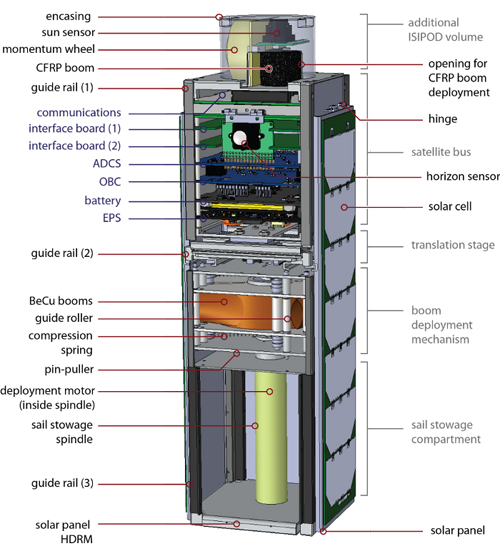
CubeSail is an exciting, ground-breaking educational satellite project at the Surrey Space Centre (SSC) that hopes to launch into a 680 km Sun Synchronous Orbit (SSO) from India in December 2014.
CubeSail Layout – Surrey Space Centre
A key feature is the deployment of a 25 square metre sail structure, which will be used to demonstrate the propulsive effect of solar radiation pressure (i.e. solar sailing) and will demonstrate the de-orbiting capabilities of the sail as a drag augmentation device. CubeSail will be the first launched three-axis stabilised solar sail.
CubeSail will build on small satellite experience at SSC, such as the STRaND-1 nanosatellite, launched on February 25, 2013. Furthermore, the mission critical sail deployment mechanism has undergone an extensive testing and validation process as part of the ESA Gossamer Deorbiter project carried out at SSC. The CubeSail project is also financially and technically supported by world leading industrial partners, Astrium and Surrey Satellite Technology Ltd.
CubeSail is a 3U CubeSat project with a 6kg mass, the mission aims are :
• Technology Demonstration 1: Deployable Sail- The CubeSail satellite will deploy a large (up to 5×5 metre) square aluminised Kapton sail, using novel CFRP deployable booms.
• Technology Demonstration 2: Solar Sailing – The CubeSail mission will demonstrate ‘solar sailing’ in LEO by utilising the solar radiation pressure on the reflective sail to change its orbital inclination.
• Technology Demonstration 3: Attitude Control CubeSail is equipped with 3-axis-stabilizing attitude determination and control system. A novel capability of this system is pointing via a centre-of-mass/centre-of-pressure (COM/COP) offset.
• Technology Demonstration 4: Drag Deorbiting -The satellite will deorbit much more quickly than otherwise due to its deployable sail. Satellite pointing will be optimized by the attitude control system for maximum drag.
• Outreach – The satellite will provide beacons for which amateur satellite users and ham radio users will be able to receive. Proposing a 9600 Bit/s AX.25 RC-BPSK downlink
The AMSAT-UK International Space Colloquium takes place on the weekend of July 26-27, 2014 at the Holiday Inn, Guildford, GU2 7XZ, United Kingdom. The event is open to all, further details at https://amsat-uk.org/colloquium/colloquium-2014/
The Surrey Electronics and Amateur Radio Society (EARS) have received the Special Interest Society of the Year award.
The Society say “Surrey EARS has been working hard to be one of the best societies on campus and this year our work has been officially recognised. At the student awards ceremony we received the award for Special Interest Society of the Year and just recently have been recognised as a Gold Society by the students union. This is a great achievement for us and we hope to do even more in the coming year”.
On Saturday, July 26 members of Surrey EARS will be giving a presentation on their recent high altitude balloon flight to the AMSAT-UK International Space Colloquium at the Holiday Inn, Guildford, GU2 7XZ, the event is open to all, further details at https://amsat-uk.org/colloquium/colloquium-2014/
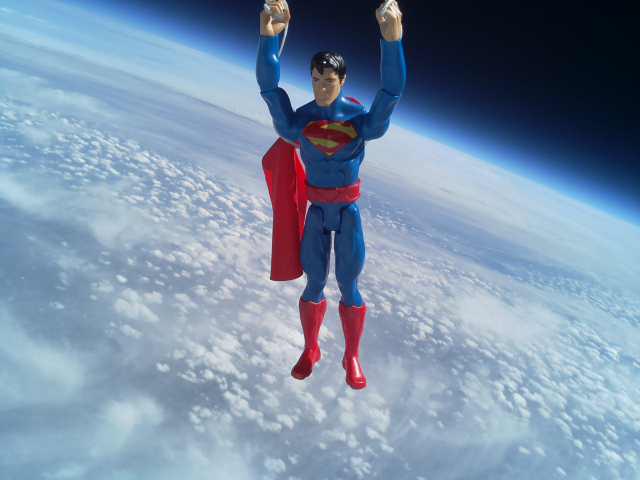
434 MHz SSDV image from the SUPER balloon launched by Dave Akerman M0RPI on July 12, 2014
Radio amateur Philip Crump M0DNY plans a number of High Altitude Balloon (HAB) flights this weekend transmitting Slow Scan Digital Video (SSDV).
SSDV picture from a PIE balloon – Image credit Dave Akerman M6RPI/2E0LTX/M0RPI
The launches will take place from Gilwell Park near Epping Forest and the balloons are expected to land around Chelmsford in Essex.
They are planned as part of the Gilwell 24 Scouts Activity event, taking place from 9am Saturday, July 12 through the night to 9am Sunday, July 13 in Gilwell Park. The plan is to monitor predictions/weather, prepare the payload, launch when convenient, then Philip M0DNY will chase, recover and repeat, up to 2 additional times.
The balloons are 100g hwoyees, and so are only expected to reach around 14 km altitude due to the weight, and increasing chances of wet landing for a longer flight. A Raspberry Pi is being used for the SSDV, and will store images as well as short but frequent video clips.
Due to tracker issues Philip may be flying a borrowed SUSF tracker on 434.613 MHz, replacing his one on 424.125 MHz.
The USB frequencies used will be
• 434.200 MHz – G24HAB – 600 baud SSDV
And either:
• 434.125 MHz – GILWELL24 – 50 baud RTTY
Or:
• 434.613 MHz – GILWELL24 – 50 baud RTTY + 300 baud TurboHAB FSK (SSB)
The 434.613 MHz tracker will alternate between 50 baud RTTY and 300 baud binary TurboHAB. To decode the binary error corrected format you need this decoder: http://users.ecs.soton.ac.uk/mfb2g09/decoder/decoder.jar , which has been updated since last time. To decode the binary protocol you first need to change ‘Encoding’ to BIN and ‘Baud’ to 300. Upon changing the callsign and position you need to press ‘Update’ for the new data to be used. It will be interesting to see the relative performance, the error correction should make most difference where there is noise or fading.
First launch is tentatively scheduled for 2pm BST Saturday. Philip will post updates on Twitter and #highaltitude. There will most likely be a live stream of the launches check http://batc.tv/ch_live.php?ch=3
David Akerman M0RPI with balloon – Image credit M0RPI
Dave Akerman M0RPI is also launching on Saturday between 10-11am from Ross On Wye. His balloon will be transmitting on three frequencies one of which will be Slow Scan Digital Video (SSDV).
The balloons should have a radio range of up to 700 km providing coverage over a large part of the British Isles and into Europe.
Listen to the Balloons via the Web
Radio amateurs Noel G8GTZ, Martin G8JNJ and Phil M0DNY from the Southampton University Wireless Society, have established an Internet accessible WebSDR receiver near Basingstoke in the UK. It has special helix antennas optimised for balloon and satellite reception in the 144 and 434 MHz bands and can be listened to from anywhere in the world. Listen using the WebSDR at http://websdr.suws.org.uk/
The Chelmsford Amateur Radio Society have a new short training course for those wishing to become radio amateurs starting on September 4. To find out more speak to Clive G1EUC on
Tel: 01245-224577
Mob: 07860-418835
E-mail: training2014 at g0mwt.org.uk
Web: http://www.g0mwt.org.uk/training/
AMSAT-DL report a team of engineers, space enthusiasts and radio amateurs have succeeded in firing the thrusters of the NASA-abandoned ISEE-3/ICE spacecraft.
The plan on Tuesday, July 8, was to fire the thrusters for a total of 7 sequences with breaks for telemetry analysis. While this would have resulted in a velocity change of 7 m/s, the course correction is required for the lunar swing-by on Aug 10, 2014 then to enter a stable orbit around Earth. However after the first firing sequence the remaining sequences were cancelled due to the returned telemetry data, which is being analyzed. A second attempt was planned for July 9.
The ISEE-3 Reboot Project (IRP) team attempted this main trajectory correction maneuver following a first short thruster firing on July 2, which increased the rotation rate of the spacecraft to the required value. This was possible due to international collaboration between the IRP, and a team of AMSAT-DL and Bochum observatory with its 20 m diameter radio telescope which received and processed critical real-time data of the maneuvers.
Amateur Radio Facility at Bochum
While the IRP has access to the Arecibo observatory which, at 305 m diameter, is the largest single-dish radio telescope in the world, downlink support from Bochum is required as Arecibo cannot transmit and receive simultaneously.
Two members of the AMSAT-DL Bochum team will be giving presentations on their reception of ISEE-3 at the AMSAT-UK International Space Colloquium on Saturday, July 26, 2014 at the Holiday Inn, Guildford, GU2 7XZ, United Kingdom. The event is open to all, further details at https://amsat-uk.org/colloquium/colloquium-2014/





 AMSAT-UK
You must be logged in to post a comment.