The July/August 2014 issue of the free professional publication SatMagazine features TechDemoSat, UKube-1 with FUNcube-2 boards, DX-1 and the publication OSCAR News produced quarterly by AMSAT-UK.
OSCAR News is edited by Jim Heck G3WGM and Graham Shirville G3VZV. On page 28 SatMagazine says:
AMSAT-UK is an information service that offers a first class magazine in OSCAR News (free to members at least every three months), and provides technical data and advice on all aspects of amateur satellite communications. Orbital data and general assistance to all radio amateurs wishing to enter this specialized part of the hobby is still available at minimal cost. For further information regarding AMSAT UK, please visit https://amsat-uk.org/
The AMSAT-UK International Space Colloquium is being held at the Holiday Inn, Guildford, GU2 7XZ on July 26-27, 2014. The event is open to all, further details at https://amsat-uk.org/colloquium/colloquium-2014/
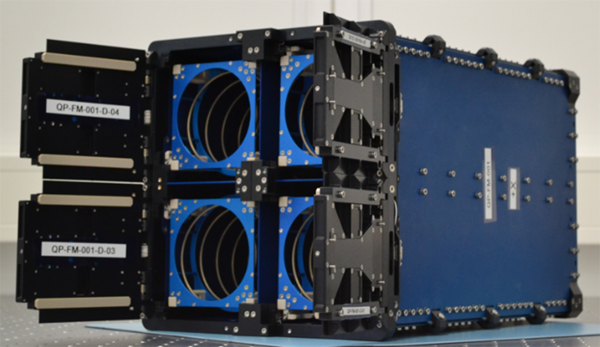
ISIS have been selected by SpaceFlight Inc. to provide QuadPack nanosatellite dispensers for the 2015 SHERPA launch. They will provide the capacity to deploy 84 3U CubeSats. Future SHERPA launches aim to go to Geostationary Transfer Orbit (GTO).
ISIS QuadPack Deployer – Credit ISIS
Following next year’s launch, Spaceflight are planning two launches each year, one to Low Earth Orbit (LEO), and the other to Geostationary Transfer Orbit (GTO). A GTO is a highly elliptical orbit which may have an apogee of 35,786 km and a perigee around 300 km.
Seattle Astronomy report SHERPA is capable of carrying up to 1,500 kilograms total although the first mission, set for the third quarter of 2015, will only be 1,200 kilograms.
The first SHERPA will not have its own propulsion system, but future models should, enabling even greater maneuverability and precision in delivering satellites to their intended destinations.
The AMSAT-UK International Space Colloquium is being held at the Holiday Inn, Guildford, GU2 7XZ on July 26-27, 2014. The event is open to all, further details at https://amsat-uk.org/colloquium/colloquium-2014/
SSDV picture from a PIE balloon – Image credit Dave Akerman M6RPI/2E0LTX/M0RPI
Pupils at Wirral Grammar School for Girls are planning to launch a High Altitude Balloon equipped with 434 MHz telemetry and Slow Scan Digital Video (SSDV) transmitters.
The launch is planned for Wednesday, July 16 at around 11:00 BST from Middletown Hill near Welshpool, weather permitting. The balloon will be a 1200g Hwoyee with Helium and the transmitter details are:
The balloon will carry a Raspberry Pi A with RFM22B based daughterboard. The radio coverage area could extend up to a radius of 700 km which would make it receivable throughout the British Isles.
Radio amateurs Noel G8GTZ, Martin G8JNJ and Phil M0DNY from the Southampton University Wireless Society, have established an Internet accessible WebSDR receiver near Basingstoke in the UK. It has special helix antennas optimised for balloon and satellite reception in the 144 and 434 MHz bands and can be listened to from anywhere in the world. Listen using the WebSDR at http://websdr.suws.org.uk/
The free BYOB CubeSat Day takes place in the Surrey Space Centre, University of Surrey, Guildford on Friday, July 25. The day will include ad-hoc tours to SSC’s cleanroom, ground–station, and new CubeSat experimentation facilities.
Following on from the success of our 2013 event, Surrey Space Centre (SSC) and AMSAT-UK invite CubeSat developers to bring their equipment to a ‘Bring Your Own Board’ (BYOB) workshop. The aims are to demonstrate your latest CubeSat developments, to foster new partnerships and links within the UK and EU community, and encouraging more interaction with AMSAT-UK and the International Space Colloquium (July 26-27 more info at: https://amsat-uk.org/colloquium/colloquium-2014/).
The workshop is free to register. Opening times are from 9 AM to 4 PM, after which there will be an Amateur Satellite Beginners Session.
You will be able to see real satellite hardware from Clyde Space, ISIS, Satellite Applications Catapult, AMSAT-UK and the Open University.
Orbits – Illustration by B. Jones, P. Fuqua, J. Barrie, The Aerospace Corporation
David Bowman G0MRFdescribes the coverage area that might be provided by an amateur radio Medium Earth Orbit (MEO) satellite (MEOSAT). He suggests there is a region of space that would be optimum for such satellites.
The Van Allen radiation belts are separated into two layers. The lower layer is comprised of high energy protons between 600 and 6000km. The second belt is essentially electrons and that occupies altitudes above 12,000km. So a MEOSAT could avoid damaging radiation by orbiting in the “safe zone” between 7,000 and 11,000 km.
Watch the MEO satellites presentation given to the AMSAT-UK International Space Colloquium 2009
Video made by the British Amateur Television Club (BATC) Slides here
Elliptical Satellite Orbits
The paper Revisiting elliptical satellite orbits to enhance the O3b constellation by Lloyd Wood, Yuxuan Lou and Opeoluwa Olusola of the University of Surrey is now available for download.
Orbital altitudes of satellite systems
Early low-orbiting satellites were launched into Highly Elliptical Orbits (HEO) as a result of not having much control over trajectory. Circular orbits with minimal eccentricity offer consistent altitudes, with the benefits of consistent free space losses and link budgets throughout the orbit, and soon became the norm. Highly elliptical orbits fell from favor for communications use.
Highly elliptical orbits can be used to provide targeted satellite coverage of locations at high latitudes. We review the history of use of these orbits for communication. How elliptical orbits can be used for broadband communication is outlined. We propose an addition of known elliptical orbits to the new equatorial O3b satellite constellation, extending O3b to cover high latitudes and the Earth’s poles. We simulate the O3b constellation and compare this to recent measurement of the first real Internet traffic across the newly deployed O3b network.
The orbits of satellites at altitudes above 2500 km can decay faster than might at first be expected. The Dash-2 satellite was a 1 kg 2.5 meter diameter balloon launched on July 19, 1963 with the West Ford Needles. The 3500 km orbit, originally circular, increased in eccentricity rapidly under the action of solar radiation pressure. Dash 2 reentered the Earth’s atmosphere less than 8 years later on April 12, 1971.
The AMSAT-UK International Space Colloquium is being held at the Holiday Inn, Guildford, GU2 7XZ on July 26-27, 2014. The event is open to all, further details at https://amsat-uk.org/colloquium/colloquium-2014/
CubeSail is an exciting, ground-breaking educational satellite project at the Surrey Space Centre (SSC) that hopes to launch into a 680 km Sun Synchronous Orbit (SSO) from India in December 2014.
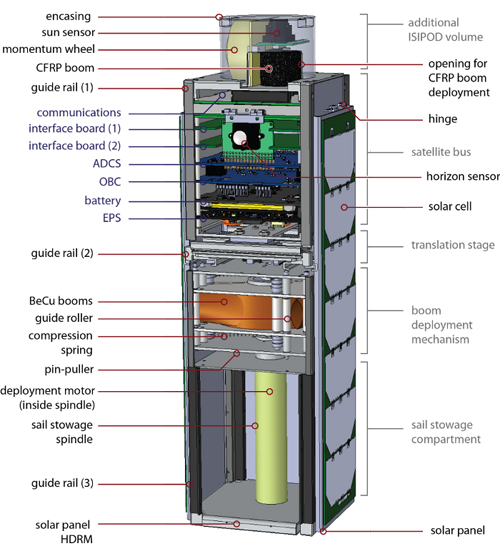
CubeSail Layout – Surrey Space Centre
A key feature is the deployment of a 25 square metre sail structure, which will be used to demonstrate the propulsive effect of solar radiation pressure (i.e. solar sailing) and will demonstrate the de-orbiting capabilities of the sail as a drag augmentation device. CubeSail will be the first launched three-axis stabilised solar sail.
CubeSail will build on small satellite experience at SSC, such as the STRaND-1 nanosatellite, launched on February 25, 2013. Furthermore, the mission critical sail deployment mechanism has undergone an extensive testing and validation process as part of the ESA Gossamer Deorbiter project carried out at SSC. The CubeSail project is also financially and technically supported by world leading industrial partners, Astrium and Surrey Satellite Technology Ltd.
CubeSail is a 3U CubeSat project with a 6kg mass, the mission aims are :
• Technology Demonstration 1: Deployable Sail- The CubeSail satellite will deploy a large (up to 5×5 metre) square aluminised Kapton sail, using novel CFRP deployable booms.
• Technology Demonstration 2: Solar Sailing – The CubeSail mission will demonstrate ‘solar sailing’ in LEO by utilising the solar radiation pressure on the reflective sail to change its orbital inclination.
• Technology Demonstration 3: Attitude Control CubeSail is equipped with 3-axis-stabilizing attitude determination and control system. A novel capability of this system is pointing via a centre-of-mass/centre-of-pressure (COM/COP) offset.
• Technology Demonstration 4: Drag Deorbiting -The satellite will deorbit much more quickly than otherwise due to its deployable sail. Satellite pointing will be optimized by the attitude control system for maximum drag.
• Outreach – The satellite will provide beacons for which amateur satellite users and ham radio users will be able to receive. Proposing a 9600 Bit/s AX.25 RC-BPSK downlink
The AMSAT-UK International Space Colloquium takes place on the weekend of July 26-27, 2014 at the Holiday Inn, Guildford, GU2 7XZ, United Kingdom. The event is open to all, further details at https://amsat-uk.org/colloquium/colloquium-2014/
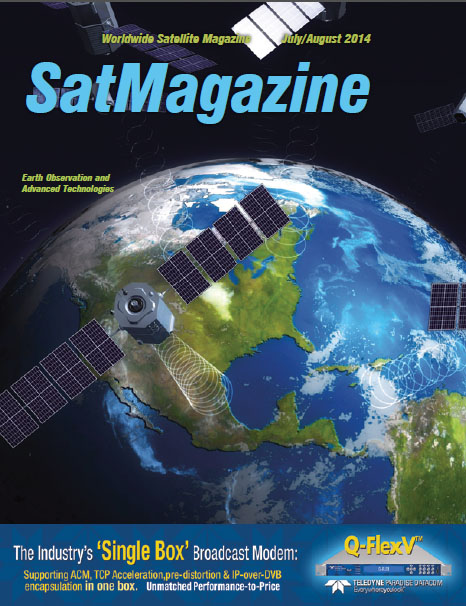 The July/August 2014 issue of the free professional publication SatMagazine features TechDemoSat, UKube-1 with FUNcube-2 boards, DX-1 and the publication OSCAR News produced quarterly by AMSAT-UK.




You must be logged in to post a comment.