Juno spacecraft QSL cards sent out

Juno Spacecraft QSL Card October 9, 2013

Juno spacecraft QSL card October 9, 2013

Juno QSL cards have been sent out to those radio amateurs who participated in the Juno Earth flyby experiment.

Amateur radio operators sent a very slow CW (1/25 WPM) to NASA’s Juno spacecraft during its Earth flyby on October 9, 2013.

Hams sent “HI” every 10 minutes as Juno approached Earth, and the message was clearly detected several times. The Juno team confirmed that more than 1400 radio hams participated, representing all seven continents.

Data video: http://youtu.be/Vg80vaGj2Gg
Data video & image caption: http://photojournal.jpl.nasa.gov/catalog/PIA17744
Mini documentary: http://youtu.be/hg9xY1zvrsw
Archived event page: http://missionjuno.swri.edu/hijuno

Radio hams say Hi to Juno https://amsat-uk.org/2013/10/09/radio-hams-say-hi-to-juno/

Final ISS Ham Video Commissioning – 2395 MHz

Front panel of the HamTV transmitter

Front panel of the HamTV transmitter

The final Ham Video Commissioning Pass 4 is  planned for Sunday, April 13 at 1823 UT.

Configuration 4 will be used:
* ARISS antenna 43
* Frequency 2395 MHz
* Symbol rate 2.0 MS/s

Koichi Wakata KC5ZTA installing CubeSat deployers on the Multipurpose Experiment Platform inside the Kibo laboratory of the ISS

Astronaut Koichi Wakata KC5ZTA

ISS astronaut Koichi Wakata KC5ZTA will operate using the call sign OR4ISS. Ground stations F6DZP and IK1SLD will receive the signals and stream the video over the BATC server. The video is expected to be received during 5 minutes.

This will mark the end of the Blank Transmissions.

We thank the operators who filed reception reports of blank transmissions. Your  participation to the Ham Video testing campaign has been invaluable.

No decision has been taken yet on the future use of Ham Video. We will keep you informed on any progress.

73,
Gaston Bertels, ON4WF
ARISS Europe chair

HamTV Antennas at ARISS Telebridge Station IK1SLD in Casale Monferrato, Italy

HamTV Antennas at ARISS Telebridge Station IK1SLD

Read the HamTV overview by Gaston Bertels ON4WF http://tinyurl.com/HamTVoverview

Join the ISS HamTV Yahoo Group http://groups.yahoo.com/group/HamTV

Webstream of the TV transmissions http://batc.tv/ch_live.php?ch=4

ARISS-EU HamTV Bulletins http://www.ariss-eu.org/

HamTV on Facebook https://www.facebook.com/Hamtvproject

KickSat Sprites – Radio Competition

KickSat Sprite Competition

On the KickSat updates page Zac Manchester KD2BHC has announced a competition to receive the first amateur radio signals from the KickSat CubeSat and the tiny Sprites satellites.

KickSat Sprite satellites deployed - Image by Ben Bishop VK2FBRB

KickSat Sprite satellites deployed – Image by Ben Bishop VK2FBRB

The KickSat CubeSat will carry 104 tiny Sprite satellites into a 325×315 km 51.5 degree inclination orbit. The launch carrying four other CubeSats, SporeSat, TSAT, PhoneSat-v2.5 and ALL-STAR/THEIA is planned for Friday, April 18, 2014 at 1925 UT and should be broadcast live on NASA TV and also streamed on Ustream.

Zac writes:

Our launch coming up in less than a week and, to keep things fun, I’d like to announce a little contest…

I’ll be offering prizes to the first several people who receive telemetry packets from KickSat as well as the first few who receive signals from the Sprites. The prizes will include souvenir Sprites and CRS-3 and ELaNa-V mission patches.

437 MHz Sprite

437 MHz Sprite

Now for the rules:
• In the case of KickSat telemetry, you have to send me the raw hex or ASCII packet data and I have to be able to successfully decode it.
• In the case of the Sprite signals, you have to send me a raw baseband recording and I have to be able to decode at least one Sprite signal from it.
• I’ll continue offering prizes until I run out of cool swag.
• I have the ultimate say on whether or not you win.

To get in on the fun, check out our wiki and join the KickSat mailing list. Let the games begin!

All the Sprites operate on a single frequency of 437.240 MHz and use Code Division Multiple Access (CDMA). The transmitter runs 10 mW output of Minimum Shift Keying (MSK) modulated binary data with each data bit modulated as a 511 bit Pseudo-Random Number (PRN) sequence. The ITU emission designator is 50K0G1D.

The KickSat CubeSat has downlinks on 437.505 MHz and 2401-2436.2 MHz.

In this video Ben Bishop VK2FBRB gives an alternative view of the deployment

Wiki https://github.com/zacinaction/kicksat/wiki

KickSat mailing list https://groups.google.com/forum/#!forum/kicksat-gs

Kicksat Updates https://www.kickstarter.com/projects/zacinaction/kicksat-your-personal-spacecraft-in-space/posts

PRN codes for KickSat Sprites released https://amsat-uk.org/2014/03/23/prn-codes-for-kicksat-sprites-released/

CRS-3 Payloads http://www.spaceflight101.com/dragon-spx-3-cargo-overview.html

Equipment for receiving the Sprite 437 MHz signals

Equipment for receiving the Sprite 437 MHz signals

Solar powered 434 MHz balloon reaches Syria

Track of the B-44 balloon taken on April 10, 214, two days after launch

Track of the B-44 balloon taken on April 10, 214, two days after launch

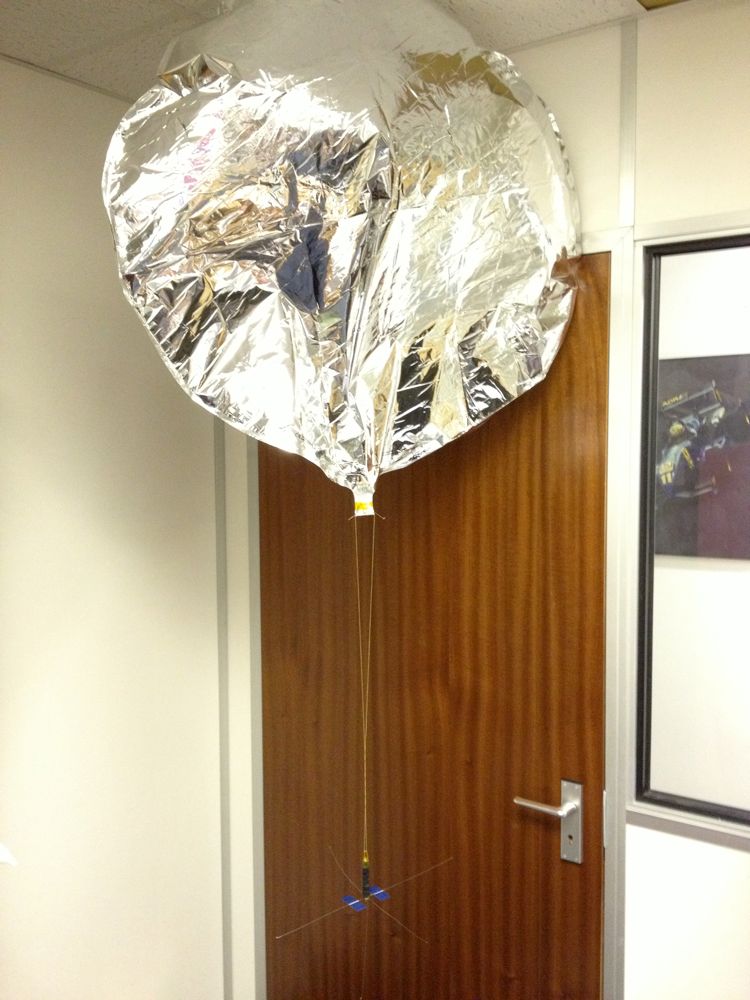
On Tuesday, April 8, 2014 radio amateur Leo Bodnar M0XER launched two foil “party” pico balloons from Silverstone with solar powered payloads transmitting on 434.500 MHz USB using the Contestia 8/1000 data mode. By Thursday, April 10 one of the balloons, B-44, was reported to be over Syria.

Typical pico balloon with tiny solar powered 434 MHz transmitter - Image credit Leo Bodnar M0XER

Typical pico balloon with tiny solar powered 434 MHz transmitter – Image credit Leo Bodnar M0XER

Depending on altitude the balloons could have a range of 300-500 km and remain aloft for several days.

Balloons: 90cm Qualatex foil party balloon
Payloads: 12 grams solar powered tracker
Telemetry: 434.500 MHz, USB, vertical polarisation, Contestia 8/1000
B-44 is 1500Hz higher than B-43 so it should be possible to see both in the same audio bandwidth.

These balloons use digital mode “Contestia 8/1000”. Unfortunately it is not possible to automatically configure this mode in dl-fldigi. Therefore please follow this procedure:
• Autoconfigure B-43 or B-44 flight as usual.  This will default to DOMX 16 mode.
• Select menu option  Op Mode -> Contestia ->  8/1000.  The bottom left corner of dl-fldigi should now read CTSTIA 8/1000
• Enable RxID button at the top right corner of dl-fldigi.

Downlink data contains two lines of telemetry every 4 minutes.Time between telemetry data is filled with beeps at 3 sec intervals.

Leo says “I appreciate help of everybody who joins in for tracking!”

Typical solar powered 434 MHz transmitter - Image credit Leo Bodnar M0XER

Typical solar powered 434 MHz transmitter – Image credit Leo Bodnar M0XER

Leo Bodnar M0XER balloons http://www.leobodnar.com/balloons/

You can see online real time tracks and frequencies of balloons at http://spacenear.us/tracker/

Download the dl-fldigi software from http://ukhas.org.uk/projects:dl-fldigi

Listen to balloons online (when in range of south-east UK) from anywhere in the world with the SUWS 434 MHz WebSDR (select USB) https://amsat-uk.org/2013/12/28/websdr-for-434-and-1296-mhz/

Beginners Guide to Tracking using dl-fldigi http://ukhas.org.uk/guides:tracking_guide

Check the #highaltitude IRC channel for chat about launches. A web client is available at
http://webchat.freenode.net/?channels=highaltitude

To get up-to-date information on balloon flights subscribe to the UKHAS Mailing List by sending a blank email to this address: ukhas+subscribe@googlegroups.com

Track of B-44 and B-45 balloons on April 19, 2014

Track of B-44 and B-45 balloons on April 19, 2014

FUNcube-1 transponder to be active at weekends

FUNcube-1 (AO-73) - Image credit Wouter Weggelaar PA3WEG

FUNcube-1 (AO-73) – Image credit Wouter Weggelaar PA3WEG

Following the 48 hour test on April 5-6, the FUNcube-1 (AO-73) CubeSat team have concluded that the battery temperature does reduce slightly during full time transponder mode, but only by a degree C or so; it remains within specification. Hence it has been decided in future to switch the satellite into ‘forced eclipse mode’, i.e. full time transponder and low power beacon at weekends. The aim is to significantly increase the availability of the transponder to radio amateurs. This will continue until further notice.

The team plan to switch to full time transponder mode during the first suitable pass over the UK on Friday evenings, normally between 1930 and 2230 UT. If for some reason this is not possible, then the switch will be done on the first suitable pass on Saturday, normally between 0930 and 1200 UT. It is planned to switch the full time transponder mode off during a suitable pass on Sunday evenings, which normally occur between 1930 and 2230 UT. Again, if this is not possible the switch off will be made on Monday mornings, approx. 0930 to 1200 UT.

Do please note that this schedule is totally reliant on the availability of command stations, who will do their very best to ensure it is maintained. We will not normally announce successful full time transponder mode on/off commands, but if it proves not possible to make one of them, then we will make a note here and on the AMSAT Bulletin Board (AMSAT-BB).

So please do enjoy the transponder, and use it any time you hear it on. We are always pleased to hear of your activity, so either leave a comment below, or email g3wgm -at- amsat.org

Watch a recent FUNcube-1 contact made by Paulo PV8DX

Thanks for the report, Paulo!

There has been a small change to the data that’s presented on the FUNcube-1 Telemetry Upload Ranking page: http://warehouse.funcube.org.uk/ranking.html?satelliteId=2

The count column is now coloured to show the period in which the last data was received from the user:
Green – within the past 7 days
Yellow – within the past 14 days
Light-grey – longer than 14 days

If you would like it more granular, please start a discussion on the ‘forum’ at http://forum.funcube.org.uk/

Thai Amateur Radio Delegation Visit DARC

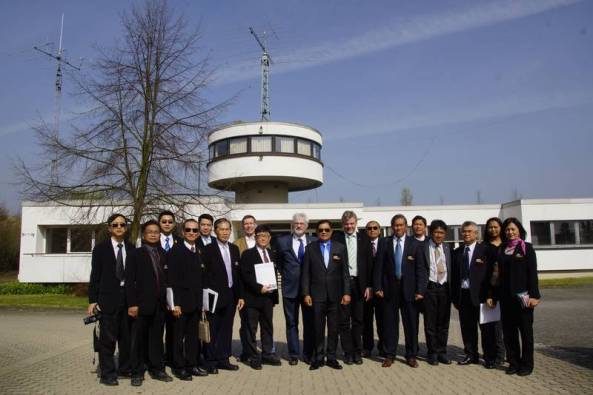
Thai Amateur Radio and Citizens Band Sub-Committee visit DARC

Thai Amateur Radio and Citizens Band Sub-Committee visit DARC

Thai radio amateurs are hoping to get a number of license improvements this year, including access to the Amateur Satellite Service band at 435-438 MHz as well as 146.0-146.5 MHz.

100 Watt Magazine Thida Denpruektham HS1ASC

100 Watt Magazine Thida Denpruektham HS1ASC

On Sunday, March 30, 2014 a delegation of the Thai National Broadcasting and Telecommunications Commission (NBTC) Amateur Radio and Citizen Band Development Sub-Committee (ARCB) visited the Deutscher Amateur Radio Club (DARC) amateur radio center in Baunatal.

Martin Köhler DL1DCT, Thilo Kootz DL9KCE, the DARC service team and Thomas Wrede DF2OO received the visitors and provided information on amateur radio topics in Germany and Europe, especially with regard to emergency radio activities and youth work.

The visit was organized by Thida Denpruektham HS1ASC. She is editor of the Thai “100 Watts Magazine” as well as a member of the ARCB.

The DARC expressed their thanks to Benji Klingler DJ5BK/HS6SSE. She acted as interpreter and ensured there were no problems communicating even in the more complex topics. At the end of the nearly three-hour visit, the guests visited the club station DF0AFZ.

In May 2012 Thailand had 246,959 radio amateurs holding the basic entry level VHF license and 717 Intermediate and Reciprocal HF license holders.
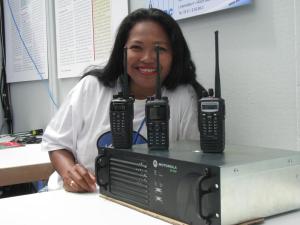
Benjamas Klingler DJ5BK / HS6SSE

Benjamas Klingler DJ5BK / HS6SSE

The reason for the low number of HF license holders seems to be because it’s impossible to sit an exam to upgrade. There appears to have only been one Intermediate exam for just 151 candidates held in almost 10 years, see
http://www.southgatearc.org/news/may2012/
thailand_holds_intermediate_exam.htm

It is hoped that the granting of 28.0 – 29.7 MHz to the basic entry license holders later this year should significantly increase HF activity from the country.

Thailand is also planning to introduce an Advanced license class equivalent to the USA Extra and UK Advanced.

100 Watts Magazine http://tinyurl.com/100WattsMagazine

100 Watts on Facebook https://www.facebook.com/100WattsMagazineOfficial

Radio Amateur Society of Thailand (RAST) http://www.qsl.net/rast/

DARC in Google English http://tinyurl.com/GermanyDARC