First QO-100 satellite contact from Indonesia

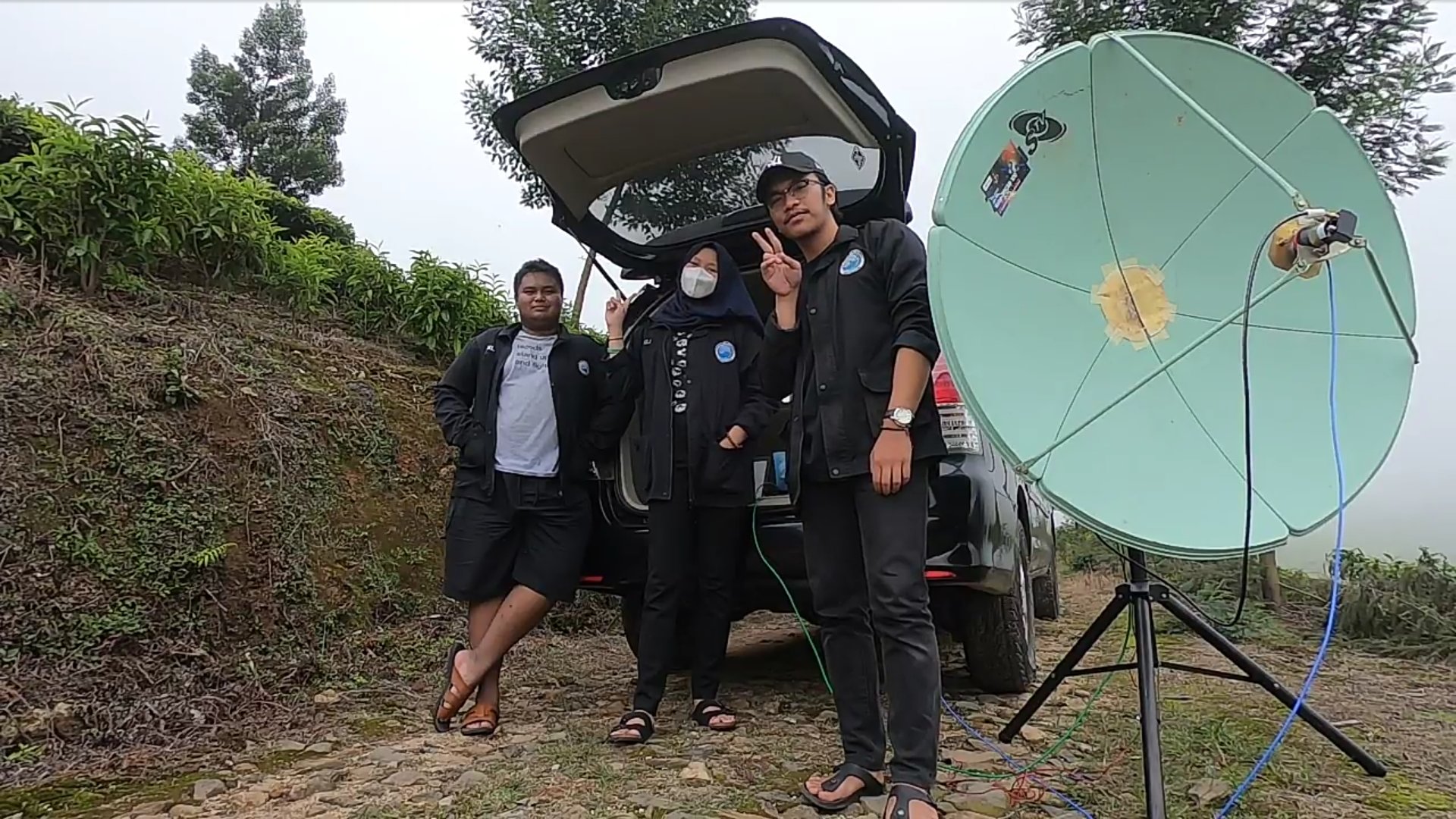
Team from the Telkom University Telecommunication Engineering Student Association

Team from the Telkom University Telecommunication Engineering Student Association

Indonesia’s national amateur radio society, ORARI, reports on the first contacts from Indonesia via the Qatar-Oscar-100 geostationary satellite transponder that took place on Thursday, January 27, 2021. Those involved were Farid Farhan YC1HVZ, Remco den Besten PA3FYM and Rene Stevens PE1CMO.

ORARI’s report says a team from the Telkom University Telecommunication Engineering Student Association (HMTT) led by Farid Farhan YC1HVZ, succeeded in conducting the first contact from Bukit Moko (Grid square OI33UD), Bandung, West Java with a satellite elevation of 0.8 degrees at an altitude of 1200m+.

Over several months Remco den Besten PA3FYM, and Rene Stevens PE1CMO had helped Farid Farham YC1HVZ get equipment operational for use on the QO-100 satellite which has an uplink in the 2.4 GHz band and a downlink in 10.45 GHz.

Farid’s location in Bandung is on the edge of the satellite’s footprint and he didn’t have a clear view to the horizon so Farid had to travel to a location in the hills of Java to get an unobstructed path to the satellite which had an elevation of just 0.8 degrees.

An attempt on Monday, January 24, was unfortunately unsuccessful and Farid YC1HVZ returned to the hill on Thursday, January 27, for a test with Remco PA3FYM and Rene PE1CMO. At about 07:40 GMT they heard the first signals from YC1HVZ but Farid couldn’t receive the QO-100 signal. It’s rainy season in Indonesia, which makes it much harder – the 10 GHz downlink has to get through the heavy rain showers which attenuate the signal.

After a few tests conditions improved and Farid heard his signal coming back from the satellite and by 07:50 GMT it was possible to make a two-way contact. Rene PE1CMO was the first to receive Farid and the first who Farid received but it was Remco PA3FYM who made the first complete contact exchanging signal report, call and locator, after which Rene has a QSO with Farid. Unfortunately the signal in Indonesia then dropped due to clouds and rain but later it came back and YC1HVZ made six more contacts. Farid hopes to try that location again or go to a location on the beach on the west coast of Java for a DXpedition.

Congratulations to Farid, Remco and Rene.

See a translation of the ORARI report at https://tinyurl.com/IndonesiaORARI

QO-100 information https://amsat-uk.org/satellites/geo/eshail-2/

ISS SSTV 145.800 FM Jan 28-29

ISS SSTV MAI-75 image 9/12 received by Chertsey Radio Club on Baofeng handheld

ISS SSTV MAI-75 image 9/12 received by Chertsey Radio Club on Baofeng handheld

Russian cosmonauts on the International Space Station (ISS) are planning to transmit Slow Scan TV images on 145.800 MHz FM using the SSTV mode PD-120.

The transmissions are part of the Moscow Aviation Institute SSTV experiment (MAI-75) and will be made from the amateur radio station RS0ISS in the Russian Service module of the ISS.

Jan 28 – Starts after 12:10 GMT and ends at 17:15 GMT*

Jan 29 – Start about 13:10 GMT and ends at 18:05 GMT*

*Dates and times subject to change.

ARISS SSTV Blog https://ariss-sstv.blogspot.com/

Useful SSTV info and links https://amsat-uk.org/beginners/iss-sstv/

CHESS CubeSat Constellation to carry FUNcube transponders

CHESS CubeSat - Credit EPFL Spacecraft Team

CHESS CubeSat – Credit EPFL Spacecraft Team

In 2020, a project between AMSAT-UK, AMSAT-NL and Swiss universities started with the aim of equipping two Swiss satellites with a linear transponder for amateur radio.

CHESS - Three Unit CubeSat

CHESS – Three Unit CubeSat

With a linear transponder, several QSOs can take place simultaneously. The satellites can be operated in CW/SSB with the simplest equipment. The satellites also include features for classroom demonstrations and experiments. In numerous teleconference discussions, the technical possibilities could be sounded out and the realisation prepared.

The CHESS [Constellation of High Energy Swiss Satellites] project includes two satellites, which will be built simultaneously and later launched as a constellation. Both will provide a linear transponder for amateur radio use. The first satellite will have a nearly circular orbit at an altitude of 400 km. The second will have an elliptical orbit with an altitude of 350×1000 km.

The satellites themselves are a project of the École polytechnique fédérale de Lausanne (EPFL) with support from the Lucerne University of Applied Sciences and Arts (HSLU – Institute of Electrical Engineering IET), the University of Bern, the Valais University of Applied Sciences and Arts (HES-SO), the Haute École Neuchâtel and the Swiss Federal Institute of Technology ETH Zurich. The amateur radio payload is a project of AMSAT-UK/-NL.

On 18 December 2020, the successful system requirements review took place. The project coordination between CHESS and AMSAT lies with the Amateur Radio Association of the Lucerne University of Applied Sciences and Arts – Technology & Architecture, Horw.

The Swiss AMSAT Operators provide information about the CHESS project at https://www.amsat-hb.org/funcube-chess/

EPFL Spacecraft Team https://www.epflspacecraftteam.com/chess-1

CHESS - Three Board Stack

CHESS – Three Board Stack

Video of Dual-band Eggbeater Antenna talk

EI6EG 144-435 MHz Dual-band Eggbeater AntennaThe South Dublin Radio Club have shared the talk Joe EI6EG gave them on the construction of a 2m – 70cm Dual Band “Eggbeater” Antenna.

Also read this article – Build Your Own Satellite Antenna – by John Hemming G0UYT which appeared in the April 2019 edition of Practical Wireless magazine https://www.radioenthusiast.co.uk/news/feature-build-your-own-satellite-antenna

Watch Building a 2m – 70cm Dual Band “Eggbeater” Antenna

Follow the South Dublin Radio Club at https://twitter.com/SDRadioClub

ISS Slow Scan TV event 145.800 MHz FM

ISS SSTV image received by Mike Rupprecht DK3WN April 12, 2016 at 1556 UT

ISS SSTV image received by Mike Rupprecht DK3WN April 12, 2016 at 1556 UT

An ARISS Slow Scan TV (SSTV) event is scheduled from the International Space Station (ISS) for December 24-31.

This will be a special SSTV event to celebrate the 20th anniversary of ARISS operations on the ISS.

The event is scheduled to begin on December 24 from 16:40 GMT and continue until December 31 ending at 18:15 GMT. Dates and times subject to change due to ISS operational adjustments.

Images will be transmitted on 145.800 MHz FM +/- 3 kHz Doppler shift and the expected SSTV mode of operation is PD 120.

If your radio has selectable FM filters then for best results try selecting the wider filter designed for 25 kHz channel spacing.

ARISS SSTV Blog http://ariss-sstv.blogspot.com/

Post and view images on the ARISS SSTV Gallery https://www.spaceflightsoftware.com/ARISS_SSTV/

ARISS SSTV Award: After your image is posted at the gallery, you can acquire a special award by linking to https://ariss.pzk.org.pl/sstv/ and follow directions for submitting a digital copy of your received image.

ISS SSTV info and links https://amsat-uk.org/beginners/iss-sstv

Amateur Radio on the International Space Station (ARISS) https://www.ariss.org/

AMSAT’s RadFxSat-2 / Fox-1E Launched

LauncherOne Drop Test July 2019 - Credit Virgin Orbit

LauncherOne Drop Test July 2019 – Credit Virgin Orbit

Virgin Orbit’s LauncherOne Launch Demo 2 mission carried AMSAT’s RadFxSat-2 / Fox-1E to orbit on Sunday, January 17, 2020.

On January 19 AMSAT issued this RadFxSat-2 / Fox-1E Status Update
https://www.amsat.org/radfxsat-2-fox-1e-status-update/

At 22:28 GMT, Jan 17, Virgin Orbit Tweeted:

Payloads successfully deployed into our target orbit! We are so, so proud to say that LauncherOne has now completed its first mission to space, carrying 9 CubeSat missions into Low Earth Orbit for our friends @NASA. #LaunchDemo2

RadFxSat-2, like RadFxSat / Fox-1B, now AMSAT-OSCAR 91, is a partnership opportunity between Vanderbilt University and AMSAT and will carry a similar radiation effects experiment, studying new FinFET technology.

RadFxSat-2 is the fifth and final Fox-1 satellite built by AMSAT. The RadFxSat-2 spacecraft bus is built on the Fox-1 series but features a linear transponder “upgrade” to replace the standard FM transponder in Fox-1A through D. In addition, the uplink and downlink bands are reversed from the previous Fox satellites in a Mode V/u (J) configuration using a 2 meter uplink and 70 cm downlink. The downlink features a 1200 bps BPSK telemetry channel to carry the Vanderbilt science data in addition to a 30 kHz wide transponder for amateur radio use. Telemetry and experiment data can be decoded using FoxTelem version 1.09 or later.

FoxTelem is available at https://www.amsat.org/foxtelem-software-for-windows-mac-linux/

Participation in telemetry collection by as many stations in as many parts of the world as possible is essential as AMSAT Engineering looks for successful startup and indications of the general health and function of the satellite as it begins to acclimate to space. AMSAT will send a commemorative 3D printed QSL card to the first station capturing telemetry from RadFxSat-2.

TLE’s of satellites on the launch are at https://www.amsat.org/tle/current/nasabare.txt

RadFxSat-2 / Fox-1E Frequencies:

Telemetry Downlink – 435.750 MHz 1200 bps BPSK
Inverting Linear Transponder Uplink – 145.860 MHz – 145.890 MHz
Inverting Linear Transponder Downlink – 435.760 MHz – 435.790 MHz

[ANS thanks AMSAT for the above information]

Source AMSAT News Service https://www.amsat.org/mailman/listinfo/ans