Good News for CubeBug-1

CubeBug-1

CubeBug-1

The amateur radio satellite CubeBug-1, also known as El Capitán Beto, launched April 26, 2013, is recovering from the power budget issue that caused the transmitter to be turned off for several days.

This was achieved after one of the AMSAT-LU stations in coordination and in conjunction with Satellogic team, send a command to reconfigure onboard software to turn off attitude control circuits feeding magnetorquers this last weekend .

Telemetry text mode command taken before change can be seen at
http://www.amsat.org.ar/images/cubebug130818.txt

CubeBug - command sent shown top and satellite response below

CubeBug – command sent shown top and satellite response below

Operation was with a RTL SDR dongle, connected directly to antenna, using HDSDR recording software as IF mode only, that helped not to record big amount of data from Orbitron connected to DDE, also automatically compensating Doppler.

After reset, Cubebug-1 went to ‘mission state’, batteries showing adequate level of charge.

Good reports were received from several amateurs from different parts of the globe.

This activity is performed as part of the agreement of mutual collaboration that Satellogic and AMSAT-LU signed on July 2013.

The satellite transmits 1200 bps AFSK, on 437.438 MHz, packets are sent every 30 seconds. The signal is at a low level and a directional antenna and preamp are needed for adequate reception.

Cubebug-1 telemetry information at http://1.cubebug.org/coms/telemetry

73, LU7AA, AMSAT-LU
email: info at amsat.org.ar/
http://www.cetra.org.ar/
http://www.amsat.org.ar/
http://facebook.com/AMSAT.LU

CubeBug-1 carries a packet radio digipeater which it is hoped will be activated for amateur radio use when the primary mission has been completed. Further information at https://amsat-uk.org/satellites/cubebug-1/

APRS destination address for ham radio satellites

APRS LogoAPRS has standardized an ID series for amateur radio OSCAR spacecraft – APOxxx

At the request of Juan Carlos, LU9DO, AMSAT-LU wanted a series of APRS designators for uniquely identifying AMSAT APRS applications.  He suggested those beginning with the letter O for OSCARS.

ALL APRS applications include this identifier in their packets so that the source of APRS data can be known.  See the list at

http://aprs.org/aprs11/tocalls.txt

Bob, WB4APR

APRS UK Yahoo Group http://groups.yahoo.com/group/APRSUK

IARU-R1 release new VHF Handbook

IARU_Region_1_logoIARU Region 1 have released edition 6.12 of the free VHF Managers Handbook.

The handbook has chapters on Band Planning, Contests, Propagation Research, Operating Procedures and Satellites. It even defines a standard for the use of circular polarization defining which way helical beam antennas should be threaded.

Download the handbook – VHF_Handbook_V6_12.

Successful Dnepr launch from Yasny – amateur radio satellite launch to follow

Dnepr_rocket_lift-off

A DNEPR Lift-Off

On Thursday, August 22, 2013 at 14:39 UT Korea’s satellite KOMPSAT-5 launched on a Dnepr from Dombarovsky near Yasny. This marked the first flight of the Dnepr launcher since August 2011.

This successful Dnepr launch should clear the way for the launch in November of another Dnepr from Yasny believed to be carrying up to 23 satellites from 13 nations.

Most of the satellites will carry amateur radio payloads and it should be the largest single deployment of amateur radio satellites since the ill-fated Dnepr launch of July 26, 2006. http://www.southgatearc.org/news/july2006/dnepr_failure.htm

The launch had originally been planned for September 2012 but was postponed while the future of the Dnepr launch program was discussed.

ZACUBE-1 ready to be shipped to the Netherlands and from there to Yasny

ZACUBE-1 ready to be shipped to the Netherlands and from there to Yasny

Among the satellites carrying payloads operating in amateur radio bands that may be on the November launch are:
UniSat-5 microsat which will deploy Eagle-1, Eagle-2, QB-Scout, Wren and PUCP-SAT-1 which it turn should release a further satellite Pocket-PUCP
Delfi-n3Xt
• Triton-1
• Triton-2
• GOMX-1
FUNcube-1
• UWE-3
CubeBug-2
• BRITE-PL1
• Humsat-D
CPUT ZAcube-1
• HinCube
• BeakerSat
NEE-02 KRYSAOR (980 MHz)

CubeSat to Mars

Late Spring on MarsIn order to prepare the Human Mission to Mars, some aspects of the mission have to be researched. During a transit to the Red Planet, future crews will be exposed to potentially hazardous radiations.

A CubeSat can provide a relatively cheap and easy way to improve the radiations environment knowledge for a Mars manned mission.

Such a CubeSat could be  launched and jettisoned as a piggyback of another satellite going to Mars,

This video shows the presentation that Boris Segret gave to the 16th Annual International Mars Society Convention, held at the University of Colorado, Boulder, August 15-18, 2013. In the presentation he describes a CubeSat mission to Mars.

Watch CubeSat – Boris Segret

CubeSat on an Earth-Mars Free-Return Trajectory to study radiation hazards in the future manned mission http://meetingorganizer.copernicus.org/EPSC2013/EPSC2013-1088.pdf

The Mars Society http://www.marssociety.org/conventions/2013

Ham Video transmitter onboard ISS Columbus module

International Space Station ISS with shuttle Endeavour 2011-05-23

How a DATV transmitter on S-band is being added to the ARISS equipment onboard the International Space Station has been related in an announcement recently circulated and available at

http://www.ariss-eu.org/HamVideo.pdf
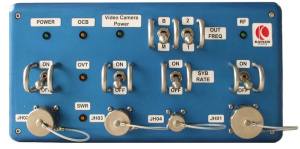
Front panel of the HamTV transmitter

Front panel of the HamTV transmitter

The ARISS Ham Video transmitter is presently onboard Columbus. The transmitter was delivered by Japanese cargo spacecraft HTV-4, which launched August 4 and docked 5 days later.

ESA astronaut Luca Parmitano KF5KDP / IR0ISS reported that the bags are stored in Columbus. There are two bags: one for the transmitter, the other for the power, camera and antenna cables.

Installation will be done by US astronaut Michael Hopkins KF5LJG who has been trained for the commissioning of the Ham Video equipment.The commissioning is planned later in the year, possibly end October when there are favourable passes over Italy. Indeed, the tests transmissions for the commissioning of the onboard equipment will be received by the ground station of the “Centro di Geodesia Spaziale” of the Italian Space Agency, located in Matera, Southern Italy.
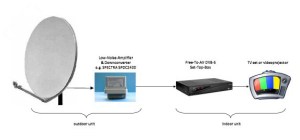
A basic amateur radio station that should be able to receive HamTV from ISS - Image AMSAT-Italia

A basic amateur radio station that should be able to receive HamTV from ISS – Image AMSAT-Italia

We will report in due time on the commissioning procedure which will involve a series of tests to be performed during 3 or 4 ISS passes.

Possibly, the Ham Video transmitter will transmit continuously between the commissioning steps offering amateur ground stations the opportunity to test and tune their receiving equipment. The transmissions will be performed in automatic mode, without requiring crew time. The camera, which runs on a battery, will not be used and the ground stations will receive a black image.

Meanwhile, commissioning is being prepared steadily. The kick-off meeting took place November 2012 at ESTEC, the European Space Research and Technology Centre, located in Noordwijk the Netherlands.  Detailed procedures are examined and finalized during weekly ESA/ARISS teleconferences. A preliminary EST (Experiment Sequence Test) is planned August 28-29. The test will involve the ARISS ground station IK1SLD, located in Casale Monferrato in Northern Italy.

One of the Columbus Module  2.4 / 1.2 GHz Antennas

One of the Columbus Module 2.4 / 1.2 GHz Antennas

IK1SLD, which is an ARISS telebridge station often used for educational ARISS school contacts on VHF, has been upgraded for S-band reception. Ham Video manufacturer Kayser Italia has delivered a 1.2 meter dish, a down converter and precision tracking motors, which are part of the ESA funded equipment. For the EST, the station will receive a DATV signal from a local low power S-band test transmitter. The decoded signal will be webstreamed to the BATC server. The British Amateur Television Club offers ARISS free access to their server. ESA examiners will connect to the BATC server and evaluate the reception. Test transmissions at IK1SLD will cover the different frequencies and symbol rates available on the Ham Video transmitter.

Web streaming will take advantage of the special software developed by Jean Pierre Courjaud, F6DZP. References are available in the HamVideo.pdf.

When the Ham Video transmitter will become operational, it will be used for ARISS educational school contacts. Video will be for downlink only. Uplink will be VHF FM audio. The Ericsson transceiver onboard Columbus will be used for reception onboard. This cross band and double mode operation is called Ham TV. Ham Video is the name of the DATV transmitter.

73,

Gaston Bertels – ON4WF
ARISS-Europe chairman
This Bulletin is available from the frontpage of http://www.ariss-eu.org/