CubeSat Presentation at Radio Club of Paris

AMSAT-Francophone LogoA  CubeSat presentation was given by AMSAT Francophone to a scientific conference held by the Radio Club of Paris F6KVP on May 29, 2013. A video of the presentation has been made available on the web.

AMSAT-Francophone site in Google English http://tinyurl.com/AMSAT-Francophone

Radio Club of Paris F6KVP in Google English http://tinyurl.com/RadioClubParis
F6KVP on Twitter https://twitter.com/F6KVP

Watch Les nanosatellites (Note this video is in French)

Video streaming by Ustream

ESA announce six CubeSats chosen for Phase 1

AAUSAT 4 CubeSat

AAUSAT 4 CubeSat

Six student teams and their supervisors have gathered at ESA’s ESTEC centre in The Netherlands for the kick-off of the new Fly Your Satellite! Programme under the ESA Education Office.

On June 26-28, ESA experts will introduce the objectives and present the activities to be performed during the first phase of the programme.

In January, ESA’s Education Office announced the ‘Fly Your Satellite!’ initiative. This is aimed at offering student teams the opportunity to become familiar with good engineering practice to build and perform satellite testing in order to increase the chances of a successful mission. The 2013 edition of the programme is however only focussing on testing selected university-built satellites that are already at an advanced stage of development.

Launch of Vega VV01

Launch of Vega VV01

‘Fly Your Satellite!’ builds on the success of the ‘CubeSats for the Vega Maiden Flight’ pilot programme. This culminated in 2012 with the launch of seven student-built CubeSats on the first flight of the new ESA Vega launcher.

The focus of the kick-off meeting will consist of coordinating the activity to be performed during the first phase of Fly Your Satellite! enabling the teams to complete the construction of their satellite. This will include extensive satellite testing in ambient conditions under the supervision of ESA specialists who will decide which satellites should participate in the next phase of the programme.

The second phase will see the satellites tested in the simulated conditions of outer space and in those the satellites will experience at launch. These will include vibration and thermal-vacuum tests.

ConSat-1 engineering model

ConSat-1 engineering model

The six CubeSats chosen for Phase 1 are:

Robusta-1B from France will validate a radiation test methodology for specific transistor components.

Oufti-1 from Belgium will demonstrate the D-STAR digital communication protocol and validate high-efficiency solar cells.

ConSat-1 from Canada will analyse radiation characteristics in the South-Atlantic Anomaly, and test technology payloads.

e-st@r-II from Italy will test an Active-Attitude Determination Control System.

AAUSAT4 from Denmark will test an improved version of student built AIS (Automated Identification System) receivers.

Politech.1 from Spain will carry a student built C-band communication system, a “GEODEYE” Earth Observation camera for academic purposes, and solar wind experiments.

Read the full ESA article at http://www.esa.int/Education/ESA_and_student_teams_kick-off_Fly_Your_Satellite

Fly Your Satellite! initiative http://www.esa.int/Education/Students_are_you_ready_to_fly_your_satellites_in_space

Two Lithuanian Amateur Radio CubeSats Plan 2013 Launch To ISS

Kibo Robot Arm CubeSat Deployment

Kibo Robot Arm CubeSat Deployment

It is hoped that two Lithuanian satellites will be among the CubeSats sent by Nanoracks LLC to the International Space Station (ISS) on the SpaceX CRS-3 mission in November, 2013. They will be deployed from the ISS by the JEM Small Satellite Orbital Deployer (J-SSOD) of the Japan Aerospace Exploration Agency (JAXA).

The Kaunas University of Technology is developing LituanicaSAT-1 while the Lithuanian Space Federation is working on LitSat-1.

Vytenis Buzas and Laurynas Mačiulis with LituanicaSAT-1

Vytenis Buzas and Laurynas Mačiulis with LituanicaSAT-1

2013 is the 80th anniversary of the historic flight by Lithuanian pilots Steponas Darius and Stasys Girėnas in the airplane Lituanica. On July 15, 1933, they took off from Floyd Bennett Field in New York and flew across the Atlantic Ocean, covering a distance of 6,411 kilometers without landing, in 37 hours and 11 minutes. Tragically they crashed by the village of Kuhdamm, near Soldin, Germany just 650 km from their destination of Kaunas in Lithuania.

LituanicaSAT-1 plans to carry a VGA camera, GPS receiver, 9k6 AX25 FSK telemetry beacon and a 150 mW V/U FM voice transponder. Links:
• Google English web http://tinyurl.com/KosmonautaiLituanicaSAT-1
• Google English Wiki http://tinyurl.com/WikiLituanicaSAT-1
• Facebook https://www.facebook.com/Lituanicasat1

LituanicaSAT-1

LituanicaSAT-1

LitSat-1 is understood to be planning a U/V linear transponder for SSB/CW communications. Links:
• Lithuanian Space Association in Google English  http://tinyurl.com/LithuanianSpaceAssociation
• Facebook https://www.facebook.com/palydovas
• Google English article http://tinyurl.com/LitSat-1-Article

The IARU coordinated frequencies for the two CubeSats are:

LitSat-1
• SSB Transponder Uplink 435.180 MHz Downlink 145.950 MHz
• AX25 Uplink 437.550 MHz Downlink 145.850 MHz

LituanicaSat-1
• FM Transponder Uplink 145.950 MHz Downlink 435.180 MHz
• AX25 Uplink 145.850 MHz AX25 Downlink 437.550 MHz
• CW Beacon 437.275 MHz

Google English article on the two Lithuanian CubeSats http://tinyurl.com/LithuanianCubeSats

1933 Lituanica flight http://en.wikipedia.org/wiki/Lithuanica

Joint Submission to Ofcom 2.4 GHz Consultation

AMSAT-UK_Bevelled_LogoAMSAT-UK, the UK Microwave Group (UKuG), the British Amateur Television Club (BATC) and the Radio Society of Great Britain (RSGB) have responded to the Ofcom 2400 MHz consultation.

The 2400-24500 MHz band is allocated to the Amateur and Amateur-Satellite Services. Ofcom’s consultation ‘Licence Exempt spectrum use in the 2400 MHz band’ calls for input to understanding spectrum use by licence exempt (LE) devices in the 2400 MHz band.

This band is close to radio spectrum in the 2300 MHz band which the Ministry of Defence (MoD) plans to release for new civil uses. These plans are part of a Government commitment to release 500 MHz of spectrum for new civil uses by 2020. This aims to address the increasing demand for spectrum fueled by devices such as smartphones and tablets.

The joint response highlights that careful consideration is required to avoid a significant loss of capacity for both amateurs and the general public.

As well as the Amateur Services the band supports a host of valuable consumer applications such as Wi-Fi, Bluetooth and ZigBee.

Read the joint response at http://rsgb.org/main/files/2013/06/RSGB_2400LE-reply.pdf

Ofcom consultation page http://stakeholders.ofcom.org.uk/consultations/2400-mhz/

AMSAT-LU Ham Radio High-Altitude Balloon to fly FM Repeater and SSTV

AMSAT-LU RF Module

The system board containing RF transmitter module, receiver module, level adjustments, duplexer and antenna connector. Image credit LU7AA

AMSAT Argentina is pleased to announce that on Saturday, June 29, 2013 from 1400 GMT, weather permitting, it is planned to launch an amateur radio high altitude balloon FM repeater ‘Betty II’ from Victorica, La Pampa, 665 km. west of Buenos Aires, it is expected to travel east.

The 435.950/145.950 MHz FM repeater will be activated by a 123 Hz CTCSS subtone. The balloon can also transmit Slow Scan Television (SSTV) ROBOT-36 images from the onboard camera on 145.950 MHz. There is an APRS transmitter on 144.930 MHz.

It should be possible to access the balloon using a 2 watt FM handheld rig from 750 km away giving a theoretical maximum distance for two-way contacts of 1500 km.
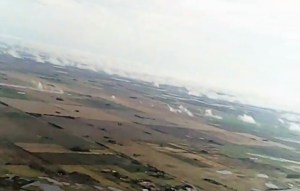
AMSAT-LU May 2012Details and photos of the announcement and prior experiences in http://www.amsat.org.ar/globo29.htm

Approval of ANAC (Argentina FAA)) had been granted by NOTAM (notice to air crew) http://amsat.org.ar/images/faxanac.jpg .

For these experiments members of AMSAT-LU, LUSEX, project development group http://lusex.org.ar , are working together with Pampeano and QRM Belgrano Radio Clubs, APRS Group, etc.

Electronics is comprised of a voice UHF to VHF FM repeater with CW TLM, APRS, DTMF and SSTV. According to estimates balloon could reach 30,000 meters high, traveling for 3 hours, 150 km east of the launch site.

This would allow contacts between stations located in the provinces of Buenos Aires, Santa Fe, Entre Rios, Cordoba, Catamarca, Santiago del Estero, La Pampa, San Luis, Mendoza, San Juan, Rio Negro, Neuquen, Uruguay and Chile. (It is launched from the center of the country to facilitate greater participation). Coverage at http://www.amsat.org.ar/picocubr.jpg

To receive the payload, if less than 750 km from launch site, only need is a handy or base FM receiver on 145.950 MHz for voice/sstv and 144.930 for APRS.

The repeater which is enabled via 123 Hz CTCSS subtone, receives 435.950 MHz FM voice (-112dBm, 0.56 uV) emitting 2W output simultaneously on 145.950 MHz.

AMSAT-LU picocubrPayload will also carry an emergency long duration APRS transmitter sourced by solar cells and supercapacitors as batteries.

To enable better utilization, it is suggested short QSOs (license, own locality, grid locator, received signal and short comments).

Simultaneous emits APRS 1200 baud at 144.930, and also in 145.950. The DTI symbol on APRS will change from a balloon ( /O ) during ascent to a slider ( /g ) during the parachute descent.

Will operate for 90 seconds voice, then a beep alerting the end of that time will make way for the issuance of APRS at different frequencies. Every five minutes CW TLM via telegraphy audio tones sends callsign LU7AA and height in meters, then repeat the cycle.

On 145.950 MHz SSTV images ROBOT-36 mode (36 seconds) will be emitted on demand showing what the balloon sees (Can be received, with either MIXW or RX-SSTV (recommended)).

Balloon will carry two GoPro TV cameras (one to ground and another to the horizon) that will record images and sound during flight and can be retrieved with the payload.

It will be live in APRS on http://aprs.fi/?call=lu7aa-11 every minute, including speed, height, internal and external temperatures and battery voltage.

Local georeferenced maps are available for UI-View in http://www.amsat.org.ar/pico2.jpg , http://www.amsat.org.ar/pico2.txt to be renamed to pico2.inf .

The experiment on 435.950 MHz voice also receives and accepts DTMF user issued commands i.e. B * (DTMF keypad UHF handy) will return S5 … ….. on VHF CW 145.950, your signal strength received at balloon, if P10 that states S9 +10.

There are more commands that enable issuance of TLM in CW or APRS beacon and remote commands to drop payload, mode changes, control of timers, energy, power, enable SSTV, etc..

Additionally a VAISALA RS92SGP radiosonde emitting FM wide on 402.740/403 MHz has been added, which provides GPS location, pressure, winds, height, course, dwt point, temperatures, etc. Same data as daily collected by the National Meteorological Service.

Data can be received using an SDR dongle and sondemonitor program available as test for 21 days from internet.

On launch day/time AMSAT-LU will have one of his members on the Ezeiza Airport Traffic Control, acting as a contact between ANAC and AMSAT-LU, using VOR locations application, adapted from EOSS and available on http://amsat.org.ar/vor.asp .

Local frequencies coordination and announcements before and during flights will be 7095 kHz LSB + / -10 kHz and VHF frequencies of local repeaters in the area.

During flight 430.930 AMSAT-LU APRS will operate wide coverage Igate LU7AA-10, installed at the Investigation Center, besides a portable Igate close to launch site. Any area stations that can receive and provide bridge to the APRS network are welcome.

Being an experiment aimed at a next satellite, contacts made between stations thru this UV repeater will be considered valid and awarded upon request by AMSAT-LU Permanent Satellite Certificate, free and also applicable for license upgrades, see http://www.amsat.org.ar/certsat.html, http://www.lu4ao.org.ar, http://www.amsat.org.ar/lu4aao.

Top 10 participants with the highest two-way contacts/distances sum thru repeater will be awarded with a special certificate. Send email with data filled on form http://www.amsat.org.ar/lu4aao/Globo_29jun2013.xls QSOs with stations via the balloon including QRA Locators, QTR to RC QRM Belgrano before July 23.

All reports welcome. If you want or can organize or be part of launch teams, control, monitoring and recovery, operating as an independent station and capturing data, and / or want to join us in this adventure from the launch site can do it through an email to parapente arroba amsat.org.ar.

We appreciate having read this information and forward if possible.

73, LU7AA, AMSAT-LU. aiming to the future by making present fun.
Email: info at amsat.org.ar

AMSAT Argentina http://www.amsat.org.ar/
Facebook http://facebook.com/AMSAT.LU

Book Now for AMSAT-UK International Space Colloquium

Holiday Inn Guildford GU2 7XZ

Holiday Inn Guildford GU2 7XZ

The 2013 AMSAT-UK International Space Colloquium is open to all and takes place from late Friday afternoon on July 19 until Sunday afternoon on July 21 at the Holiday Inn, Guildford, GU2 7XZ, UK.

It will be preceded by an exciting “Hands-on” CubeSat Workshop. This free workshop will take place at the nearby University of Surrey on the Friday and this will be followed, at the hotel, by the usual Colloquium “Beginners Session” in the late afternoon.

A number of keynote presentations have already been arranged for the Colloquium. These include Alistair Scott, the President of the British Interplanetary Society. The BIS has, over many decades, developed ideas and concepts about the future of space travel and both Patrick Moore and Arthur C Clarke were members. Alistair has had many years experience working in the space industry and will be reviewing the future possibilities for ventures into space both small and large. The BIS is presently developing one of the Sprites for the Kicksat mission and Andrew Vaudin will be presenting a paper about this and also providing a demonstration.

STRaND-1 Engineering Model and Cleanroom SSC

STRaND-1 Engineering Model and Cleanroom SSC

It is anticipated that both the FUNcube-1 and FUNcube-2 missions will be launched later this year and the FUNcube team will be on hand to talk about the missions and the planned educational outreach. A full demonstration of the Engineering Model, which has been performing flawlessly for almost a year, will also be provided.

On the Sunday, the General Manager of the RSGB, Graham Coomber, G0NBI will be talking about the Society’s vision of the future of amateur radio and how amateur satellites can play a major part in helping to secure that future.

We will also have updates on a number of the other current amateur satellite projects including HAMtv from the ISS, spectrum matters, operating methods, new products etc.

FUNcube-1 flight model - Image credit Wouter Weggelaar PA3WEG

FUNcube-1 flight model – Image credit Wouter Weggelaar PA3WEG

There are still a few slots available for additional speakers, so if you would like to make a presentation, please contact Dave Johnson G4DPZ e-mail: dave at g4dpz dot me dot uk as soon as possible.

The AMSAT-UK organising committee looks forward to welcoming both regular attendees and newcomers – you can be assured of a warm welcome and an exciting weekend.

The event is open to all, full details of the accommodation, travel and booking arrangements are at
https://amsat-uk.org/colloquium/colloquium-2013/

Details of the free “Hands On” CubeSat Workshop are at
https://amsat-uk.org/colloquium/cubesat-workshop-2013/