STRaND-1 Ground Station Testing Video

STRaND-1 Ground Station Antennas

STRaND-1 Ground Station Antennas

The UK smartphone amateur radio satellite STRaND-1 should launch Feb. 25 at 1225 UT.

At the heart of STRaND-1 is a Google Nexus One smartphone with an Android operating system. Smartphones contain highly advanced technologies and incorporate several key features that are integral to a satellite – such as cameras, radio links, accelerometers and high performance computer processors – almost everything a spacecraft needs except the solar panels and propulsion.

Being the first smartphone satellite in orbit is just one of many ‘firsts’ that STRaND-1 is hoping to achieve. It will also fly innovative new technologies such as a ‘WARP DRiVE’ (Water Alcohol Resistojet Propulsion Deorbit Re-entry Velocity Experiment) and electric Pulsed Plasma Thrusters (PPTs); both ‘firsts’ to fly on a nanosatellite. It is also flying a 3D printed part – believed to be the first to fly in space!

A video of ground station testing has just been released.

Continue reading

Glasgow based CubeSat start-up in The Herald newspaper

Alba Orbital -The Herald February 22 2013Tom Walkinshaw’s Glasgow based start-up Alba Orbital was featured in the Friday, February 22 edition of The Herald. It was even mentioned on the newspapers front page.

Tiny satellites known as CubeSats have traditionally been used for amateur radio communications and other educational purposes. Alba Orbital proposes to use CubeSats to send people’s ashes into space.

Read the story at
http://www.heraldscotland.com/news/home-news/rest-in-space-funeral-plan-is-out-of-this-world.20280879

Alba Orbital http://www.albaorbital.com/

Twitter http://twitter.com/albaorbital

Alba Orbital make Shell top 10 http://www.amsat-uk.org/?p=12172

Alternative use for CubeSats http://www.amsat-uk.org/?p=11637

Watch Live Video of UK STRaND-1 Smartphone Satellite Launch

The STRaND-1 build and test phase took just 3 months

The STRaND-1 build and test phase took just 3 months

The UK smartphone satellite STRaND-1 is expected to launch from India on Monday, Feb. 25 at 12:25 GMT. You can follow the launch on Twitter or watch live video.

STRaND-1 and other CubeSats carrying amateur radio payloads are planned to launch on the ISRO PSLV-C20 rocket into a 785 km orbit.

STRaND-1 carries an amateur radio 9600 bps AX.25 packet radio downlink on 437.568 MHz. It is hoping to be the first ever satellite to carry a smartphone into space and is also believed be the first satellite to use a part produced with a 3D Printer.

On Twitter the Surrey Space Centre @SpaceAtSurrey tweeted:

Official launch hashtag of STRaND-1 spacecraft is #S1Launch. Post launch we will be using #STRaND1 hashtag. Launch time:12.25 GMT 25th Feb 2013 #UniOfSurrey #SSTL

Launch Authorisation Board (LAB) for PSLV – C20 @STRaND mission has cleared the launch on Monday, Feb 25, 2013. @university of surrey #S1Launch

Live video launch feeds for Monday’s PSLV launch http://www.webcast.gov.in/live/ and http://ibnlive.in.com/livetv/

Launch times can and do change at the last minute so follow Twitter for the latest information.

Follow Surrey Nanosats https://twitter.com/SurreyNanosats

Read more about STRaND-1 at http://www.amsat-uk.org/?page_id=12196

STRaND-1 telemetry format http://www.amsat-uk.org/?page_id=12875

STRaND-1 videos http://www.amsat-uk.org/?page_id=12472

Other satellites on the same launch http://www.amsat-uk.org/?p=12180

STRaND-1 on Facebook https://www.facebook.com/nanosats

Provisional initial track of STRaND-1

Provisional initial track of STRaND-1

STRaND-1 smartphone CubeSat mounted on PSLV rocket

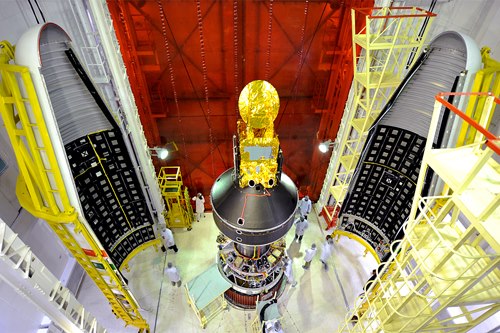
Panoramic view of SARAL and smaller satellites including STRaND-1 attached to the PSLV C20 - Image credit ISRO

Panoramic view of SARAL and smaller satellites including STRaND-1 attached to the PSLV C20 – Image credit ISRO

The STRaND-1 build and test phase took just 3 months

The STRaND-1 build and test phase took just 3 months

The launch rehearsal of PSLV-C20 with the primary satellite SARAL and six other satellites has been completed satisfactorily at SDSC SHAR, Sriharikota. Mission Readiness Review and meeting of Launch Authorisation Board are scheduled on Feb 22, 2013.

STRaND-1 is a joint mission between Surrey Space Centre at University of Surrey and Surrey Satellite Technology Ltd (SSTL). There will be an amateur radio AX.25 packet radio 9k6 bps downlink on 437.568 MHz and the launch is expected to take place on Feb 25.

STRaND-1 information and videos http://www.amsat-uk.org/?page_id=12196

STRaND-1 telemetry format http://www.amsat-uk.org/?page_id=12875

Other satellites on the same launch http://www.amsat-uk.org/?p=12180

ISRO PSLV-C20 status http://www.isro.org/pslv-c20/c20-status.aspx

Article on LED Optical Morse Code Spacecraft ShindaiSat

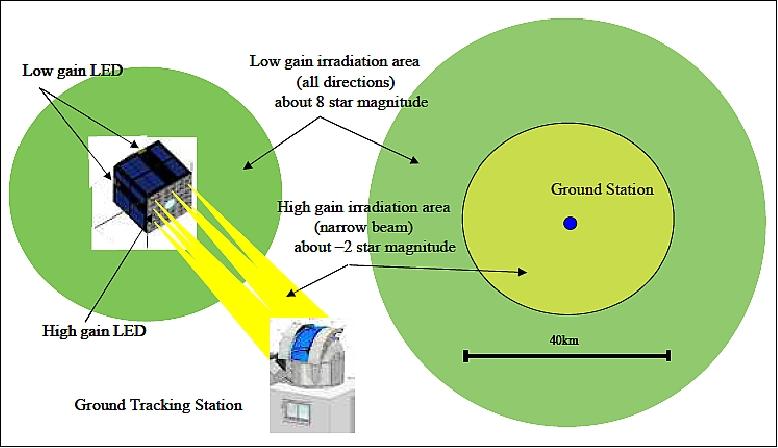
Illustration of high-gain and low-gain LED illumination scenario at the ground station - Image credit Shinshu University

Illustration of high-gain and low-gain LED illumination scenario at the ground station – Image credit Shinshu University

An English language article about ShindaiSat is available at

https://directory.eoportal.org/web/eoportal/satellite-missions/s/shindaisat

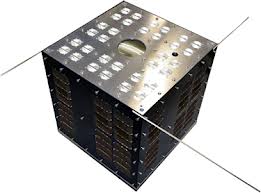
ShindaiSatShindaiSat is a 20 kg spacecraft approx 300 by 300 by 350 mm which is planning to use bright LEDs for Space to Earth optical communication using Morse code. It also carries an optical lens system for receiving modulated LED light from the ground station.

There will be an AX.25 packet radio telemetry beacon and a low power CW beacon. Downlink frequencies of 437.305 and 437.485 MHz have been coordinated by the IARU Amateur Satellite Frequency Coordination Panel.

The article says “A launch of ShindaiSat as a secondary payload is manifested for mid-2014 on the primary GPM (Global Precipitation Measurement) mission of NASA and JAXA. JAXA is providing the launch on the H2A vehicle from the Tanegashima Space Center, Japan.

Orbit: Non-sun-synchronous circular orbit, altitude = 407 km, inclination = 65º.”

ShindaiSat website in Google English

ARISS contact planned February 19, 2013 with school in Greece

The International Space Station

ARISS contact planned February 19, 2013 with school in Greece

An International Space Station school contact has been planned February 19 2013 with participants at 4th Dimotiko Scholeio Chaidariou, Chaidari (near Athens), Greece.             The event is scheduled to begin at approximately 14:06 UTC, which is 16:07 CEWT.

The contact will be a direct operated by J41ISS. Interested parties in Europe are invited to listen to dowlink signals on 145.800 MHz FM. The contact will be conducted in English.

The event will be webcast on several webstreaming servers: http://www.sv1eag.gr/ http://www.justin.tv/sv1eag#r=-rid-&s=em http://www.youtube.com/watch?v=6RFJbw5NeAc

School presentation:

Our school is located in Chaidari, a suburb in the north-west of Athens.             It was constructed in 1978, but it is now being renovated so as to be more energy efficient. It is a two-storey building with 16 classrooms, a Head office and a staff room. Continue reading