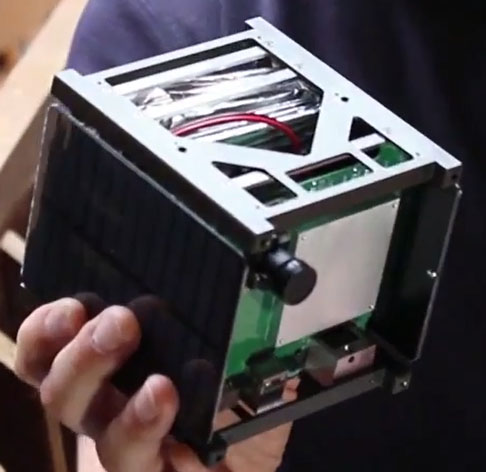
Introduction to satellite tracking and listening

Orbitron Screenshot

This video covers the basics of satellite tracking using the free Orbitron software.

Watch Introduction to satellite tracking and listening part 1 of 2

Watch Introduction to satellite tracking and listening part 2 of 2

Watch Satellite tracking example using HO-68 and Orbitron

Orbitron satellite tracking software http://www.stoff.pl/

South African CubeSat DynaCube

Image of a CubeSat in Space

DynaCube is a 1U CubeSat intended to take pictures of the earth that also carries temperature sensors and radiation detectors.

It plans to have a VHF CW beacon and a separate VHF 1200 bps GMSK telemetry downlink.

It is intended to launch from Baikonur into a Sun Synchronous Orbit (SSO).

Facebook https://www.facebook.com/permalink.php?id=162777567175347&story_fbid=216853691767734

Denel Dynamics http://www.deneldynamics.co.za/

IARU Satellite Frequency Coordination Panel status http://www.amsat.org.uk/iaru/


Aeneas CubeSat to Deploy 2.4 GHz Dish Antenna

Built by students at the University of Southern California (USC) Aeneas is a 3U CubeSat planned to launch August 2, 2012 from the Vandenburg Air Force Base on an Atlas-5 rocket into a 880 x 450 km 60.4 degree inclination orbit.

It aims to prove the concept of WiFi based tag tracking from Low Earth Orbit using the first ever 0.5 meter dish deployed from a CubeSat.

Small 1 watt asset tags will be on the ground and a similar transceiver is in feed piece of the deployed dish in the CubeSat. The satellite will surface track the position of the tag.

It plans to use a 436.00 MHz AX25 1200 bps beacon every 10 secs and a spread spectrum two-way link elsewhere in the 70cm band.

The WIFI transmitter will transmit on 2425.0 MHz with 1 watt of output power.

CP5, Cinema, CXBN, CSSWE, Horus, Re, ORSES and Aerocube-3 are expected to be deployed from the same launch.

More information at http://www.isi.edu/projects/serc/aeneas

Watch USC Aeneas Baseline Mission

Live TV broadcast for launch of HTV-3 CubeSats

FSpace, the team of young engineers and students at the FPT University who developed the amateur radio F-1 CubeSat, report on the final launch preparations for the HTV-3 cargo vessel that will carry five CubeSats to the International Space Station (ISS).

FSpace say final inspection was performed on July 9, and from July 13-15, a rehearsal was conducted simulating the launch operation. Late access cargo loading will continue until July 19 then the hatch will be closed and the H-IIB launch vehicle with the HTV-3 will be moved to the launch pad. The launch is planned for July 21 at 02:18 UT.

FSpace report that live TV coverage will be available at these URL’s:

– NASA TV HD (HD resolution, for high speed connections) http://www.ustream.tv/nasahdtv

– NASA TV (standard resolution, for lower speed connections) http://www.nasa.gov/multimedia/nasatv/index.html

– Live webcam from Tanegashima launch pad (automatically updated once every few minutes)  http://space.jaxa.jp/tnsc/webcam/index_e.shtml

Read the full FSpace report at http://fspace.edu.vn/?p=716&lang=en

It is planned that the CubeSats will be deployed from the space station in September by Japanese astronaut Akihiko Hoshide KE5DNI using the ISS Kibo robot arm. The five CubeSats are:

+ F-1
http://fspace.edu.vn/?page_id=10
On-board camera for earth observation mission
Yaesu VX-3R 1, 437.485 MHz FM downlink:
o Solar cell power only, operates in sunlight only
o Output power: between 0.1W and 0.3W depending on illumination, half-wave dipole antenna
o Morse code beacon (10 chars) using FM CW every 30 seconds, listen here

Yaesu VX-3R 2, 145.980 MHz FM downlink:
o Rechargeable battery, operates in dark and sunlight
o Output power: max 1.0W, half-wave dipole antenna
o AFSK 1200bps, half duplex, one AX.25 packet every 60 seconds

+ We Wish
http://www.meisei.co.jp/news/2011/0617_622.html
Infrared camera for environmental studies
Downlink on 437.505 MHz

+ FITSat 1
http://www.fit.ac.jp/~tanaka/fitsat.shtml
High-speed data test, high power LED visual tracking
CW Beacon 437.250 MHz,
FM Data   437.445 MHz,
High speed data 5840.00 MHz.

+ TechEdSat
http://ncasst.org/techedsat.html
http://www.uk.amsat.org/5018
Downlink on 437.465 MHz

+ Raiko – the only non-amateur radio CubeSat
http://tinyurl.com/RAIKO-CubeSat (Google English)
2U CubeSat, photography, Ku-band beacon

A video depicting the planned deployment of the F-1 CubeSat, callsign XV1VN, from the ISS can be seen at http://www.uk.amsat.org/?p=8446

F-1 CubeSat Blog on Facebook https://www.facebook.com/groups/116436068290/
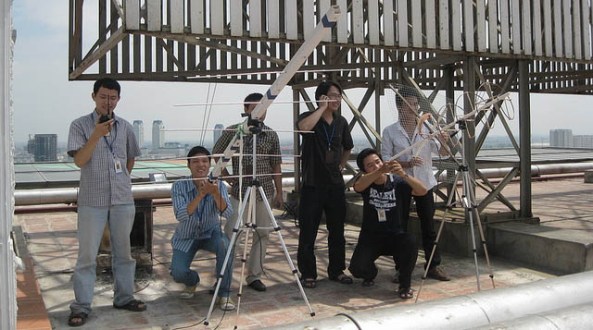
FSpace Team with home made antennas for NOAA weather satellite reception

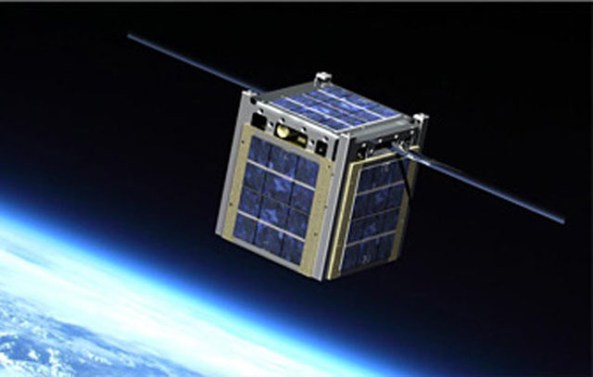
PIE1 – Raspberry Pi Sends Live Images from Near Space

A Raspberry Pi

Dave Akerman M6RPI has used a Raspberry Pi computer board as the flight computer on a High Altitude Balloon (HAB) and sent back live images from near space at an altitude of almost 40 km.

SSDV picture from a previous PIE balloon - Image credit Dave Akerman M6RPI

SSDV picture from a previous PIE balloon – Image credit Dave Akerman M6RPI

The balloon, appropriately called PIE1, was launched from Brightwalton, in Berkshire on July 14, 2012. The images were transmitted on 434.650 MHz (300 bps, 600 Hz shift) in the amateur radio 70cm band using the Slow Scan Digital Video (SSDV) standard.

PIE1 reached an altitude of 39,994 metres and images were received as far away as Northern Ireland (that’s over 500 km, not bad for just 10 mW on 434.650 MHz!).

See the images sent by PIE1 http://sanslogic.co.uk/ssdv/live

The full story and pictures are on Dave Akerman’s website http://www.daveakerman.com/?p=592

Read The Register article http://www.theregister.co.uk/2012/07/17/pi_ascent/

Slow Scan Digital Video (SSDV) http://ukhas.org.uk/guides:ssdv

UK High Altitude Society http://www.ukhas.org.uk/

High Altitude Balloons have featured at a recent AMSAT-UK International Space Colloquium in Guildford.

You can watch a video online of the presentation that Cambridge University Spaceflight gave called “Teddy Bears in Space” at http://www.batc.tv/channel.php?ch=1
In the Archive List category box select AMSAT then click Select Category then in the stream box select Teddys and click on Select Stream

Or download a copy of the video at http://www.batc.tv/vod/Teddys.flv

This years AMSAT-UK International Space Colloquium takes place Sept. 15-16 details at
http://www.uk.amsat.org/colloquium/twelve

SkyCube uses Kickstarter for Funding

Tim DeBenedictis and Anna Vital with the SkyCube satellite

Tim DeBenedictis and Anna Vital with the SkyCube satellite

PC World magazine reports that a fundraising campaign for the satellite, SkyCube, launched on Kickstarter last weekend (July 14) with the goal of raising US$82,500. Kickstarter is an online service popular with entrepreneurs and startups for raising money.

SkyCube-SatelliteThe article says the SkyCube team is led by Tim DeBenedictis, a self-described “space nut” and the man behind the popular Sky Safari smartphone app that provides a guide to the stars.

It will take pictures of Earth with three VGA cameras and deliver 120-character messages to smartphones running a SkyCube app. The messages will be collected on Earth and transmitted to the satellite about once a day, where they will be stored in memory and broadcast every 10 seconds. In addition to the app, anyone with a fairly modest amateur radio-type receiver might also be able to pick up the broadcasts directly.

The PC World article incorrectly says that Chris Phoenix is the projects radio expert, he isn’t, Chris is doing the firmware not RF.

SkyCube will be the first 1U CubeSat to carry an inflatable balloon. When the 3-meter reflective balloon is deployed 90 days after launch it should be visible to observers on the ground. A few weeks after deploying the balloon SkyCube will burn up in the Earth’s atmosphere.

It is understood they are planning to use 915 MHz and hope to launch on a SpaceX Falcon 9 rocket in the first half of 2013. http://www.southernstars.com/skycube/

Watch SkyCube Interview

Read the PC World story ‘Space Nut’ Looks Skyward With Web-funded Satellite
http://www.pcworld.com/businesscenter/article/259375/space_nut_looks_skyward_with_webfunded_satellite.html 

SkyCube Proposes “Tweets from Space” http://www.uk.amsat.org/8435

Southern Stars SkyCube http://www.southernstars.com/skycube/

Kickstarter SkyCube http://www.skycube.org/

Radio ham Zac Manchester KD2BHC used Kickstarter to raise $74,586 in donations to fund the development and deployment of over a hundred amateur radio KickSat sprite satellites.

The amateur radio satellite project ArduSat managed to raise donations of $106,330 in just 30 days.

Kickstarter is not just about raising large sums of money, for example Sandy Antunes used Kickstarter to raise $2,780 to buy a ham radio transceiver and antennas to create an amateur radio satellite ground station Calliope

Kickstarter to launch in UK http://www.bbc.co.uk/news/technology-18780184