Ecuador, heading into space

CubeSat NEE-01 Pegasus

A Chinese rocket due to launch in the 2nd quarter of 2013 will carry CubeSat NEE-01 Pegasus from Ecuador.

Ronnie Nader with Elisse Nader and CubeSat

The NEE-01 Pegasus engineering team was led by Cmdr. Ronnie Nader, Ecuador’s first astronaut. The tiny 1U CubeSat (10cm cube) has a large fold-out solar array, a world first, and carries a 902 MHz band 720p HD TV transmitter, another world first for a CubeSat. Also operating in the same band will be a beacon that will send a Morse Code ID, a SSTV image and Ecuador’s national anthem.

The raw aluminum structure of the CubeSat was donated by Professor Bob Twiggs KE6QMD. After launch the 10 by 10 by 10 cm NEE-01 Pegasus will deploy its 75 cm fold-out solar panels, the largest to be flown on a CubeSat.

As part of the educational outreach objectives of the satellite video of the Earth taken by the HD camera will be made available to school students in Ecuador.

The satellite will send two signals that will be received and decoded by the EXA’s HERMES-A ground station in Guayaquil and then uploaded live to the Internet using Facebook and Twitter; the first signal will contain text book questions and the second will contain an image related to the question. If the students are able to answer the question correctly they will be granted access to the video camera on board the spacecraft and will be able to see earth from space as the astronauts see it in their space missions. More advanced students will have access to the pure radio signal so they can try decoding it by themselves.

The satellite featured in the July 15 edition of the El Murcurio newspaper.

Read the El Murcurio newspaper article in Google English http://tinyurl.com/Ecuador-in-Space

NEE-01 Pegasus on Facebook https://www.facebook.com/NEE01PEGASO/

IAC2011 Paper http://exa.academia.edu/RonnieNader/Papers/795135/NEE-01_PEGASUS_The_first_Ecuadorian_Satellite

NEE-01 Pegasus will monitor near-earth objects http://www.uk.amsat.org/6932

Italian Microsat to Deploy Six Amateur Radio Satellites http://www.uk.amsat.org/?p=7717
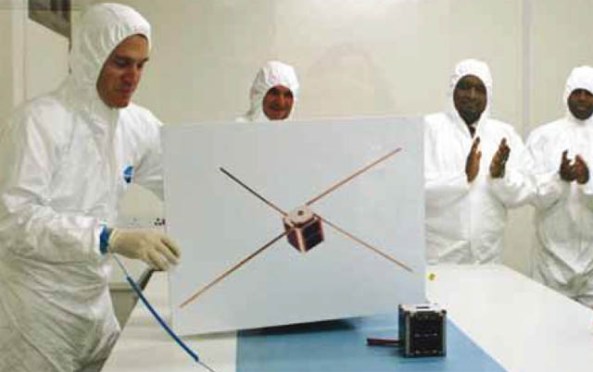
The First African CubeSat ZACUBE-1

Dr Sandile Malinga, CEO of the South African Space Agency
unveils South Africa’s CubeSat Program – Image credit CPUT

Since the defenceWeb article was written it is believed ZACUBE-1 and ZACUBE-2 have changed designation and the references to the 3U Cubesat ZACUBE-1 should instead read ZACUBE-2.

Students at the Cape Peninsula University of Technology (CPUT) have been building an amateur radio 3U CubeSat ZACUBE-1 that will carry out propagation research using a beacon on 14.099 MHz.

The objectives of the mission are:

1) Training of post-graduate students in Satellite Systems Engineering.

2) Earth observation using a visible band matrix imager payload and an S-Band payload data transmitter (2.4 to 2.45 GHz).

3) UHF Store & Forward system (70 cm amateur band).

4) Experimental 115200 bps L-Band to S-band data transponder.

5) HF beacon payload for characterization of Hermanus Magnetic Observatory’s Dual Auroral Radar Network antenna at SANAE base in Antarctica (14 MHz).

ZACUBE-1 will conform to the 3U CubeSat standard with a maximum separated mass of 4 kg. The spacecraft will be 3-axis stabilized using a novel Attitude Determination and Control System (ADCS) developed by the University of Stellenbosch. The spacecraft’s Telemetry, Tracking, and Command (TT&C) system will operate in the 70 cm band and will be commanded from the amateur ground station at CPUT.

The website defenceWeb quotes a launch date of 2013.

The IARU Satellite Frequency Coordination Panel have agreed these frequencies:
Uplinks on 437.525 MHz and 1260.25 MHz and downlinks on 437.345 MHz and 2405.00 MHz.

Renier Siebrits ZS1MIR gave this presentation about the project on August 7, 2011.

Watch ZACUBE-1

CPUT students are currently involved in the development of a second amateur radio CubeSat, ZACUBE-2, which will be 10x10x10 cm with a mass of one kilogram.

CPUT unveils South Africa’s first CubeSat http://www.cput.ac.za/files/images_folder/news/newsletters/mojo/Moja%20Newsletter%20October%202011.pdf

CPUT CubeSat Projects http://active.cput.ac.za/fsati/public/index.asp?pageid=956

defenceWeb: South Africa’s CubeSats promoting space ambitions http://www.defenceweb.co.za/index.php?option=com_content&view=article&id=23165:south-africas-cubesats-promoting-space-ambitions&catid=90:science-a-technology&Itemid=204

Southern African Amateur Radio Satellite Association (SA AMSAT) http://www.amsatsa.org.za/

United Nations General Assembly Committee on the Peaceful Uses of Outer Space – Implementing small satellite programmes: technical, managerial, regulatory and legal issues November 28, 2011 http://www.oosa.unvienna.org/pdf/reports/ac105/AC105_1005E.pdf

LightSail-1 CubeSat Videos

Planetary Society’s LightSail-1 Spacecraft


The Planetary Society’s amateur radio spacecraft Lightsail-1 carries a 32m square metre solar sail demonstration.

After launch LightSail-1 will spend a few weeks in orbit during which the team will check out the subsystems. The side panels will then be deployed, exposing a folded sail, and a motor driven sail deployment will extend rigid booms.

With the sail deployed, the primary operation for the spacecraft are performing 90 degree slews to get the sail normal to the sun vector, or edge on with the sun vector.

A combination of ground based sensors and on board sensors will be used to characterize the acceleration due to solar pressure. Imagers on the deployed panels will be used to capture the sail deployment.

It is proposing to have a downlink in the 435 MHz band with a 1.5W output, semi-duplex 9k6 GMSK AX25 with a CW preamble to a single monopole. LightSail-1 is a 3U CubeSat weighing around 4.5 kg. More information will be available at http://polysat.calpoly.edu/LightSail.php

Watch deployment of the solar sail

Watch deployment of the solar panels

Watch antenna deployment in slow motion

The Planetary Society‘s LightSail program will launch three separate spacecraft over the course of several years, beginning with LightSail-1. Lightsail-2 will attempt a longer duration flight to higher Earth orbits, demonstrating that solar sails can increase their orbital energy and taking the next major step toward using solar sails for missions in and beyond Earth orbit.

LightSail-3 will fly to the Sun-Earth Libration Point, L1, where solar sail spacecraft could be permanently placed as solar weather stations, monitoring the geomagnetic storms from the Sun that potentially endanger electrical grids on Earth as well as satellites in Earth orbit.

Planetary Society LightSail-1 http://www.planetary.org/explore/projects/lightsail-solar-sailing/

Amateur Radio Satellites mentioned on Phoenix FM Drivetime show

Phoenix FM – Scott Ross and Pete Sipple M0PSX

Always keen to promote Amateur Radio in Essex, Pete M0PSX from Essex Ham was given the opportunity to join presenter Scott Ross on Phoenix FM in Brentwood to discuss the hobby. During the interview Pete took the opportunity to briefly plug the amateur radio satellites.

The interview was broadcast from studios based at The Brentwood Centre at 2:30pm on Thursday July 12, 2012, as part of the Drivetime show.

Watch Amateur Radio Interview – Phoenix FM July 2012

Read the report by Pete Sipple M0PSX at
http://www.essexham.co.uk/news/essex-ham-interviewed-on-phoenix-fm.html

Phoenix FM report on interview http://www.phoenixfm.com/2012/07/12/a-three-day-week-drive/

Essex Ham report on ARISSAT-1 http://www.essexham.co.uk/news/time-running-out-to-hear-arissat-1.html

The Chelmsford Amateur Radio Society, mentioned in the interview, run training courses for the Amateur Radio exams, to find out more speak to Clive G1EUC on
Tel: 01245-224577
Mob: 07860-418835
E-mail: training2012<at>g0mwt.org.uk
Web: http://www.g0mwt.org.uk/training/

Essex Ham http://www.EssexHam.co.uk/

Phoenix FM http://www.PhoenixFM.com/

Three Radio Hams Scheduled to Head to ISS This Weekend

Akihiko Hoshide KE5DNI, Yuri Malenchenko RK3DUP and Sunita Williams KD5PLB

ARRL report that NASA will televise the launch and docking of the next mission to the International Space Station (ISS), scheduled for 8:40 PM (CDT) Saturday, July 14 (0140 UT, Sunday, July 15).

NASA Flight Engineer Sunita Williams, KD5PLB, along with Russian cosmonaut Yuri Malenchenko, RK3DUP, and Japan Aerospace Exploration Agency astronaut Akihiko Hoshide, KE5DNI, are completing preparations as they undergo their final Soyuz spacecraft fit. Live NASA TV coverage of the Soyuz TMA-05M spacecraft launch from the Baikonur Cosmodrome in Kazakhstan begins at 8:30 PM CDT on Saturday, July 14 (0130 UT July 15).

The trio will arrive at the station on July 16, joining NASA Flight Engineer Joe Acaba, KE5DAR, and two Russian cosmonauts: Expedition 32 Commander Gennady Padalka, RN3DT, and Flight Engineer Sergei Revin, RN3BS. Acaba, Padalka and Revin have been aboard the ISS since mid-May. Williams, Malenchenko and Hoshide — who also will be part of the Expedition 33 crew starting in September — will return to Earth in mid-November. Source ARRL

NASA TV’s scheduled coverage is available at,
http://www.arrl.org/news/three-hams-scheduled-to-head-to-iss-this-weekend

Soyuz FG Rocket with the Soyuz TMA-05M Spacecraft – Roscosmos

Middlesex Radio Hams success in UAV competition

HALO UAV in flightStudents from Middlesex University Robotics department obtained their Foundation Licences after a Verulam Amateur Radio Club (VARC) course and went on to win UAVforge.

The amateur radio Foundation training course was part of the preparations by members of the HALO team to take part in the international UAVForge competition in the USA.

This is an international drone competition and involved the team taking on some of the world’s top engineers and universities. They succeeded in becoming the highest scoring team at UAVforge.

The HALO team comprised:
Witold Mielniczek M6HUJ
Mantas Brazinskas M6LTU
Mehmet Ali Erbil M6DUC
Dr Stephen Prior M6ESY

Their HALO Unmanned Aerial Vehicle (UAV) used a Frequency Hopping Spread Spectrum (FHSS) system with a 900 MHz data downlink and a 5.8 GHz video downlink along with a 1280 MHz video feed.

Watch DARPA UAVforge Milestone 3 Live Fly Video – Team HALO HD

This video was shot from HALO and relayed over 3.2 km via a 1280 MHz live video feed using a 2.5 W Video TX with a Yagi antenna positioned 30 m up a tree.

Watch UAVforge 2012 Team HALO Attempt 2

Further information including a photo of some of the Middlesex University radio amateurs can be seen at http://www.mdx.ac.uk/aboutus/news-events/news/uavforge-final.aspx

Team HALO Win UAVForge Competition 2012 http://www.eis.mdx.ac.uk/research/robotics/uncategorized/
team-halo-win-uavforge-competition/

A 2009 paper on Development of a Co-Axial Tri-Rotor UAV http://eprints.mdx.ac.uk/2873/1/Prior_-Development_of_a_Co-Axial
_Tri-Rotor_UAV_-_Middlesex_University_%28compressed%29.pdf

UAVforge http://www.uavforge.net/uavhtml/index.php

Verulam Amateur Radio Club (VARC) http://www.radioclubs.net/verulam/

10 year old Foundation licence holder interviewed on TV about his amateur radio DIY space projects http://www.amsat-uk.org/?p=8821/