Student HRBE Amateur Radio CubeSat in SatMagazine

SatMagazine April 2012

SatMagazine April 2012

The student built Hiscock Radiation Belt Explorer (HRBE) amateur radio CubeSat formerly known as Explorer-1 [PRIME] is featured on page 10 of the April issue of SatMagazine.

In the article SatMagazine says:

The Montana State University (MSU) satellite that rode into space on a NASA rocket has now gathered information longer than the historic U.S. satellite it was built to honor, said the director of MSU’s Space Science and Engineering Laboratory (SSEL).

Almost four months after the October 28 launch, and shortly after learning that NASA had selected another MSU satellite for possible launch on a NASA rocket next year, SSEL Director David Klumpar [KD7MFJ] cheered as he suddenly realized that Montana’s only satellite had collected data for 111 days as of February 15. Since then, the satellite has well surpassed the entire 111-day mission of its history-making predecessor, Explorer-1, the first successful U.S. satellite.

On the HRBE site the team say “A special thanks goes to all of the HAM operators that have been listening into beacons and sending us the data. Data Submissions from HAM Operators have comprised of almost half of the data we have collected so far and has become a vital part in monitoring the health and systems of HRBE.”

Download the April issue of SatMagazine from http://www.satmagazine.com/2012/SM_Apr2012.pdf

SatMagazine http://www.satmagazine.com/

HRBE (Explorer-1 [PRIME] ) https://ssel.montana.edu/

How to receive the 437.505 MHz LSB Amateur Radio Cubesat E-1P / HRBE http://www.uk.amsat.org/2446

Busy weekend for Cuba's amateur radio satellite group

Raydel Espinet CM2ESP - 640

Raydel Espinet CM2ESP

This is going to be a busy weekend for Cuba’s recently founded “Grupo de Radioaficionados para Operaciones Satelitales” (GROS). Three different activities have been scheduled so far.

Hector Martinez CO6CBF

Hector Martinez CO6CBF

* Friday night (20:30 EDT), Hector CO6CBF will be hosting a talk about amateur radio satellite on Pico San Juan 2m repeater (145.130). The topics will include:
– The GROS presentation in the province.
– Brief history of amateur radio satellites.
– Current operational satellites.
– Future projects.
– Types of satellites and its transmissions methods.
– Amateur radio recieving stations requirements and homebrew solutions.
– Operating practices.
– Amateur Radio Satellite operations in Cuba.
– Special Guest: Arnaldo Coro, CO2KK, Cuba’s second ham in perform a satellite QSO and Cuba’s first in conduct a EME QSO.

Pavel Costa CO7WT

Pavel Costa CO7WT

* Saturday morning (10:00 EDT) at Camaguey, Pavel CO7WT will be hosting a talk at Camaguey City Amateur Radio Club. The topics will include:
– The GROS presentation in the province.
– Brief history of amateur radio satellites and its operators.
– Basics of orbital mechanics.
– Operation methods.
– Technical requirements for set up a APRS/Beacon Packet station using the ISS digipeater.
– Amateur Radio Satellite Fleet Status.
– Related examples.

* Saturday morning at Havana (10:00 EDT) in Cuba’s National Amateur Radio Federation (FRC). Raydel CM2ESP will be hosting the Official Presentation of the recently founded Group.

The topics will include:
– Origin and background of the Group.
– Working profile and prospects.
– Brief abstract about the Group’s Rules.
– Current Board of Directors.
– Schedule of future activities and meetings.
– Questions and Answers Session.

All three events are jointly coordinated between GROS’s members and each province radio club.

The events will be also be in commemoration of the first human spaceflight by Yuri Gagarin the April 12, 1961, the inaugural launch of NASA’s Space Shuttle on the same day of 1981 and the celebration of the 87th Anniversary of the founding of the International Amateur Radio Union, IARU, April 18, 1925.

Unfortunately in both Saturday’s activities we will not be able to perform a satellite demostration because ISS and AO-27 passes are too late and SO-50 is too early instead. We are right know working on more activities coordinations for the next week.

73, Raydel, CM2ESP

Yuri’s Night April 12 http://www.uk.amsat.org/6338

New Cuban Amateur Radio Satellite Group formed http://www.uk.amsat.org/5454

Busy weekend for Cuba’s amateur radio satellite group

Raydel Espinet CM2ESP - 640

Raydel Espinet CM2ESP

This is going to be a busy weekend for Cuba’s recently founded “Grupo de Radioaficionados para Operaciones Satelitales” (GROS). Three different activities have been scheduled so far.

Hector Martinez CO6CBF

Hector Martinez CO6CBF

* Friday night (20:30 EDT), Hector CO6CBF will be hosting a talk about amateur radio satellite on Pico San Juan 2m repeater (145.130). The topics will include:
– The GROS presentation in the province.
– Brief history of amateur radio satellites.
– Current operational satellites.
– Future projects.
– Types of satellites and its transmissions methods.
– Amateur radio recieving stations requirements and homebrew solutions.
– Operating practices.
– Amateur Radio Satellite operations in Cuba.
– Special Guest: Arnaldo Coro, CO2KK, Cuba’s second ham in perform a satellite QSO and Cuba’s first in conduct a EME QSO.

Pavel Costa CO7WT

Pavel Costa CO7WT

* Saturday morning (10:00 EDT) at Camaguey, Pavel CO7WT will be hosting a talk at Camaguey City Amateur Radio Club. The topics will include:
– The GROS presentation in the province.
– Brief history of amateur radio satellites and its operators.
– Basics of orbital mechanics.
– Operation methods.
– Technical requirements for set up a APRS/Beacon Packet station using the ISS digipeater.
– Amateur Radio Satellite Fleet Status.
– Related examples.

* Saturday morning at Havana (10:00 EDT) in Cuba’s National Amateur Radio Federation (FRC). Raydel CM2ESP will be hosting the Official Presentation of the recently founded Group.

The topics will include:
– Origin and background of the Group.
– Working profile and prospects.
– Brief abstract about the Group’s Rules.
– Current Board of Directors.
– Schedule of future activities and meetings.
– Questions and Answers Session.

All three events are jointly coordinated between GROS’s members and each province radio club.

The events will be also be in commemoration of the first human spaceflight by Yuri Gagarin the April 12, 1961, the inaugural launch of NASA’s Space Shuttle on the same day of 1981 and the celebration of the 87th Anniversary of the founding of the International Amateur Radio Union, IARU, April 18, 1925.

Unfortunately in both Saturday’s activities we will not be able to perform a satellite demostration because ISS and AO-27 passes are too late and SO-50 is too early instead. We are right know working on more activities coordinations for the next week.

73, Raydel, CM2ESP

Yuri’s Night April 12 http://www.uk.amsat.org/6338

New Cuban Amateur Radio Satellite Group formed http://www.uk.amsat.org/5454

CubeSats at the Naval Postgraduate School

Researchers at the Naval Postgraduate School (NPS) hope to get one of their own CubeSats into space for the first time on the Operationally Unique Technologies Satellite (OUTSat) mission slated for launch, along with 10 other CubeSats, in August 2012.

At 19:08 into the following video is a segment that covers the two NPS projects that are scheduled to head to space in August of this year. One is a CubeSat, a small satellite destined for Low Earth Orbit, and the other, the NPS CubeSat Launcher or NPSCuL, is the payload platform that will carry it there.

Watch INSIDE NPS April 2012

NPS CubeSat Prepares to See Space By Way of New Payload Platform
http://www.nps.edu/About/News/NPS-CubeSat-Prepares-to-See-Space-By-Way-of-New-Payload-Platform-.html

Integrated Solar Panel Antennas for Cubesats

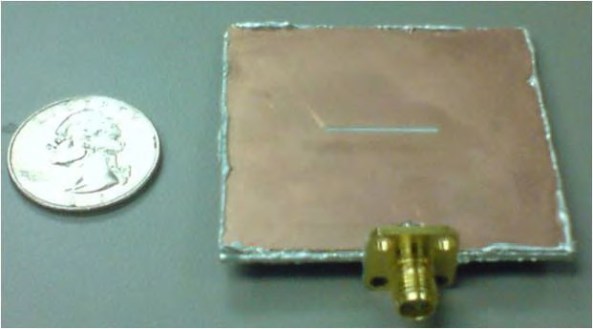
5GHz Fabricated Antenna

A paper by Mahmoud N. Mahmoud presents an innovative solution for small satellite antennas by integrating slot antennas and solar cells on the same panel to save small satellite surface real estate and to replace deployed wire antennas for certain operational frequencies.

The two main advantages of the proposed antenna are:
1) the antenna does not require an expensive deployment mechanism that is required by dipole antennas;
2) the antenna does not occupy as much valuable surface real estate as patch antennas.

The antenna design is based on using the spacing between the solar cells to etch slots in these spaces to create radiating elements for 2.4 or 5 GHz.

Read the paper at http://digitalcommons.usu.edu/cgi/viewcontent.cgi?article=1738&context=etd

Flexible Solar Panel Deployment for CubeSat

Senior design project to incorporate flexible solar panels in a CubeSat. The mechanism consists of a rack and gear spring loaded mechanism to release the rolled up solar panel.

Watch Flexible Solar Panel Deployment for CubeSat