Next ISS School contact -St Anthony's Parish Primary School, Australia

Space station
Space station


03 April at 08:15 UTC

St Anthony’s Parish Primary School, Canberra, Australia – Dan Burbank, KC5ZSX

Telebridge station VK5ZAI in Australia will call NA1SS at approximately 08:15 UTC.


St Anthony’s School is located in the suburb of Wanniassa, which is part of the central region of the Tuggeranong Valley in the Australian Capital Territory. Currently the school has an enrolment of 528 students with generally three classes in each of 7 Year levels from Kindergarten (the first year of primary school in the ACT) to Year 6. Our average class size is 1 teacher to 26 students. We have a strong Integrated Unit of Inquiry programs that primarily focus on authentic experiences that the ARISS program would facilitate.


Students will ask as many of the following questions as time allows:
1. What is the most interesting thing you have ever seen out of the Space Station window?
2. What do you love most about outer space and miss about home?
3. What are the challenges you face in zero gravity?
4. If someone is injured, what do you do?
5. What is your job in outer space?
6. Is there enough light in space or do you need to use special glasses?
7. I live really close to Tidbinbilla Space Tracking Station. Is Tidbinbilla involved with this mission?
8. How long can you stay in space before it effects your health?
9. I know you can see the Great Wall of China, but can you see any other interesting landmarks on Earth?
10. What do you do in space to entertain yourself?

As always, the ISS will be audible to anyone listening in on the 145.80 MHz downlink.

*Note* – for telebridge contacts, the ground station will NOT be near the school that is contacting the ISS.

Please note, the amateur equipment on the ISS will be turned off prior to the beginning of the contact. It will be returned to service as quickly as possible.

 ARISS is an international educational outreach program partnering the participating space agencies, NASA, Russian Space Agency, ESA, CNES, JAXA, and CSA, with the AMSAT and IARU organizations from participating countries. ARISS offers an opportunity for students to experience the excitement of Amateur Radio by talking directly with crewmembers on-board the International Space Station. Teachers, parents and communities see, first hand, how Amateur Radio and crewmembers on ISS can energize youngsters’ interest in science, technology, and learning. Further information on the ARISS programme is available on the website http://www.rac.ca/ariss (graciously hosted by the Radio Amateurs of Canada). Information about the next scheduled ARISS contact can be found at http://www.rac.ca/ariss/upcoming.htm#NextContact.


Tuesday, April 3, 2012

UKube-1: 4 payloads

Rt Hon David Willetts MP learns about UKube-1 visiting Clyde space, seeing the clean rooms and talking to Craig Clark about CubeSat components. Courtesy http://www.clyde-space.com/news/305_uk-science-minister-visits-clyde-space


The UK Space Agency’s pilot programme has narrowed down from a total of 20 proposals to four payloads to fly on Ukube-1 from UK industry and academia.

Payloads chosen include a CMOS (complementary metal-oxide semiconductor) Imager Demonstrator, a specialist imaging device to measure radiation damage in space developed by the Open University and Essex-based e2v technologies.

Another, the United Kingdom Students for the Exploration and Development of Space (UKSEDS) payload, myPocketQub442, is an open source system comprising five experiments, one of which will allow school pupils, university students and hobbyists to run their own experiments in space for a day.

The other two payloads are the EADS Astrium , which will test random number generation crucial to secure communications systems in the radiation environment, and TOPCAT http://www.bath.ac.uk/elec-eng/invert/topcat.html, a system designed by the University of Bath to measure space weather conditions which can adversely affect global positioning systems (GPS).

UKube-1 will also take an educational subsystem called FUNcube, developed by the voluntary organisation AMSAT-UK, to encourage young people to learn about radio, space, physics and electronics.

The spacecraft is being developed through a knowledge transfer project with Scottish spacecraft system developer Glasgow based Clyde Space and the University of Strathclyde, which Clyde Space is also funding.

One of the world’s leading firms in the micro spacecraft sector, dubbed CubeSat , Clyde Space has made components for about 40% of the 600 CubeSats launched globally so far. It also makes components for larger satellites.

Ukube-1 is also being funded by the UK Space Agency, the Technology Strategy Board and The Science and Technology Facilities Council (STFC). The agency is currently in negotiations to find a launch vehicle to take the Ukube-1 satellite into space.

UKSEDS – Students for the Exploration and Development of Space http://www.uk.amsat.org/4369

Bath TOPCAT Project http://www.uk.amsat.org/1612

Thailand AMSAT High Altitude Balloon Videos

Videos have been released by the Thailand Amateur Satellite group TAMSAT showing their successful amateur radio balloon flight call sign HS1JAN-11 on March 18.

Watch the launch of MSBSAT-2

Watch MSBAT-2 at 30km and its descent to Earth

Watch a timelapse video of the balloon being assembled

The track of the balloon can be seen at http://aprs.fi/#!call=a%2FHS1JAN-11&timerange=3600

Apex students talk with space station

On Wednesday, March 21, students at Salem Elementary in Apex came together in the school’s multipurpose room for a once-in-a-lifetime event.

WRAL TV news reports that fourteen students, six of them winners of the school’s science fair a few weeks earlier, made their way onto the stage for their turn to ask a question of astronaut Don Pettit KD5MDT 241 miles (388 km) up and on the other side of the Earth aboard the International Space Station. Tony Hutchison VK5ZAI provided the telebridge link to the ISS amateur radio station NA1SS.

At 10:07 am EDT, the station came over the horizon of Southern Australia and ham radio volunteer Tony Huchison VK5ZAI called out to callsign NA1SS. Everyone relaxed a little bit when Pettit KD5MDT responded and students lined up to ask their questions one after another.

Watch the WRAL video

Read the full WRAL news report at http://www.wral.com/weather/blogpost/10904028/

ARISS ham radio space contact with Salem Elementary School, Apex, NC http://www.southgatearc.org/news/march2012/ariss_event_2103.htm

Amateur Radio on the International Space Station (ARISS) http://www.rac.ca/ariss/

TAMSAT – Internal Housekeeping Unit – IHU

Internal Housekeeping Unit – IHU

When we first founded TAMSAT, Association of Amateur Satellite Technologies approximately two years ago, we have made a big commitment. Our commitment was to develop technology in Turkey, not any technology, but a complex one related to space systems.

I am sure during this time period those of you, who have been following us up, were wondering about the progress that has been made to realize this mission. In this article, I want to share with you an amazing adventure that we experienced in these two years. I don’t want to limit this with technological narration, but also tell you about how our members, who work simultaneously in different corners of the world, did what they do and why we waited all this time to submit our work to you. It was a long path filled with hard work, patience and long tests.

The group of articles to be published after this introductory one, will be about the ‘Internal Housekeeping Unit – IHU’ of our satellite. I just want to mention that this unit may also be referred as OBC – On Board Computer in some articles, but we are going to stick with ‘IHU’ as it has been a standard within The Radio Amateur Satellite Corporation (AMSAT) world.

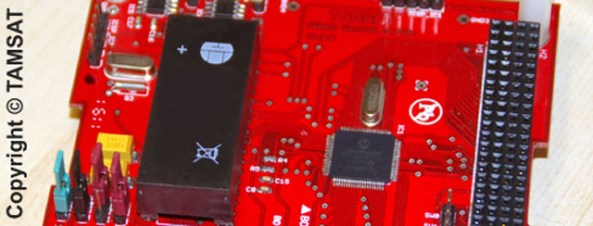
We want to share some very good news later in this first article . The IHU, which is the first module of the series has a very special place for us, the hardware was originally produced in May of 2011.

The circuit design was realized utilizing EAGLE s/w, by one of our members, Barbaros ASUROGLU, whom Turkish Radio Amateurs are familiar with, through his work on PIC. After the primary tests on the IHU and the prototype were done first on computer, then on the test platform, a printed circuit in the standard PC104 was designed by Osman DALAMAN, another TAMSAT member. The circuit was tested once before it was transferred on PCB by a local printed circuit manufacturer in Istanbul. After this process the SMD circuit components were mounted on card by Osman DALAMAN. After the completion of the first IHU prototype, a second IHU prototype was prepared with the same diligence.

These two IHU prototypes, traveled a long way by land and by air in their special little nests, without any complications and reached us in the USA for the software tests. After careful planning these two IHU prototypes and two VHF/UHF receiver cards, also original products of TAMSAT were lucky enough to participate annual Dayton Radio Amateurs Convention – 2011, as surprise guests.

The reception of these first products of TAMSAT in Dayton, honored us. These 4 prototype circuits, without any software on them, brought an unexpected prestige to TAMSAT in the USA, which we will share with you later.

The hardware was tested by TAMSAT continuously and under a variety of different circumstances, between May 2011 and December 2011.

Then it was time for the toughest trial of all. The IHU was uploaded by a special software after Mr. Asuroglu’s last test and controls and was sent to Istanbul Technical University – Space Systems Design and Test Laboratories (ITU – USTTL), which is one of the two centers in Turkey authorized to run these test in this field. With this hard testing period, TAMSAT also entered a period of nervous expectancy.

And now, the good news that we mentioned before; the TAMSAT – IHU, a complete product of Turkish Engineers and a first in its field, passed all the tests and became our first licensed product to work under real space conditions.

It is my honor and duty to thank to our members Barbaros ASUROGLU and Osman DALAMAN for their sacrifice and hard work for producing our first IHU.

TAMSAT started this hard journey with a very small group of dedicated people and the mission of realizing a first in Turkey, now it is getting bigger not only with the technology it is creating, but also with your support. Right now, our base covers a variety of professionals from electronic engineers to teachers, from astronomers to civil engineers, from students to faculty. If you want to be a contributor please contact with us immediately, our doors are always open to all our friends who shares our mission.

Looking forward to share new, more detailed and informative article with you.

Sincerely,

Levent Sasmazel
TAMSAT – Project Coordinator

Contact: info@tamsat.org.tr

Web: http://www.tamsat.org.tr/
and  http://www.amsat-tr.org/

Facebook: https://www.facebook.com/profile.php?id=100000953042369

Twitter: https://twitter.com/#!/tamsat_tr

UK CubeSat Plasma Propulsion Thruster

STRaND-1 CubeSat Plasma Propulsion Test

STRaND-1 CubeSat Plasma Propulsion Thruster

The amateur radio STRaND-1 smartphone CubeSat is a joint project between SSTL and the Surrey Space Centre (SSC). It’s not only its smartphone that makes it exceptional. Engineers at the Surrey Space Centre have also developed a unique mass and power saving plasma propulsion system to fly on the satellite. This system will be the first propulsive technology to provide very precise attitude control and pointing.

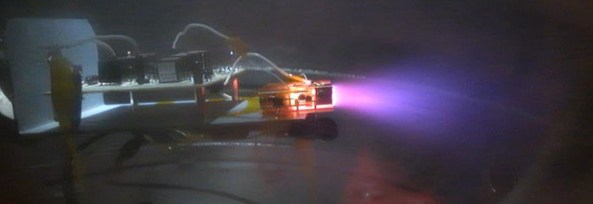
STRaND-1 will carry both a Resistojet and a Pulsed Plasma Thruster (PPT) module on board. The PPT will consist of eight micro thrusters; four located at the top of the satellite stack and four located at the bottom. The micro thrusters operate by discharging a discrete train of pulses. Each pulse is a plasma discharge that forms between two metal electrodes, much like a small lightning bolt or electrical spark. The spark erodes the metal from the electrodes and electromagnetics accelerate the eroded mass out of the nozzle, which produces thrust. This is known as the Lorentz force.

Surrey Space Centre has developed two ways of minimising mass and volume. Firstly, the electrodes which form the plasma discharge also function as the propellant. As metal is highly dense, more propellant can be stored in a smaller volume than that of conventional chemical propulsion systems. The total weight of the propellant for the whole STRaND-1 PPT system is just 10g.

Secondly, Surrey Space Centre’s novel discharge initiation system uses a mechanical contact trigger built out of a tiny piezoelectric motor only 5mm in length. This takes up less space than the conventional spark plug system which requires volume intensive circuitry.

A video of the Pulsed Plasma Thruster firing can be seen st http://www.facebook.com/video/video.php?v=10150533409463432

Download a video of the STRaND-1 presentation given at the 2011 AMSAT-UK International Space Colloquium in Guildford from http://www.batc.tv/vod/Strand.flv

A six page article on STRaND-1 appeared in the Spring 2011 issue of the AMSAT-UK publication OSCAR News available for download at http://www.uk.amsat.org/on_193_final.pdf

UK Amateur Radio Smartphone CubeSat STRaND-1 http://www.uk.amsat.org/1942

STRaND on Facebook http://www.facebook.com/nanosats