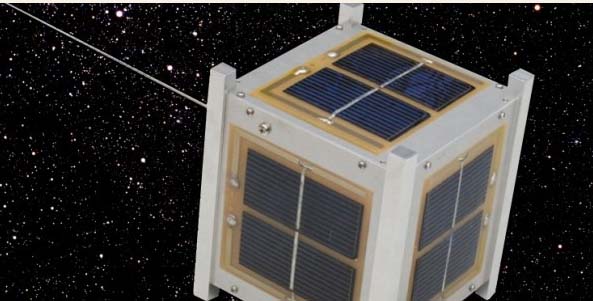
Article – “OSCAR-1 Launched 50 Years Ago”

Lance Ginner K6GSJ with OSCAR 1

Lance Ginner K6GSJ with OSCAR 1

The ARRL have released an English translation of an article about the pioneering amateur radio satellite OSCAR-1

A new, highly informative article on how the world’s first Amateur Radio satellite, OSCAR-1, came to be designed, built and launched has been posted to the ARRL’s Space Communication web page (see the “Articles” section). Written by Andreas Bilsing, DL2LUX, “OSCAR-1 Launched 50 Years Ago” was first published in the German magazine Funkamateur. It is reprinted with their permission. OSCAR-1 was launched just over 50 years ago, on December 12, 1961.

Link the the article in English http://www.arrl.org/files/file/Technology/Bilsing.pdf

ARRL Space Communication page http://www.arrl.org/space-communication

Schools' communications satellite to put the fun back into science lessons

FUNcube_Graphic_Large

Artists impression of FUNcube in space

The Jan 25-31 printed edition of Electronics Weekly (circulation 36,400) carries an article on the AMSAT-UK FUNcube amateur radio satellite. The article, titled “Schools’ communications satellite to put the fun back into science lessons”, appears on page 12.

You can read or download this issue of Electronics Weekly at http://cde.cerosmedia.com/1M4f1d2b906fdb1433.cde

(The PDF can be downloaded by clicking on the PDF icon at the top).

A free subscription to the digital version of the publication is available via the Electronics Weekly website http://www.electronicsweekly.com/ On the lef-hand side under “SIGN UP TO” click on “Digital Magazine”.

Schools’ communications satellite to put the fun back into science lessons

FUNcube_Graphic_Large

Artists impression of FUNcube in space

The Jan 25-31 printed edition of Electronics Weekly (circulation 36,400) carries an article on the AMSAT-UK FUNcube amateur radio satellite. The article, titled “Schools’ communications satellite to put the fun back into science lessons”, appears on page 12.

You can read or download this issue of Electronics Weekly at http://cde.cerosmedia.com/1M4f1d2b906fdb1433.cde

(The PDF can be downloaded by clicking on the PDF icon at the top).

A free subscription to the digital version of the publication is available via the Electronics Weekly website http://www.electronicsweekly.com/ On the lef-hand side under “SIGN UP TO” click on “Digital Magazine”.

RS-39 (Chibis-M) Deploys

RS-39 Chibis-M

RS-39 Chibis-M

RS-39 has CW beacons on 435.315 and 435.215 MHz that can be received directly by schools and colleges for educational outreach purposes. It deployed from Progress M-13M into a 500 km orbit on January 24 at approximately 23:18:30 UT.

On November 2, 2011 cargo ship “Progress M-13M”, which also delivered microsatellite “Chibis-M”, was docked with ISS. The main purpose of “Chibis-M” is the study of physical processes in the vicinity of the lightning, during which the Terrestrial Gamma Ray Flashes (TGFs) are generated. TGFs are likely produced by beams of very energetic electrons, which are accelerated in the intense electric fields generated by large thunderstorm systems.

The deployment of “Chibis-M” in a circular orbit of 500 km will take place during the final phase of “Progress M-13M” operation. According to the plan of the Russian Space Control Centre, undocking of “Progress M-13M” will occur at January 24, 01:59 msk and after two corrections it will be positioned at 500 km orbit. At January 25, 03:14 msk “Chibis-M” will separate. Beside scientific data “Chibis-M” will transmit service telemetry (the housekeeping parameters) in the beacon format on 435.315 or 435.215 MHz CW (Doppler shift +/- 10 kHz) and has the designation of RS-39. The format of data is typical for RS satellites and can be downloaded here.

The telemetry of RS-39 can be easily received directly by schools and colleges for educational outreach purposes. This telemetry will give details of the spacecraft’s health – battery voltages and temperatures of critical units. In combination with orbital data such information will be useful as the curriculum for student lessons.

The team of RS-39 will very much appreciate any reception reports of “Chibis-M”. Special attention is requested for the first orbits as these are outside of control stations for “Chibis-M”. Each report will be confirmed by special QSL card. The email address is amateur-rs39@chibis.cosmos.ru

The RS-39 Chibis-M website managed the by Space Research Institute of the Russian Academy of Sciences (RAS) can be seen in Russian at http://chibis.cosmos.ru/ or in Google English at http://tinyurl.com/RS-39-Chibis-M

As well as measuring electromagnetic parameters of “space weather” in the spectrum 0.1 – 40 kHz the satellite also carries a receiver for the analysis of radio frequency signals in a frequency band of 26-48 MHz. http://www.energia.ru/en/iss/researches/geophis/19.html

RS-39 Morse Code telemetry format http://tinyurl.com/RS-39-Morse-Code-Telemetry

RS-39 Telemetry Decoder http://www.uk.amsat.org/4029

RS-39 Real Time Tracking Map http://chibis.cosmos.ru/cyclogr/prepare1/google/index.html
For Keps click on two gear wheels in top left-hand corner then click on Satellites.

It may be worth checking the AMSAT Bulletin Board (AMSAT-BB) for the very latest news. The 48-hour archive of the AMSAT-BB is at http://www.amsat.org/amsat/archive/amsat-bb/48hour/threads.html or you can join the bulletin board at http://www.amsat.org/amsat-new/tools/maillist/maillist.php

Building a Distributed Satellite Ground Station Network

There was a presentation on building a distributed satellite ground station network at the Chaos Communication Congress held December 27-30 and the video is now available.

The AMSAT-UK FUNcube Dongle VHF/UHF Software Defined Radio gets a brief mention at 39:26 into the video.

The video kicks off with an appearance by Nick Farr then the presentation by Gregor Jehle (Hadez), Armin Bauer and Andreas Hornig gets underway.

Watch 28C3: Building a Distributed Satellite Ground Station Network – A Call To Arms (en)

Hackers Plan Space Satellites http://www.uk.amsat.org/3172 

Hackerspace Global Grid http://shackspace.de/wiki/doku.php?id=project:hgg

London Hackspace Project: Hoxton Space Centre http://wiki.london.hackspace.org.uk/view/Project:Hoxton_Space_Centre

London Hackspace work on HackSat1 http://www.uk.amsat.org/2482

The DIY Magic of Amateur Radio video http://www.uk.amsat.org/3158

ITF-1 CubeSat – Imagine The Future

University of Tsukuba ITF-1 (YUI) CubeSat

University of Tsukuba ITF-1 (YUI) CubeSat

Students at the University of Tsukuba are working on the ITF-1 (YUI) CubeSat project that is planned to be launched on a H-IIA rocket in the fiscal year 2013. The orbit will be 400 by 350km with an inclination of 65 degrees.

The formal name ITF-1 comes from the initial letter of the university slogan “Imagine The Future”.  The satellite also has a popular name YUI which means “bond” in Japanese, it came from the project’s concept‚ “Creating the Worldwide Human Community”.

The 435MHz satellite beacon will send telemetry by a Morse Code audio tone on an FM transmitter running 300 milliwats output. It should be possible to receive it using simple equipment such as a handheld transceiver or scanner. Telemetry information will be first compressed into binary data  and then cut into 5 bits and converted into 10 – 15 Morse codes.

Ayano Okamura ITF-1 Project Manager

Reception reports will be acknowledged with a certificate and the telemetry will be made available on the web.

The UTF-1 Project Manager is Ayano Okamura and you can read her blog at http://tinyurl.com/ITF-1-ProjectManagerBlog

The Chief Tech blog by Asai Eisuke is at http://tinyurl.com/ITF-1-TechBlog

ITF-1 (YUI) on the IARU Amateur Satellite Frequency Coordination pages http://www.amsatuk.me.uk/iaru/formal_detail.php?serialnum=226

ITF-1 website in Google English http://tinyurl.com/CubeSat-ITF-1