FO-29 Test Successful

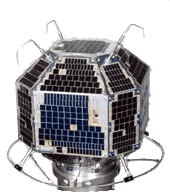
Amateur Radio Satellite FO-29

Amateur Radio Satellite FO-29

On the AMSAT bulletin board Masa JN1GKZ reports that the December 23 command test on the 15 year old amateur radio satellite FO-29 was successful.

FO-29 has been inoperative due to eclipse length and the poor condition of the batteries. It carries a 100 kHz wide 145/435 MHz linear transponder for SSB/CW contacts.

Masa wrote:  JTA was on at 1422z. Loud CW telemetry was heard. Unfortunately, the telemetry was shut off by UVC at 1426z.

I put the telemetry MP3 file on the following URL: http://www.ne.jp/asahi/m-arai/gkz/sound/FO29-111223142200-142544z.mp3

The command station announced Dec. 24 sked as starting at 0405z. I guess this is typo. The correct time is 0505z. Transponder will operate until eclipse. East Asia, VK and southern South American stations will chat over FO-29.

FO-29 frequencies and tracking http://www.amsat.org/amsat-new/satellites/satInfo.php?satID=5

John Heath G7HIA mentions FO-29 in his article ‘Getting started on amateur radio satellites’. Download the article:
http://www.uk.amsat.org/2011/05/09/getting-started-on-amateur-radio-satellites/

Working the SSB satellites http://www.uk.amsat.org/2011/12/04/working-the-ssb-satellites/

Seven Student CubeSats Ready For Flight

Artists impression of Vega launch

Artists impression of Vega launch

The first student built amateur radio CubeSats to be sponsored by ESA’s Education Office have passed their Final Acceptance Review and have been declared ready for launch on board the maiden flight of Vega, the new ESA launcher.

The launch window for this historic lift-off opens on 26 January and ends in the first week of February 2012.

The seven university-built picosatellites, each weighing only 1 kilogram, were integrated with the devices that will carry them during launch – the P-PODs, or Poly-Picosatellite Orbital Deployers – between late October and mid November. Before they could be cleared for launch, they had to pass a detailed technical examination known as the Final Acceptance Review.

The single-unit CubeSats, whose development represented a highly valuable, if not unique hands-on learning experience for the university students that were involved – were developed by teams from 6 different European countries:

  • Xatcobeo (a collaboration of the University of Vigo and INTA, Spain)
  • Robusta (University of Montpellier 2, France)
  • E-St@r (Politecnico di Torino, Italy)
  • Goliat (University of Bucharest, Romania)
  • PW-Sat (Warsaw University of Technology, Poland)
  • MaSat-1 (Budapest University of Technology & Economics, Hungary)
  • UniCubeSat GG (Universitá di Roma ‘La Sapienza’, Italy)

As well as the CubeSats Vega will also carry the Amateur Radio microsatellite ALMASat-1.

Frequencies and links for the satellites can be found at http://www.ne.jp/asahi/hamradio/je9pel/esa9cubf.htm

Read the full ESA story at http://www.esa.int/SPECIALS/Education/SEMG1C8XZVG_0.html

2007 – AO-51 to switch to V/S 38k4 to support ALMASat ground station testing
http://www.southgatearc.org/news/march2007/ao51_switch.htm

AMSAT-UK publishes a colour A4 newsletter, OSCAR News, which is full of Amateur Satellite information.
Free sample issue at http://www.uk.amsat.org/on_193_final.pdf
Join online at http://tinyurl.com/JoinAMSAT-UK
Last chance to hear ARISSat-1

Sergey Samburov RV3DR with ARISSat-1

Sergey Samburov RV3DR with ARISSat-1

The amateur radio satellite ARISSat-1 may have only a few more days to live before it re-enters Earth’s atmosphere. Ken GW1FKY reports it’s putting out a strong signal in the early evening.

On the AMSAT bulletin board Ken writes:

I again monitored and worked into ARISSat-1 during the earlier pass and the final one as it entered eclipse over here in Europe.

The early pass was a low angle from my QTH and screened by buildings so I was not able to access the satellite. However the FM downlink was quite reasonable and I did hear someone active on CW.

The final pass as it moved into eclipse was really remarkable and my downlink and the FM transmissions were booming in . The loudest that I have ever heard from the satellite, in addition I quickly monitored the CW portion and someone was booming in, I could not stay at that end of the band as I was trying to make schedule on SSB. Heard someone calling but not able to confirm whom it was as they were not easy to copy.

Ken was listening in the early evening which seems to be a good time to hear the satellite. The satellite is only operational when its solar panels are illuminated. You can get orbital predictions times by selecting ARISSat-1 on the online prediction tool at http://www.amsat.org/amsat-new/tools/

If you hear the satellite on 145.950 MHz FM, you can get a certificate. Depending on what mode you copied, send an e-mail with the information to:
tlmreport@arissat1.org
secretword@arissat1.org
sstvreport@arissat1.org

Details at http://www.southgatearc.org/news/august2011/ arissat_1_reception_certificates.htm

There is also a CW contest if you send in 5 calls heard on the 145.920 MHz CW transmission of notable AMSAT people of the past & present email them to cwreport@arissat1.org

ARISSat-1 CW Contest http://www.uk.amsat.org/2011/10/10/arissat-1kedr-team-announces- cw-contest/

Catch the Last ARISSat-1 Telemetry http://www.uk.amsat.org/2011/11/09/catch-the-last-arissat-1-telemetry/

Get your colour ARISSat-1 Frequency Guide http://tinyurl.com/4t497t2

ARISSat-1 http://www.arissat1.org/

PW-SAT on BRITE TV

PW-Sat with antennas deployed

PW-Sat with antennas deployed

The Polish amateur radio satellite PW-SAT built by students at the Warsaw University of Technology was featured on BRITE TV.

The Internet TV channel BRITE TV, covers the construction of the first Polish scientific satellites BRITE-PL 1 – Lem and BRITE-PL 2 – Hevelius which will be part of the BRITE constellation. Sometimes the TV channel covers other topics related to space technology.

Episode 14 talks about the CubeSat PW-SAT, built by students of Warsaw University of Technology working with the Space Research Centre PAS, due to be launched on Vega at the end of January.

PW-SAT carries a single channel transponder that will operate in a similar way to the amateur satellite AO-16. The uplink on 435.020 MHz will be FM and the downlink on 145.900 MHz will use the BPSK telemetry beacon transmitter to produce Double Sideband (DSB) that can be received on an SSB radio.

Watch BRITE-TV – Episode 14 – PW-SAT (in Polish)

PW-SAT Blog http://ska.meil.pw.edu.pl/pwsat_blog_pl/?lang=en

PW-Sat to launch in January http://www.uk.amsat.org/2011/12/15/pw-sat-to-launch-in-january/

For more information on PW-Sat in Google English see http://tinyurl.com/CubeSatPW-Sat

BRITE Constellation http://www.univie.ac.at/brite-constellation/

BRITE-PL in Google English http://tinyurl.com/BRITE-PL

AMSAT-UK publishes a colour A4 newsletter, OSCAR News, which is full of Amateur Satellite information.
Free sample issue at http://www.uk.amsat.org/on_193_final.pdf
Join online at http://tinyurl.com/JoinAMSAT-UK

Space Station School Contact Video

A video has been released of the contact between ISS commander Daniel C. Burbank KC5ZSX and students at Hirano Elementary school, Kobe City.

Watch ARISS ham radio contact with Hirano branch of Kobe Youth Nurturing Council, Kobe-city

Further information: http://www.southgatearc.org/news/december2011/ariss_event_1212.htm

Amateur Radio on the International Space Station (ARISS) http://www.ariss.org/

From OSCAR 1 to Mars and Beyond

A video of the presentation about Amateur Radio Space Communications given by Mario Lorenz DL5MLO to hackers at the Chaos Communication Camp 2011 is now available.

The talk  was titled ‘From OSCAR 1 to Mars and beyond – Amateur Space Exploration – The last 50 years, now, and the future’ and the YouTube description reads:

Radio amateurs have been building and operating satellites for almost fifty years now, and we are aiming for more. In this talk, I’ll present who AMSAT is, what we have achieved in the last fifty years, and what we are working on now.

Back in the 1960’s, radio amateurs seized the opportunity of launching a satellite into space. It would not be the only one; we are approaching OSCAR 70 now. Building satellites has always been challenging and involves using technology in creative ways. I’ll cover some of the more fascinating cases, including some lessons learned during the process. In addition to the satellites in earth orbit, we are also aiming for Mars, and I’ll show what are doing to get there.

Watch From OSCAR 1 to Mars and beyond – CCCamp 2011

Hackers Plan Space Satellites http://www.uk.amsat.org/3172 

London Hackspace Project: Hoxton Space Centre http://wiki.london.hackspace.org.uk/view/Project:Hoxton_Space_Centre

London Hackspace work on HackSat1 http://www.uk.amsat.org/2482

The DIY Magic of Amateur Radio video http://www.uk.amsat.org/3158