A video of the presentation about Amateur Radio Space Communications given by Mario Lorenz DL5MLO to hackers at the Chaos Communication Camp 2011 is now available.
The talk was titled ‘From OSCAR 1 to Mars and beyond – Amateur Space Exploration – The last 50 years, now, and the future’ and the YouTube description reads:
Radio amateurs have been building and operating satellites for almost fifty years now, and we are aiming for more. In this talk, I’ll present who AMSAT is, what we have achieved in the last fifty years, and what we are working on now.
Back in the 1960’s, radio amateurs seized the opportunity of launching a satellite into space. It would not be the only one; we are approaching OSCAR 70 now. Building satellites has always been challenging and involves using technology in creative ways. I’ll cover some of the more fascinating cases, including some lessons learned during the process. In addition to the satellites in earth orbit, we are also aiming for Mars, and I’ll show what are doing to get there.
Watch From OSCAR 1 to Mars and beyond – CCCamp 2011
At Hamfest India (HFI) 2011, held in Kochi Dec 10-11, a presentation was given on a new Indian linear transponder and a CubeSat communications system.
This was the largest gathering of radio amateurs in India so far. Radio Amateurs and SWLs from all over the country and invited guests from other countries enjoyed the two-day event.
AMSAT-India gave several presentations at the event, among them was one by Ganesan Namachivayam KJ6LRR in which he described a satellite 435/145 MHz linear transponder with a bandwidth of 50 kHz and capable of 1-3 watts PEP output. AMSAT-India plan to develop a smaller linear transponder for CubeSats.
AMSAT-India CubeSat
Ganesan also described a CubeSat communications system comprising a 435 MHz half-duplex narrow‐band FM transceiver supporting a data rate of 1200-9600 bps. The transmitter produces 1 watt output and can also operate as a Morse Code beacon.
Amateur radio CubeSats and ALMASat-1 being prepared for launch
The integration of Vega’s first, second and third stages is now complete at ESA’s Spaceport at Kourou in the Caribbean. ESA say the new rocket is moving full speed ahead towards its maiden flight at the end of January.
Vega will carry seven amateur radio satellites, ALMASat-1 and six Cubesats. The primary payload is LARES (Laser Relativity Satellite), a passive satellite with laser mirrors for the study of the Earth gravitational field and general relativity measurements (Lense-Thirring effect).
By the end of December, the six CubeSats, ALMASat-1 and LARES will be ready and enclosed in the fairing, well in time for the launch.
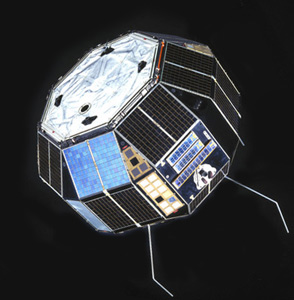
Roger J A Duthie M0RJA and the team are carrying out further attempts to reactivate Prospero, the United Kingdom’s first satellite launched on a UK-built rocket, Black Arrow, on October 28, 1971.
The team now have an AMSAT-UK FUNcube Dongle (FCD) VHF/UHF Software Defined Radio to receive Prospero on 137.560 MHz and use an Icom IC-746 tranceiver on transmit commands to the satellite.
Because the frequency is now used by a number of Orbcomm satellites it can be difficult to identify the Prospero X-3 signal. The intention is to switch the satellite on and off by making commanding attempts and listening for a response in the RF carrier to indicate that Prospero is indeed still in some sort of working condition.
It is hoped Amateur Radio operators will be able to provide recordings of the signals on 137.560 MHz.
PW-Sat, a 1U CubeSat to be launched on the first VEGA flight in January, will carry a 435 to 145 MHz Amateur Radio transponder.
The single channel transponder will operate in a similar way to the amateur satellite AO-16. The uplink on 435.020 MHz will be FM and the downlink on 145.900 MHz will use the BPSK telemetry beacon transmitter to produce Double Sideband (DSB) that can be received on an SSB radio.
PW-Sat should be launched into a 1450 by 300 km 71 degree orbit and may be expected to have a lifetime of about 4 years before re-entry. It was built by students of Warsaw University of Technology in cooperation with the Space Research Centre and will be Poland’s first satellite.
PW-Sat has five modes of operation:
1. Receive only mode – no downlink
2. Beacon CW mode – Downlink On-Off Keying (OOK) CW (1kHz) 12 WPM on 145.900 MHz
3. Beacon BPSK mode – Downlink BPSK (3 kHz) 1200 bps AX25 (1 frame on 20 sec) on 145.900 MHz
4. Control communication mode. Downlink BPSK (3 kHz) 1200 bps AX25 on 145.900 MHz
5. Voice Repeater mode (aka “AO-16” mode) – Uplink 435.020 MHz FM (15 kHz) Downlink 145.900 DSB (3 kHz)




You must be logged in to post a comment.