AMSAT-CE working on CESAR-1 FM transponder satellite

AMSAT-CE LogoThe Radio Club de Chile has announced the reactivation of the AMSAT-CE Foundation.

The Government of Chile has announced a plan to renew the Chilean Air Force Fasat Charlie satellite, along with promoting the construction of several micro and nano satellites.

This motivated the AMSAT-CE Foundation to propose that the CESAR-1 project of Chilean radio amateurs can be reactivated, modernized and completed, as part of the government plan.

Radio Club de Chile has supported AMSAT-CE since its begining and the Vice-President of Radio Club of Chile, José Tijoux CE3BCO, has just joined the Board of Directors of AMSAT-CE continuing and strengthening the space activity of Chilean radio amateurs .

The AMSAT-CE Foundation was created in 1993 and its first project is CESAR-1 which stands for CE (Chile) Satellite of Radiocommunication.

AMSAT-CE is designing and building five satellites, to be used by radio amateurs around the world, which will allow a series of scientific experiments in the field of digital communications, as well as gravimetric and orbitgraphic studies.

Of these five satellites, one will be the engineering prototype, three will be flight units, and the remaining one will be used to check or replicate on the ground the operation of the units that are in space.

The CESAR-1 satellite will be a  23 cm cube with a mass of about 12 kg and is planned to have five main experiments:

• A real-time digital transponder (Digipeater) using AX.25 at 9,600 kbps

• An electronic message box (Store and Forward) using AX.25 at 9.6 kbps)

• A 145 MHZ to 436 MHz band FM transponder

• A link to two terrestrial repeaters that will enable low power stations operating on 147 MHz FM to access the satellite

• An on-board GPS receiver, which will collect information for gravimetric and orbitgraphic research.

The orbit of CESAR-1 will be low, polar and heliosynchronous (about 800 km high).

AMSAT-CE
https://www.amsat-ce.org/
https://twitter.com/AmsatChile

Radio Club de Chile
http://www.ce3aa.cl/amsat-ce/
https://twitter.com/RCDECHILE

High school students in Brazil building QO-100 ground station

Students at Colégio Embraer Casimiro Montenegro Filho

Students at Colégio Embraer Casimiro Montenegro Filho

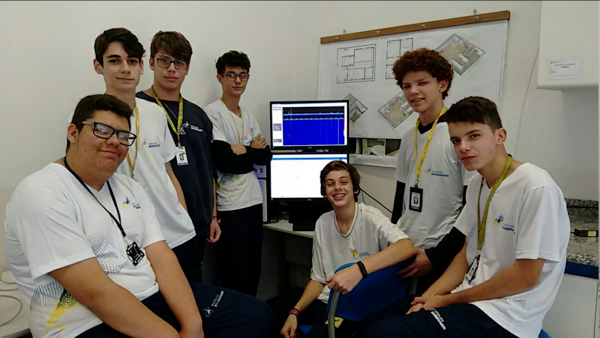
High school students in Brazil are building a ground station for the amateur radio transponder on the QO-100 geostationary satellite as part of a STEM education project.

A group of eight students, from Colégio Embraer Casimiro Montenegro Filho in Botucatu state of São Paulo, are participating in all steps of the project with the help of teachers and amateur radio volunteers from LABRE/AMSAT-BR (Edson PY2SDR, Demilson PY2UEP, José PU2MJR).

The station consists of a 1.2m offset dish antenna, an Amiko L-104 LNBF, a home-made bias-t, a RTL-SDR receiver and SDRsharp software running on a dedicated computer. During the project students were exposed to several STEM topics related to radio communications, antennas, software defined radios, geostationary orbits as well as hand-on activities during the station assembly and configuration.

The students were able to successfully receive test transmissions in morse code kindly made by Roland PY4ZBZ and Fábio PY4AJ. The next step of the project is to introduce digital communication concepts, decode the BPSK engineering beacon and finally to add transmission capability to the station. In the near future, besides making contacts with other stations on QO-100, the students would also very much like to contact other schools and students in the QO-100 footprint.

Watch Report on the students QO-100 project
(you can enable YouTube Subtitles and then enable Auto-Translate)

QO-100 (Es’hail-2) information https://amsat-uk.org/satellites/geo/eshail-2/

Iceland’s IRA buys Qatar Oscar 100 and APRS equipment

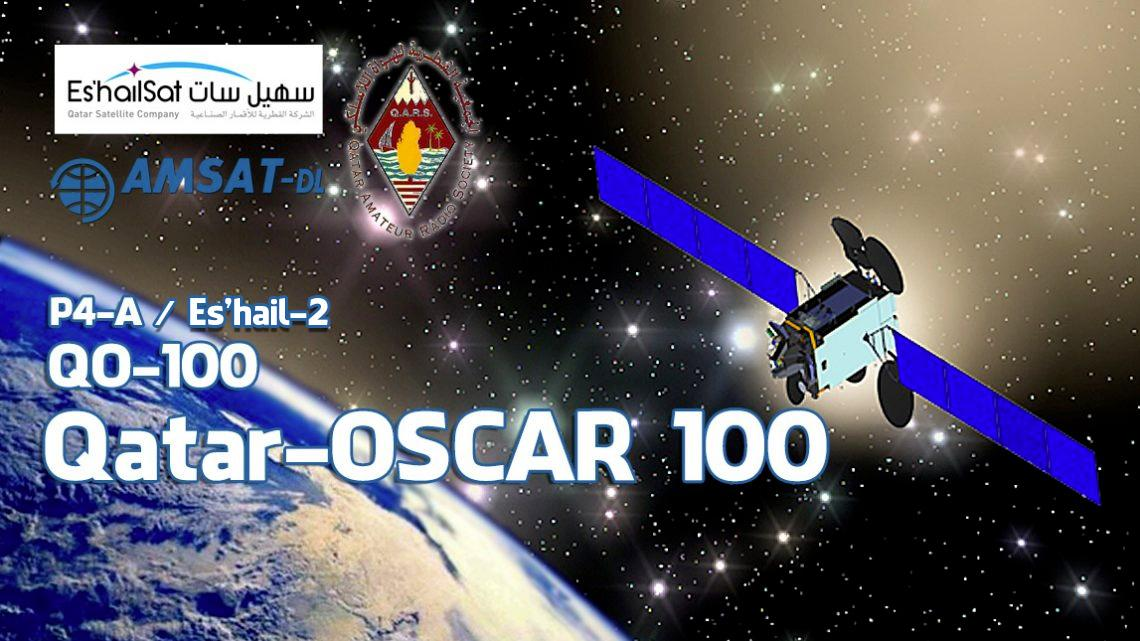
Es'hail-2 Qatar-OSCAR-100The Board of Directors of Iceland’s nation amateur radio society, the IRA, has authorized the purchase of equipment to operate via the amateur radio transponder on the QO-100 (Es’hail 2) geostationary satellite.

A translation of the IRA post reads:

The Board of Directors of ÍRA recently agreed to authorize the Fund to purchase the following equipment from Microsat in Poland:

• Microsat WX3in1 Mini APRS Advanced Digipeater / I-gate (2 pcs.)
• PLXDigi – APRS Digipeater (2 pcs.)

Guðmundur Sigurðsson, TF3GS, submitted a request to the company on the APRS group. He says the equipment will seal the system and increase the quality and usability of the system, including utilizing the Motorola GM-300 terminal, which recently received eight such stations. The installation includes, among other things, installation of I-gate in Akureyri and Digipeater on Þorbjörn near Grindavík.

At the same meeting, the acquisition of QO-100 transverter from PE1CMO in the Netherlands was further authorized; “A complete transverter with a 25 MHz reference oscillator for the LNB, a downlink converter from 739 to 432 MHz and an upconverter from 432 to 2400 MHz, double filtered and a 20 Watt amplifier.” Ari Þórólfur Jóhannesson, TF1A, VHF manager of the company, negotiated a discount price for the company at Ham Radio show 2019 in Friedrichshafen.

The APRS equipment costs about 45 thous. krónur and the Oscar-100 equipment by 118 thous. krónur (with accessories and connectors). The stated price includes transportation and charges in Iceland.

Source IRA https://tinyurl.com/IcelandIRA

PE1CMO amateur radio products
http://hfprints.com/pe1cmo/rc_images/pe1cmo_products.pdf
https://twitter.com/Pe1Cmo

QO-100 (Es’hail-2) information https://amsat-uk.org/satellites/geo/eshail-2/

JAISAT-1 Telemetry Data Sought

Tanan Rangseeprom HS1JAN with CubeSat model

Tanan Rangseeprom HS1JAN with CubeSat model

Tanan Rangseeprom HS1JAN, Project Manager of the new 3U CubeSat JAISAT-1 has requested telemetry data from the 435.700 MHz beacon. JAISAT-1 launched on July 5 and carries an amateur radio 145 to 435 MHz linear transponder for SSB/CW communications.

On the AMSAT Bulletin Board Tanan posted:

RAST President Dr.Jakkree Hantongkom HS1FVL who had contacted German Orbital Systems (GOS) which had informed of object 2019-038F confirm JAISAT-1 satellite.

2019-038F
1 44419U 19038F 19190.66730395 .00001667 00000-0 10000-3 0 9996
2 44419 97.4914 152.5407 0020014 233.1737 126.7422 15.12176922 634

The JAISAT-1 Beacon signal on 435.700 MHz in GMSK Mobitex 4800 bps mode code for JAISAT-1 frames 1 in row 11
41 (0x29) – JAISAT UHF1
42 (0x2A) – JAISAT UHF2

Example of signals in this format can be found with the reception of signals from the satellite

The Radio Amateur Society of Thailand (RAST) and the JAISAT-1 Project Team are urgently seeking raw data that can be received from all packets worldwide. Please send raw data and KSS files to RAST by email at jaisatonetele<at>gmail.com

Sincerely and with respect.

Tanan Rangseeprom, HS1JAN
Project Manager of JAISAT-1

RAST – The JAISAT-1 satellite is launched https://www.qsl.net/rast/

CAS-7B with FM transponder launched

CAS-7B / BP-1B satellite schematic diagram

CAS-7B / BP-1B satellite schematic diagram

The Amateur Radio satellite CAS-7B (BP-1B), carrying an FM transponder, was launched at 05:00 GMT on July 25, 2019 and the FM transponder and Telemetry Beacon have been received.

The satellite was launched on Hyperbola-1 from Jiuquan into a 300 km 42.7 degree inclination orbit. CAS-7B is expected to have a lifetime of less than a month before reentry.

CAS-7B is a spheriform spacecraft of 500 mm diameter with a mass of 3 kg
• CW Telemetry Beacon: 435.715 MHz 20 dBm
• V/U FM Transponder Downlink: 435.690 MHz 20 dBm, 16 kHz bandwidth
• V/U FM Transponder Uplink: 145.900 MHz 16 kHz bandwidth

Update July 30, 2019: CAS-7B Designated BIT Progress-OSCAR 102 (BO-102)

On July 25, 2019, the CAS-7B (BP-1B) microsatellite was launched on a Hyperbola-1 launch vehicle from the Jiuquan Space Center, China.

CAS-7B (BP-1B) was developed by the Chinese Amateur Satellite Group (CAMSAT), and in cooperation with the Beijing Institute of Technology (BIT). CAMSAT completed the project planning, design, build, and testing, and manages the on-orbit operation of the satellite. BIT provided the satellite environmental testing, launch support, and financial support. Many students from BIT were involved with the project, learning about satellite technology and amateur radio. The satellite carries a CW telemetry beacon and FM repeater that has been active since launch.

At the request of CAMSAT and the BIT team, AMSAT hereby designates CAS-7B (BP-1B) as BIT Progress-OSCAR 102 (BO-102). We congratulate the owners and operators of BO-102, thank them for their contribution to the amateur satellite community, and wish them continued success on this and future projects.

Further CAS-7B information from Alan Kung BA1DU https://amsat-uk.org/2019/06/02/cas7b-bp1b-satellite/

TX Factor Show: Demonstration of QO-100 satellite operation

The TX Factor show visits the National Radio Centre at Bletchley Park where Noel Matthews G8GTZ and Graham Shirville G3VZV demonstrate how to set up and operate using the amateur radio transponders on the new geostationary satellite Qatar-Oscar-100 (QO-100).

Plus, Bob McCreadie G0FGX visits the folks at Icom UK with a full review of Icom’s long-awaited VHF / UHF all-mode transceiver the IC-9700.

Watch TX Factor Show – Episode 23 (TXF023) starting at 17:46

QO-100 information https://amsat-uk.org/satellites/geo/eshail-2/

Listen to QO-100 online with the AMSAT-UK / BATC WebSDR located at Goonhilly https://eshail.batc.org.uk/