Digital ATV co-ordination on Es’hail-2

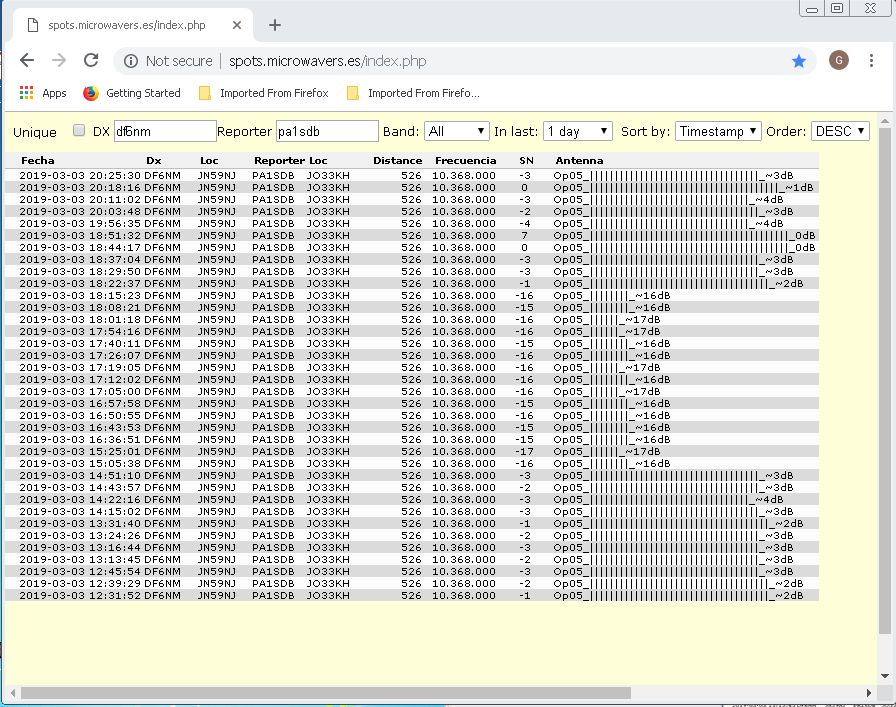
Narrowband DATV image (150 kHz bandwidth) via QO-100 Noel G8GTZ Feb 14, 2019 at 0950 GMT

Narrowband DATV (150 kHz bandwidth) via QO-100 sent by Noel G8GTZ Feb 14, 2019 at 0950 GMT

AMSAT-DL has agreed to a proposal by the British Amateur Television Club (BATC) for the use of the bottom 100 kHz of the wideband transponder (10491 – 10491.1 MHz) for ATV co-ordination purposes.

The announcement on the BATC Forum says:

This is on an experimental only basis and stations must keep their power levels to a minimum and certainly not exceed power levels greater than 15dB above the noise floor as shown on the Goonhilly spectrum monitor.

This is sanctioned on an experimental only basis and AMSAT-DL reserve the right to move the WB beacon towards the band edge or implement DVB-S with a wider rolloff which would render the frequencies unsuitable for this purpose.

So another challenge but should be manageable and prove a useful facility although we do see the chat being the major tool for reports and contacts.

73 Noel G8GTZ

BATC Forum Announcement https://forum.batc.org.uk/viewtopic.php?f=101&t=5923

Es’hail-2 WebSDR https://eshail.batc.org.uk/

Es’hail-2 Wideband amateur radio transponder operating guidelines
https://amsat-dl.org/en/p4-a-wb-transponder-bandplan-and-operating-guidelines

Es’hail-2 amateur radio information
https://amsat-dl.org/en/eshail-2-amsat-phase-4-a

See the Satellite Forum for additional information https://forum.amsat-dl.org/

Tate Gallery features ISS and Amateur Radio as Art

Ten Minute Transmission - image credit Henry Cooke @prehensile

Ten Minute Transmission – image credit Henry Cooke @prehensile (click for larger image)

The impressive artwork “Ten Minute Transmission”, featuring the amateur radio Kenwood TS-2000 transceiver and the International Space Station, is once again on display at the Tate Gallery in London.

The Tate Gallery says:

Ten Minute Transmission is a sculpture by Jennifer Allora and Guillermo Calzadilla modeled after the International Space Station. Made of wire and attached to a ham radio transmitter, this sculpture receives radio signals from the airwaves and transmits them into the gallery space.

This work was inspired by artist Alexander Calder’s suspended sculptures, or mobiles. Another influence was Russian artist and architect Vladimir Tatlin’s unrealised design, Monument to the Third International 1919, a tower with a rotating radio station at the top.

The title of this work, Ten Minute Transmission refers to the period of time when the International Space Station (ISS) can be contacted via radio as it flies past. The ISS orbits the Earth once every 90 minutes, but passes close enough to the antenna just twice a day. Usually the radio only picks up sounds of encrypted data packets sent back to Earth from the station. Two-way voice communication with the astronauts is now rare and needs to be requested in advance.

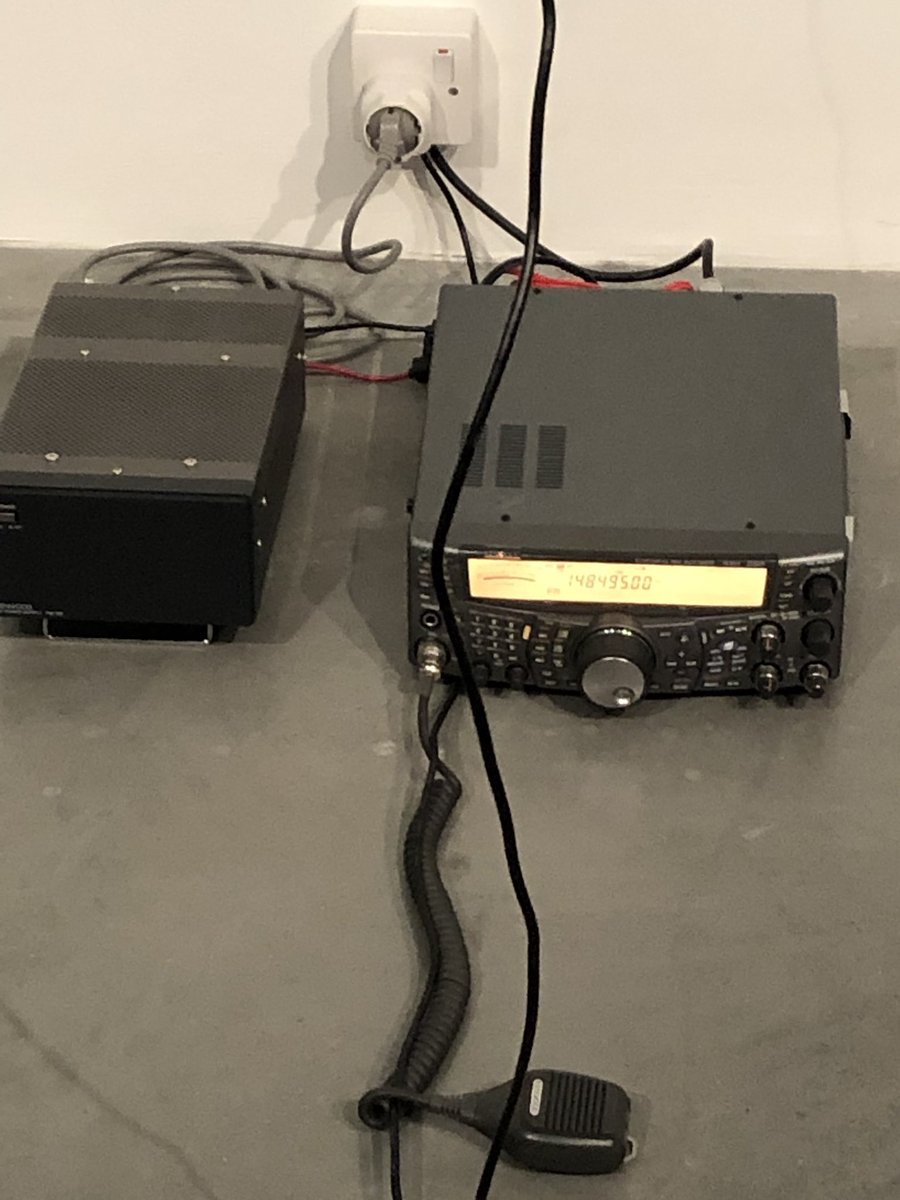
Kenwood TS-2000 used in Ten Minute Transmission at Tate Gallery - image credit Matthew Rose 2E0LJZ

Kenwood TS-2000 used in Ten Minute Transmission at Tate Gallery – image credit Matthew Rose 2E0LJZ

Collaborative artists Jennifer Allora (born 1974 Philadelphia, US) and Guillermo Calzadilla (born 1971 Havana, Cuba) are based in the United States and Puerto Rico. Their work examines the ‘space of encounter between people…whether it’s psychological territory or a physical terrain.’

Tate 2019 – Ten Minute Transmission
https://www.tate.org.uk/art/artworks/allora-calzadilla-ten-minute-transmission-t13698

Ten Minute Transmission also featured in “Common Wealth” in 2003
https://www.tate.org.uk/press/press-releases/common-wealth

SSO-A Solar Sails deployed – may be quite bright to naked eye

SSO-A mission's free flyers separating from upper stage of SpaceX's Falcon-9 rocket - credit Spaceflight

SSO-A mission’s free flyers separating from upper stage of SpaceX’s Falcon-9 rocket – credit Spaceflight

The solar sails on the SSO-A mission “Free Flyer” deployers, launched December 3, 2018 with many amateur radio satellites, are believed to have deployed and may now be quite bright to the naked eye.

Ben Taylor writes:

I represent a team from the University of Surrey in the UK; we have been developing and flying drag de-orbit sails with our first successful demonstration on our InflateSail mission in 2017.

Two dragsail systems were installed on the “Free Flyer” deployers used on the SSO-A launch from December 3, 2018 https://directory.eoportal.org/web/eoportal/satellite-missions/content/-/article/sso-a

The free flyers separated from the launch vehicle and in turn deployed multiple satellites each including Microsats and CubeSats over the course of several hours. The Upper Free Flyer (NORAD ID: 43763) is a large structure at approximately 1,000kg and the Lower Free Flyer is approximately 260kg (NORAD ID: 43760). Each Free Flyer hosts one of our 16m2 aluminised kapton sail which was set to deploy 24 hours after launch.

The systems were standalone isolated systems with no communications so we don’t have any telemetry confirmation. Drag parameters from the TLEs are indicative of a successful deployment, but far from definitive. We’re therefore waiting for them to become optically visible in northern latitudes in the next couple of weeks. Based on the experience with our InflateSail mission, we’d expect these objects to be quite bright to the naked eye if the sails have deployed successfully. InflateSail was 10m2 and (initially) transparent with a +4.2 mag, whereas these sails are 16m2 and metalised so could well flare brightly.

Any observations that could be made by the community of either of these objects would be greatly appreciated and they should make for interesting targets.

We are also the team leading the RemoveDebris mission (NORAD ID: 43510) launched from the ISS last year
https://www.surrey.ac.uk/surrey-space-centre/missions/removedebris

We have a 9m^2 dragsail installed on this mission too which is planned for deployment next month. Similarly, this should make quite a big change to the brightness of the satellite which could make for some interesting observations.

Best Regards,
Ben Taylor,
Guildford, Surrey, UK

Seesat-l mailing list http://mailman.satobs.org/mailman/listinfo/seesat-l

Track of Upper Free Flyer https://n2yo.com/?s=43763&df=1&live=1

Track of Lower Free Flyer https://n2yo.com/?s=43760&df=1&live=1
ARISS Slow Scan TV Event Feb 15-17

NOTA ISS SSTV image received in Elgin by Peter Goodhall 2M0SQL February 10, 2019

NOTA ISS SSTV image received in Elgin by Peter Goodhall 2M0SQL February 10, 2019

ARISS is planning another of their popular Slow Scan Television (SSTV) experiment events. Transmissions on 145.800 MHz FM are scheduled to begin Friday, Feb. 15 at 08:45 UT and run through Sunday, Feb. 17 at 17:25 UT.

SSTV operations is a process by which images are sent from the International Space Station (ISS) via ham radio and received by ham operators, shortwave listeners and other radio enthusiasts on Earth, similar to pictures shared on cell phones using twitter or instagram.

When this event becomes active, SSTV images will be transmitted from the ISS at the frequency of 145.800 MHz using the SSTV mode of PD120 and can be received using ham radio equipment as simple as a 2 meter handheld radio or a common shortwave or scanner receiver the covers the 2 meter ham band. After connecting the audio output of the radio receiver to the audio input of a computer running free software such as MMSSTV, the SSTV images can be displayed.

Transmissions will consist of eight NASA On The Air (NOTA) images (see https://nasaontheair.wordpress.com/). In additional, four ARISS commemorative images will also be included.

Once received, Images can be posted and viewed by the public at http://www.spaceflightsoftware.com/ARISS_SSTV/index.php . In addition, you can receive a special SSTV ARISS Award for posting your image. Once the event begins, see details at https://ariss.pzk.org.pl/sstv/ .

Please note that the event is dependent on other activities, schedules and crew responsibilities on the ISS and are subject to change at any time. Please check for news and the most current information on the ARISS Twitter feed @ARISS_status or the AMSAT Bulletin Board

The SSTV images will be transmitted in PD-120 on 145.800 MHz FM using the Kenwood TM-D710 transceiver located in the Russian ISS Service module.

Note the ISS transmissions use the 5 kHz deviation FM standard rather than the narrow 2.5 kHz used in Europe. If your transceiver has selectable FM filters try using the wider filter. Handheld transceivers generally have a single wide filter fitted as standard and you should get good results outdoors using just a 1/4 wave whip antenna.

ISS SSTV links for tracking and decoding Apps https://amsat-uk.org/beginners/iss-sstv/

You can receive the SSTV transmissions by using an Online Radio (WebSDR) and the MMSSTV software:
• Listen to the ISS when it is in range of London with the SUWS WebSDR http://farnham-sdr.com/
• Listen to the ISS when it is over Russia with the R4UAB WebSDR

If you receive a full or partial picture from the Space Station your Local Newspaper may like to know http://www.southgatearc.org/news/2016/july/now-is-a-great-time-to-get-ham-radio-publicity.htm

The RSGB produce a handy Media Guide and Template press release for anyone to download and adapt, see http://rsgb.org/main/clubs/media-guide-for-affiliated-societies/

An example of the publicity you can get for the hobby by telling your Local Newspaper
https://amsat-uk.org/2015/04/15/iss-sstv-in-the-press/

Student from Saint Paul’s School Rajkot receives ISS SSTV

Snehal Vagadia VU3WHO Receiving SSTV Image

Snehal Vagadia VU3WHO Receiving SSTV Image

14-year-old Snehal Vagadia VU3WHO successfully received his first Slow Scan TV image from the International Space Station on Sunday, February 10.

VU3WHO ARISS SSTV Award

VU3WHO ARISS SSTV Award

Snehal Vagadia VU3WHO (14), an 8th grade student of Saint Paul’s School, Rajkot, India, received the SSTV Image on February 10, 2019 at 5:33 AM UTC (11:03 AM IST).

It was good ISS pass with 56 deg elevation, strong signal were received using a 3 element Yagi antenna and a VHF HT tuned to 145.800 MHz. SSTV audio was recorded on a smartphone and later decoded with MMSSTV.

He got amateur radio licence at the age of 13 years and learnt ham activities from his father Rajesh Vagadia VU2EXP (Regional Coordinator, West India Zone, AMSAT-INDIA).

Watch the video clip

ARISS / NASA On The Air ISS (NOTA) Slow Scan TV Event February 8-10, 2019
https://amsat-uk.org/2019/02/03/ariss-nota-iss-sstv/

ISS Slow Scan TV (SSTV) hints and links https://amsat-uk.org/beginners/iss-sstv/

ISS SSTV Image Received by Snehal Vagadia VU3WHO

ISS SSTV Image Received by Snehal Vagadia VU3WHO

Qatar OSCAR-100 web receiver now live

Es'hail-2 QO-100 Narrowband WebSDR

Es’hail-2 QO-100 Narrowband WebSDR

The BATC and AMSAT-UK 10 GHz Narrowband WebSDR and Wideband Spectrum Viewer for the amateur radio transponders on the Es’hail-2 / QO-100 geostationary satellite are now available online.

Es'hail-2 / QO-100 coverage from 25.9° East

Es’hail-2 / QO-100 coverage from 25.9° East

The geostationary satellite Es’hail-2 carrying amateur radio transponders launched from Kennedy Space Center at 20:46 GMT on Thursday, November 15, 2018 and is now in a geostationary orbit at 25.9° East. The transponders should link radio amateurs across a third of the globe from Brazil to Thailand.

Following commissioning of the satellite on February 12, 2019 the Qatar Amateur Radio Society (QARS) invited radio amateurs worldwide to use the Es’hail-2 / QO-100 narrowband transponder https://amsat-dl.org/en/qo-100-nb-transponder-experimental-operation

Qatar OSCAR-100 is the first geostationary amateur radio transponder, a joint project between the Qatar Satellite Company (Es’hailSat), the Qatar Amateur Radio Society (QARS), and AMSAT Deutschland (AMSAT-DL) which provided the technical lead.

OSCAR-100 is hosted on Es’hail-2, a Broadcast Transponder Satellite owned by the Es’hailSat Qatar Satellite Company, the satellite is now in geostationary orbit at 25.9° E.

More information on the OSCAR-100 project can be found at AMSAT-DL Phase 4-A

Es'hail-2 / QO-100 2.4 GHz Ground Station - Wouter Weggelaar PA3WEG

Es’hail-2 / QO-100 2.4 GHz Ground Station – Wouter Weggelaar PA3WEG

In co-operation with AMSAT-UK, the British Amateur Television Club will be operating a 10 GHz WebSDR for the narrowband segment, and a Spectrum Viewer for the wideband (DATV) segment.

Goonhilly Earth Station is supporting the project, providing hosting for the Ground Station facility at their world-famous site in Cornwall, UK.

Es’hail-2 WebSDR https://eshail.batc.org.uk/

UHF–VHF Receive Converter for use with a satellite LNB by David Bowman G0MRFDownload article PDF here

Article: Receiving the Es’hail-2 geostationary satellite by George Smart M1GEO at https://www.george-smart.co.uk/2019/02/eshail2-rx/

Digital ATV co-ordination on Es’hail-2 / QB-100
https://amsat-uk.org/2019/02/27/digital-atv-co-ordination-on-eshail-2/

Es’hail-2 / QO-100 Teleport Inauguration Day Thursday, February 14
https://amsat-uk.org/2019/02/10/eshail-2-teleport-inauguration/

Es’hail-2 Narrowband amateur radio transponder operating guidelines
https://amsat-dl.org/en/p4-a-nb-transponder-bandplan-and-operating-guidelines

Es’hail-2 Wideband amateur radio transponder operating guidelines
https://amsat-dl.org/en/p4-a-wb-transponder-bandplan-and-operating-guidelines

Es’hail-2 amateur radio information
https://amsat-dl.org/en/eshail-2-amsat-phase-4-a

See the Satellite Forum for additional information https://forum.amsat-dl.org/

Es'hail-2 Qatar-OSCAR-100