Jeri Ellsworth AI6TK will be AMSAT/TAPR Banquet Speaker during Hamvention

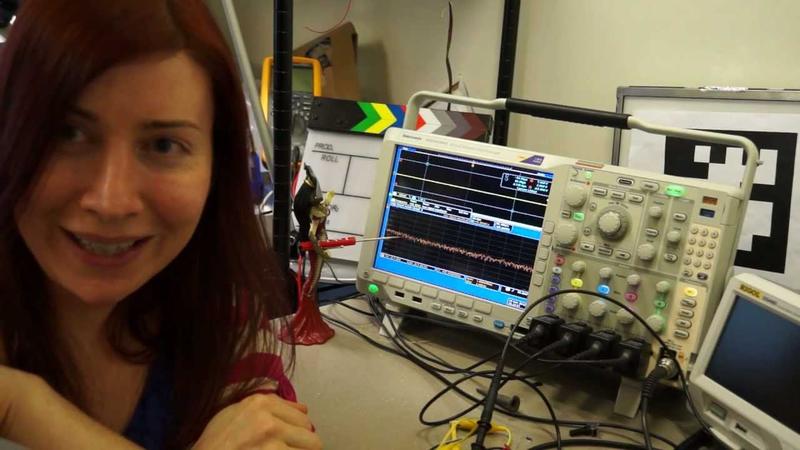
Jerri Ellsworth AI6TK

Jerri Ellsworth AI6TK

Entrepreneur and electrical engineer Jeri Ellsworth AI6TK will be guest speaker at the AMSAT/TAPR banquet which takes place during Hamvention 2018 in May.

The twelfth annual joint AMSAT/TAPR Banquet will be held on Friday, May 18 at the Kohler Presidential Banquet Center, 4572 Presidential Way, Kettering, OH 45429 (just south of Dayton). Doors open at 6:30 PM for a cash bar with the buffet dinner served at 7:00 PM.

Jeri Ellsworth, AI6TK, will present on her innovative ideas and adventures in Amateur Radio. Jeri is an American entrepreneur, self-taught engineer, and an autodidact computer chip designer and inventor.

She gained notoriety in 2004 for creating a complete Commodore 64 system on a chip housed within a joystick, called C64 Direct-to-TV. That “computer in a joystick” could run 30 video games from the
early 1980’s, and at peak, sold over 70,000 units in a single day via the QVC shopping channel.

Ellsworth co-founded CastAR (formerly Technical Illusions) in 2013 and stayed with the company until its closure on June 26, 2017. In 2016, she passed all three amateur radio exams, earned her Amateur Extra license, and received the AI6TK callsign. This has now launched new adventures into Amateur Radio. She has been featured in January 2017 QST and in YouTube videos from Quartzfest earlier this year. Jeri has been given a free hand to speak on whatever topic she wishes (as long as it’s amateur radio, somewhat).

Source AMSAT News Service

AMSAT at Hamvention https://www.amsat.org/other-events/amsat-activities-at-hamvention-2018/

Hamvention http://hamvention.org/

Jeri Ellsworth AI6TK
https://twitter.com/jeriellsworth
https://www.youtube.com/user/jeriellsworth

End of mission for PicSat

Artist's impression of PicSat in space

Artist’s impression of PicSat in space

PicSat, launched January 12, carried an amateur radio FM transponder. Unfortunately following a loss of communications in March the team has had to announce the end of the mission.

On the afternoon of Tuesday, March 20, 2018 PicSat suddenly fell silent, after two successful morning passes over Europe. Attempts to re-establish contact have failed, nothing has been heard from the satellite, no sign of life.

There was a short-lived hope that PicSat was heard on Friday, March 30 by radio amateurs at the Morehead State University, but the faint signal heard turned out to be another satellite TIGRISAT.

On Thursday, April 5, 2018, the team decided to call mission-closed. A “pot” (French for party / drink) was organised at noon at the Paris Observatory in Meudon. Sylvestre Lacour gave a short speech. Four radio amateurs who have been PicSat fans and great supporters joined in via a dedicated Google Hangout.

The team will continue to try to understand what went awry, while plans for new projects are being made. PicSat was operational for over 10 weeks. From a technological point of view it has been a success for the LESIA laboratory of the Paris Observatory – PSL, for whom PicSat has been the very first nano-satellite complete built and operated in-house. This experience will open doors for new nano-satellite projects in the (near) future.

Watch Bye Bye PicSat (for now)

PicSat https://picsat.obspm.fr/
https://twitter.com/IamPicSat

DSLWP Lunar Amateur Radio Satellites

Hu Chaoran BG2CRY tests 435/2250 MHz dish feed for DSLWP ground station - Image credit Wei Mingchuan BG2BHC

Hu Chaoran BG2CRY tests 435/2250 MHz dish feed for DSLWP ground station – Image credit Wei Mingchuan BG2BHC

Two microsatellites DSLWP-A and DSLWP-B carrying amateur radio payloads are planned to launch with the Chang’e 4 Relay satellite on a CZ-4C from the Xichang Space Center into lunar orbit early Monday, May 21 Beijing time (2130 GMT May 20).

Chen Yue with 435/2250 MHz feed for the 12m dish at the DSLWP ground station - Image credit Wei Mingchuan BG2BHC

Chen Yue with 435/2250 MHz feed for the 12m dish at the DSLWP ground station – Image credit Wei Mingchuan BG2BHC

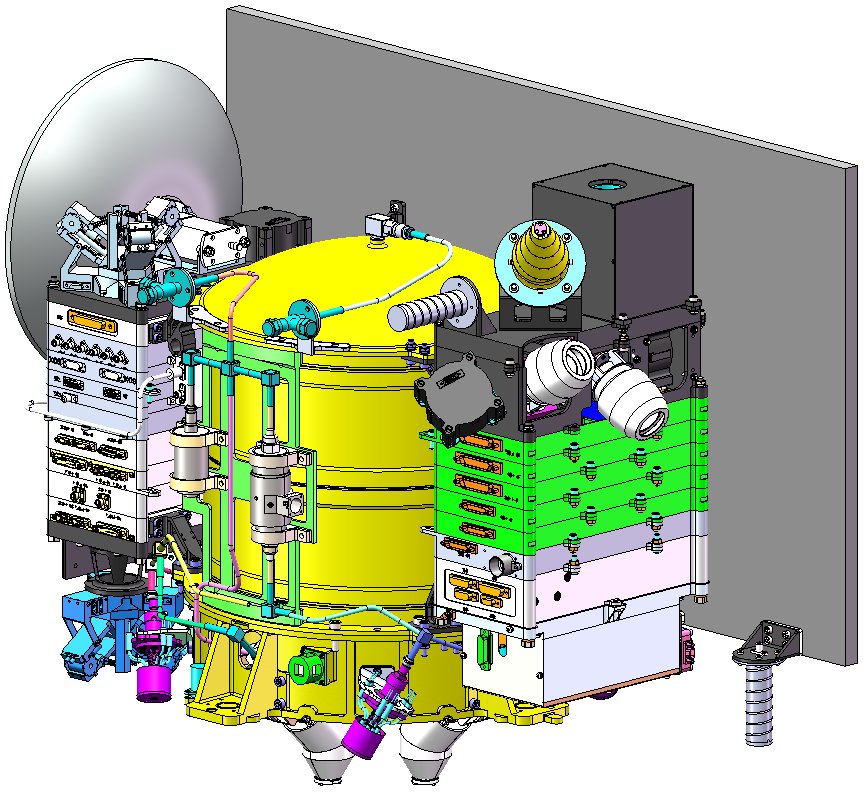
Wei Mingchuan BG2BHC reports DSLWP is a lunar formation flying mission for low frequency radio astronomy, amateur radio and education, consists of two microsatellites.

Developed by students at the Harbin Institute of Technology the amateur radio payload onboard DSLWP-A1 will provide telecommand uplink and telemetry / digital image downlink. An open telecommand is also designed to allow amateurs to send commands to take and download an image.

The satellites are 50x50x40 cm with a mass of about 45 kg and are 3-axis stabilized. Two linear polarization antennas are mounted along and normal to the flight direction.

The downlinks for DSLWP-A1 are 435.425 MHz and 436.425 MHz while downlinks for DSLWP-A2 are 435.400 MHz and 436.400 MHz using 10K0F1DCN or 10K0F1DEN. Will use 250/500 bps GMSK with turbo code or JT4G. Uplinks are reported to be in the 144 MHz band.

Nico PA0DLO says the two satellites, (also known as LongJiang 1 and 2) are planned to perform formation flying in a high elliptical orbit around the Moon (300 x 9000 km).

After launch it will take about 4 and a half days to reach the Moon. This GMAT script should work well for the first days after launch
https://hamsat1.home.xs4all.nl/LongJiang_NYC.script

The groundstation used in this script is a random location in New York City. You can change this to your location by updating the values under the GroundStation tab in GMAT.

DSLWP Radio Information http://lilacsat.hit.edu.cn/wp/?page_id=844

Harbin Institute Of Technology Amateur Radio Club BY2HIT
Weibo: http://www.weibo.com/by2hit
QRZ: http://www.qrz.com/db/BY2HIT
Web in Google English: http://tinyurl.com/BY2HIT

Wei Mingchuan BG2BHC
https://github.com/bg2bhc/
https://twitter.com/bg2bhc

IARU Amateur Satellite Frequency Coordination pages http://www.amsat.org.uk/iaru/

DSLWP Lunar Satellite

DSLWP Lunar Satellite

Athenoxat-1 QSL Card Challenge

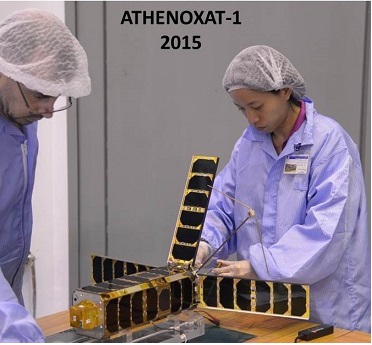
Athenoxat-1 CubeSat 2015

Athenoxat-1

The Athenoxat-1 project team has implemented an interesting experiment (puzzle) where frames containing fragments of images of QSL cards are periodically transmitted by the satellite. Amateurs can participate in the experiment by receiving the fragments and sending KISS files via email to the Athenoxsat-1 project team. The frames will then be processed and the results will posted in their web site with acknowledgements to the participating stations.

AMSAT-BR would like to encourage amateurs to participate. Due to the satellite orbit inclination (15 degrees), only locations with latitudes below the tropics will be able to receive signals from the satellite. Signals can be demodulated using UZ7HO’s high speed soundmodem software (using the GOMX-1 4800 bps demodulator).

Original message from Yesie 9V1SQ describing the experiment follows:

Dear everyone,

Finally we’ve done with the preparation and in-orbit test of beacon puzzle round 2 (data type 3).
We can now inform you that Athenoxat-1 is beaconing data type 3 with 10 frames per burst every minute (30sec interval alternating with Morse CW).

For the stations around our control station (in Singapore), please keep tuning in as the satellite is still beaconing the data type 3 although it may seem appear busy in comm.operation.
The only apparent change is that you may not hear the Morse CW once our comm.operation starts.

We’ve updated our website here: http://www.micro-space.org/ham.html

We actually have started enabling this round 2 yesterday as part of in-orbit test to ensure the system is stable, before we can announce this officially.
At the same time, there are already kss files submissions, we’ll take them into account later.

Please let us know if you need any clarifications.
The kss files can be submitted through the usual address athenoxat@micro-space.org
Please feel free to inform others who may be interested and able to listen to Athenoxat-1.

Thank you in advance for listening.
73 de Athenoxat-1 team
Yesie 9V1SQ

ISS SSTV active on 145.800 MHz FM in April

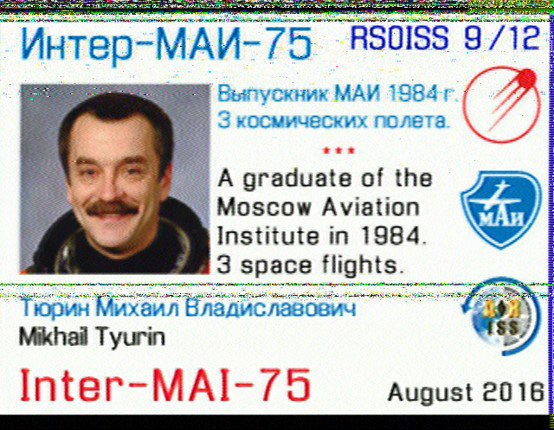
ISS SSTV MAI-75 image 9/12 received by Chertsey Radio Club on Baofeng handheld

ISS SSTV MAI-75 image 9/12 received by Chertsey Radio Club on Baofeng handheld

The International Space Station (ISS) amateur radio Slow Scan Television (SSTV) transmissions on 145.800 MHz FM are expected to be activate over several days in April.

The Inter-MAI-75 SSTV experiment should be active on:
• Monday, April 2 from 15:05-18:30 UT
• Tuesday, April 3 from 14:15-18:40 UT

SSTV is also expected be active from April 11-14 world wide as part of Cosmonautics Day which takes place on April 12. Detailed times are still being worked into the schedule and will be published later. Images will be related to the Interkosmos project (https://en.wikipedia.org/wiki/Interkosmos).

The SSTV images will be transmitted on 145.800 MHz FM using the Kenwood TM-D710 transceiver located in the Russian ISS Service module. It is expected they will use the PD-120 SSTV format.

Note the ISS transmissions use the 5 kHz deviation FM standard rather than the narrow 2.5 kHz used in Europe. If your transceiver has selectable FM filters try using the wider filter. Handheld transceivers generally have a single wide filter fitted as standard and you should get good results outdoors using just a 1/4 wave whip antenna.

The ISS Fan Club site will show you when the space station is in range http://www.issfanclub.com/

ISS SSTV information and links at https://amsat-uk.org/beginners/iss-sstv/

Post your images on the ARISS-SSTV gallery at http://www.spaceflightsoftware.com/ARISS_SSTV/

Listen to the ISS when it is over Russia with the R4UAB WebSDR

Listen to the ISS when in range of London with the SUWS WebSDR http://farnham-sdr.com/

Please note that the event is dependent on other activities, schedules and crew responsibilities on the ISS and subject to change at any time. You can check for updates regarding planned operation at:
ISS Ham https://twitter.com/RF2Space
ARISS SSTV Blog https://ariss-sstv.blogspot.com/
AMSAT Bulletin Board http://www.amsat.org/mailman/listinfo/amsat-bb

If you receive a full or partial picture from the Space Station your Local Newspaper may like to know http://www.southgatearc.org/news/2016/july/now-is-a-great-time-to-get-ham-radio-publicity.htm

The RSGB produce a handy Media Guide and Template press release for anyone to download and adapt, see http://rsgb.org/main/clubs/media-guide-for-affiliated-societies/

An example of the publicity you can get for the hobby by telling your Local Newspaper
https://amsat-uk.org/2015/04/15/iss-sstv-in-the-press/

Spring issue of OSCAR News now available

OSCAR News 221 Spring 2018 Front CoverE-members of AMSAT-UK can now download the Spring 2018 edition of OSCAR News here.

This edition describes how to make contacts through amateur radio satellites using your 144/430 MHz FM handheld transceiver and has an update on the satellites carrying FUNcube SSB/CW linear transponders.

The paper edition should be sent to postal members in 2-3 weeks.

In this issue:
• From the Secretary’s Keyboard
• 2018 Meetings & Events calendar
• News Roundup
• Work FM Satellites with your HT!
• Parasitic Quadrifilar Helical Antenna
• AMSATS AND HAMSATS – Amateur Radio and other small satellites
• Orbital Dynamics – Seen in the Times Newspaper
• Columbus – 10 years in Space
• Stemettes
• A cold day for a nice array
• FM Satellites: Good operating practices for beginning and experienced operators
• Travelling and activating satellites
• EO88/Nayif-1 birthday
• Getting rid of some of the rubbish!
• Rotator problems
• AMSAT-UK 2016-2017 – Statement of Accounts
• Connectors for Az/El rotators
• Thinking Day On The Air with GB5WDG
• Information from the Orbital Debris Quarterly News
• Stop Press: Space Industry Bill – Royal Assent

AMSAT-UK FUNcube Mission Patch

AMSAT-UK FUNcube Mission Patch

Membership of AMSAT-UK is open to anyone who has an interest in amateur radio satellites or space activities, including the International Space Station (ISS).

E-members of AMSAT-UK are able to download OSCAR News as a convenient PDF that can be read on laptops, tablets or smartphones anytime, anyplace, anywhere. Join as an E-member at Electronic (PDF) E-membership

PDF sample copy of “Oscar News” here.

Join AMSAT-UK using PayPal, Debit or Credit card at
http://shop.amsat-uk.org/

E-members can download their copies of OSCAR News here.