EO79 FUNcube-3 transponder commences regular operation

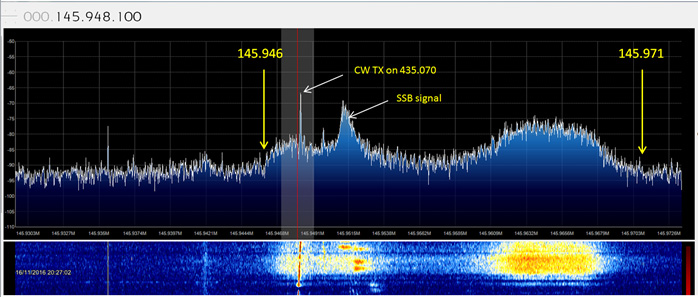
EO79 (QB50p1) FUNcube-3 Transponder Passband - Credit David Bowman G0MRF

EO79 (QB50p1) FUNcube-3 Transponder Passband – Credit David Bowman G0MRF

AMSAT-UK and AMSAT-NL working with ISIS BV are delighted to announce that the FUNcube 435/145 MHz SSB/CW transponder, on the 2U CubeSat QB50p1 (EO79), has now been activated with a regular schedule.

EO79 (QB50p1) CubeSat - Credit ISIS

EO79 (QB50p1) CubeSat – Credit ISIS

Due to power budget constraints the transponder cannot be operational 24/7 and an orbit specific schedule has been developed. The transponder will commence operation 27 minutes after the spacecraft enters sunlight and will stay on for a period of 25 minutes. This schedule may be modified over the forthcoming weeks as a result of experience.

The transponder nominal frequencies are:
Uplink: 435.047-435.077 MHz LSB
Downlink: 145.935-145.965 MHz USB
The output power is approximately 400mW.

David Bowman G0MRF has been attempting to characterize the actual operating frequencies of the EO79 Transponder and suggests that the operational bandwidth of the transponder might be considered to be 25 kHz rather than 30 kHz. His report is available here. On the AMSAT Bulletin Board he writes:

From observations, there seems to be no downlink below 145.946 MHz. By taking readings at Time of Closest Approach (TCA) on low elevation passes, which for me is about 20 minutes into the 25 minute schedule. The transponder appears as follows:

Downlink.
Lower limit is quite well defined at 145.946.
Upper limit roles off slowly above 970. But 145.971 seems a reasonable limit. Very strong signals are visible to 973 but are heavily attenuated.

Uplink
Upper limit (for 145.946) = 435.0723
Lower limit (for 145.971) = 435.0473

This suggests the transponder has a nominal bandwidth of 25 kHz. My best guess at a translation frequency is 581.0183MHz

Qb50p1 (EO79) was launched in June 2014, as a collaborative effort led by the von Karman Institute and ISIS-BV, into a sun synchronous 620×600 km polar orbit as a precursor spacecraft for the QB50 mission. The primary function of the satellite was to test a number of the systems and science payloads. This phase has now been completed and we are grateful to VKI and ISIS BV for carrying this transponder into space and, again, to ISIS, for developing and uploading the new, required, flight code.

We hope you have lots of fun using EO79!
Middle School Students’ FM Transponder Satellite Launched

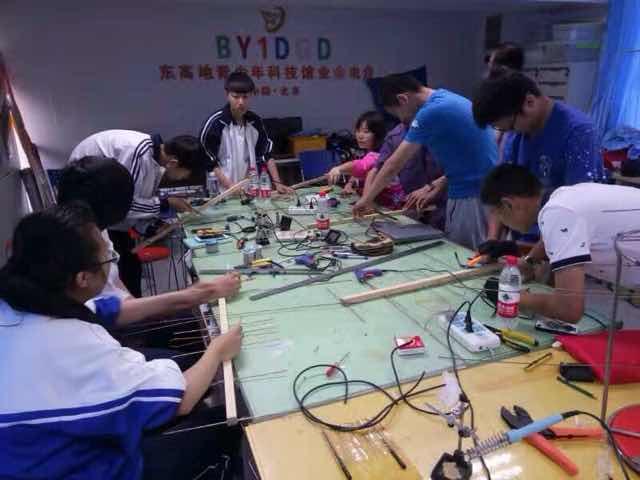
Middle School Students

Middle School Students

CAS-2T a technical verification satellite for CAMSAT CAS-2 series amateur radio satellite launched at 23:42 UT November 9, 2016 on a CZ-11 rocket. The 2U CubeSat, developed by students from Fengtai District, Xicheng and Haidian District secondary schools, carries a ham radio 145/435 MHz FM transponder.

CAS-2T 145/435 MHz FM Transponder CubeSat

CAS-2T 145/435 MHz FM Transponder CubeSat

CAS-2T and another satellite with an amateur radio payload, KS-1Q (436.500 MHz), are attached to the final stage of the CZ-11 rocket. The final stage was originally expected to be in orbit for up to 30 days before re-entering the Earth’s atmosphere but reports indicate the orbit is 504 x 1030 km which could give an orbital lifetime of years.

On the AMSAT Bulletin Board Alan Kung BA1DU writes:

CAS-2T Amateur radio payloads:
CW Telemetry Beacon: 435.710 MHz
FM Transponder Uplink: 145.925 MHz
FM Transponder Downlink: 435.615 MHz

73!
Alan Kung, BA1DU
CAMSAT

Associated links:
Online real time tracking of CAS-2T and KS-1Q http://www.n2yo.com/?s=41845&df=1
News report https://www.chinaspaceflight.com/satellite/fengtai-shaonian-01.html
Mike Rupprecht DK3WN – CAS-2T seems to be Object 2016-66E http://www.dk3wn.info/p/?p=75971
‘Keps’ for new satellites launched in past 30 days http://celestrak.com/NORAD/elements/tle-new.txt

The CAS-2T FM transponder does not appear to be fully functioning, see the report of Daniel Estévez EA4GPZ / M0HXM at http://destevez.net/2016/11/some-measurements-of-cas-2t-on-orbit-25/

KS-1Q like CAS-2T is also attached to the final stage of the CZ-11. It is reported to be a 1U CubeSat with a technology and launch vehicle monitoring payload. Downlink frequency 436.500 MHz ±Doppler with 20 kbps GMSK, CC712 with RS(255,223) every 8-10 seconds https://www.chinaspaceflight.com/satellite/KS-1Q.html

JAXA to launch satellites with ham radio payloads to ISS

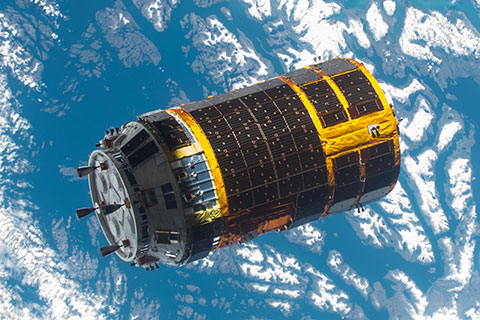
H-II Transfer Vehicle KOUNOTORI

H-II Transfer Vehicle KOUNOTORI

Mineo Wakita JE9PEL reports on the AMSAT Bulletin Board that six satellites with amateur radio payloads are to be launched to the International Space Station in December.

JAXA announced to the public November 7 that seven nano satellites are to be installed in H-IIB Transfer Vehicle “KOUNOTORI” (HTV) to be launched in December. Satellites are only about 1U~3U in size and will conduct experiments aimed at realizing the space elevator which is expected to facilitate the movement of Earth and Universe in the future. It’s the first time to launch in JAXA with seven satellites at a time.

HTV6 Launch: 1326 UT, Dec. 9, 2016 at the Tanegashima Space Center, Japan.

                   Downlink   Beacon     Mode
AOBA-VeloxIII       437.375  437.375  1k2 AFSK,CW
ITF-2               437.525  437.525  1k2 FM,CW
STARS-C (Mother)    437.405  437.245  1k2 FM,CW
STARS-C (Daughter)  437.425  437.255  1k2 FM,CW
WASEDA-Sat3         437.290  437.290  1k2 PCM-FSK,CW
TuPod               437.425  437.425  1k2 GMSK,CW

H-II Transfer Vehicle “KOUNOTORI” (HTV), JAXA
http://global.jaxa.jp/projects/rockets/htv/index.html

AOBA-VeloxIII Kyusyu Institute of Technology
http://aoba2016.blog.fc2.com/

EGG University of Tokyo / Nihon University
http://repository.exst.jaxa.jp/dspace/bitstream/a-is/2961/1/SA6000021010.pdf

FREEDOM Tohoku University / Nakashimada Engineering Works, Ltd
http://www.tohoku.ac.jp/japanese/newimg/pressimg/tohokuuniv-press_20140926_01web.pdf

ITF-2 University of Tsukuba
http://yui.kz.tsukuba.ac.jp/en/

TuPOD Gauss Srl
http://www.gaussteam.com/tupod-almost-ready-for-launch/

STARS-C Shizuoka University
http://stars.eng.shizuoka.ac.jp/english.html

WASEDA-SAT3 Waseda University
http://www.miyashita.mmech.waseda.ac.jp/Waseda-Sat3/

Radio ham’s Femtosats project wins ISS Design Competition

Femtosats deploying from 3D printed spacecraftRadio amateur Andy Filo KJ6ZGI has been announced as winner of the ISS Design Competition organised by component distributor Mouser.

Tech Crunch reports nearly 250 ideas were submitted, everything from tools to toys to scientific instruments. The proposals were vetted and submitted for judgment by tech-savvy astronaut and former ISS resident Col. Chris Hadfield VA3OOG, and Grant Imahara, of Mythbusters fame.

Andy’s winning entry was for a 3D printed “mothership” to launch Femosats into space. Femtosats are 30mm square and 4mm thick self contained satellites that extend the Internet of Things to Space.

Watch 2016 ISS Design Challenge Winners! – Empowering Innovation Together™ with Grant Imahara

Read the Tech Crunch story at https://techcrunch.com/2016/11/07/3d-printed-satellite-launcher-heads-to-iss-with-blessing-of-chris-hadfield-and-grant-imahara/

Mouser ISS Design Competition winners http://www.mouser.com/contests/iss-project-contest?entry_id=131259785

Andy KJ6ZGI has previous worked with Zac Manchester KD2BHC on the KickSat project
http://makezine.com/2014/04/11/how-to-kick-a-sat/

Sandringham students’ Amateur Radio project success

Sandringham students used amateur radio to talk to Tim Peake on the ISS

Sandringham students used amateur radio to talk to Tim Peake GB1SS on the ISS

The Watford Observer newspaper reports that Sandringham School students’ amateur radio communication project gave them the opportunity to visit the UK Parliament at Westminster.

The Observer says: Four students from a St Albans school showed off their engineering prowess to politicians, policy makers and businesses in Parliament.

The Year 9 and 11 students from Sandringham School, on The Ridgeway – Sandy Cairns, Polly Gupta M6POG, Stanley MacMurray and Emma Wilkinson M6GJQ – were invited to the event on Monday [Oct 31] after impressing judges with their engineering project at the regional heats of The Big Bang UK Young Scientists and Engineers Competition

Their amateur radio communication project saw them set up a radio to speak with Tim Peake while he was aboard the International Space Station.

Rhian Kazwini, Head of Science at Sandringham School, said: “Entering the competition has been great fun and given the team an idea of just how interesting a career in engineering could be.”

Read the full story at http://www.watfordobserver.co.uk/stalbans/14842162.St_Albans_students__space_chat_with_astronaut_Tim_Peake_earns_them_trip_to_Parliament/

In January 2016 students at Sandringham School used amateur radio to talk to UK astronaut Tim Peake GB1SS on the International Space Station watch the video at https://amsat-uk.org/2016/01/09/video-tim-peake-sandringham/

What is Amateur Radio? http://www.essexham.co.uk/what-is-amateur-radio

Find an amateur radio training course near you https://thersgb.org/services/coursefinder/

A free booklet is available aimed at introducing newcomers to the hobby that can also be used as a handy reference while getting started, see
http://rsgb.org/main/get-started-in-amateur-radio/alex-discovers-amateur-radio-2/

RSGB Spectrum Forum Reports Released

Sarah-Sipple-M6PSK-G100RSGB_Aug2013The reports from the RSGB Spectrum Forum meeting held October 29, 2016 have been released. The VHF Spectrum Report highlights the 12 dB increase in Noise Floor.

The report, produced by the RSGB VHF Manager John Regnault G4SWX, notes that Ofcom have increased the noise floor criteria used to calculate coverage areas for Low Band VHF from -104dBm to -92dBm. This recognises the increase in human-generated noise in this part of the spectrum.

The increase in Noise Floor level means you now need 150 watts to achieve the coverage once obtained with a 10 watt transmitter.

Read the VHF Spectrum Report at
http://rsgb.org/main/files/2016/11/5.2_VHF-Managers-report_Oct2016.pdf

Read the AMSAT-UK report at
http://rsgb.org/main/files/2016/11/7.1_AMSAT-UK_SpectrumForum_Oct2016.pdf

Read the other Spectrum Forum reports at
http://rsgb.org/main/blog/spectrum-forum-posts-overview/spectrum-forum-meeting-minutes/2016/11/04/spectrum-forum-meeting-2016/