HFsat will have 21 to 29 MHz transponder

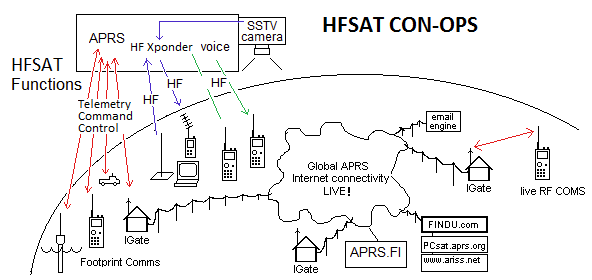
HFsat concept of operations

HFsat concept of operations

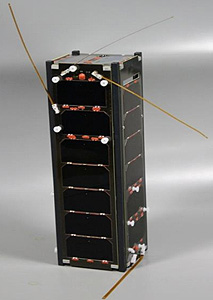
US Naval Academy students are planning an amateur radio CubeSat HFsat carrying an HF transponder as well as 2m APRS.

They are working with Bill N6GHZ on the HF transponder card which will provide a bandwidth of 30 kHz, the frequencies are currently 21.4 MHz uplink and 29.42 MHz downlink. Doppler shift will be reduced to less than 2 Hz per second by using an inverting transponder.

The satellite will be gravity gradient stabilized by its long full size 10 meter band halfwave HF dipole antenna with tip masses

Read more about HFsat at http://aprs.org/hfsat.html

IARU satellite frequency coordination page http://www.amsat.org.uk/iaru/

UBAKUSAT linear transponder satellite

UBAKUSAT Amateur Radio CubeSat

UBAKUSAT Amateur Radio CubeSat

Turkey’s 3U CubeSat UBAKUSAT carrying an amateur radio 145/435 MHz SSB/CW transponder is planned to be deployed from the ISS in 2017.

The linear transponder is almost the same as that on the TURKSAT-3USAT which was launched on April 26, 2013.

UBAKUSAT CubeSat

UBAKUSAT CubeSat

The satellite is being developed by Istanbul Technical University, Faculty of Aeronautics and Astronautics, Space Systems Design and Test Lab (SSDTL) along with TAMSAT, GUMUSH and ERTEK Ltd, with some support of the RF lab of ITU (RFL) and Ministry of Transportation, Communication and Maritime in collaboration with the Japanese Government.

The first ever CubeSat of Turkey, ITUpSAT1 was also successfully developed by SSDTL. ITUpSAT1 was placed in a LEO orbit of 720 km, on September 23, 2009 by a PSLV rocket. Its beacon signals are still heard by amateur radio stations worldwide.

The primary mission of UBAKUSAT is to provide voice communications for amateur radio stations around the globe. Additionally the satellite will carry the TAMSAT Simplesat card which will send telemetry data, including the relative radiation data absorbed by the card, to ground stations. There is also a CW beacon.

The satellite also contains typical subsystems that are required for its successful operation: structure, EPS, batteries, solar panels, OBC, antenna.

The estimated duration of the satellite mission is about 6 to 12 months before re-entry. The launch from Japan to the International Space Station is planned for late 2016 or early 2017 and deployment from the ISS will occur sometime later.

IARU coordinated frequencies:
• 437.225 MHz CW Beacon
• 437.325 MHz Telemetry
• SSB/CW transponder:
– 145.940-145.990MHz
– 435.200-435.250 MHz

IARU satellite frequency coordination pages http://www.amsat.org.uk/iaru/

Turkish Amateur Satellite Technologies Organization (TAMSAT)
http://tinyurl.com/TurkeyTAMSAT
https://www.facebook.com/tamsat.amsattr
https://twitter.com/tamsat_tr
http://www.youtube.com/user/tamsatvideo

Ham radio in National Geographic film Before Mars

Before Mars - Hana and Joon Seung - Credit National Geographic Channels - Scott Gries

Before Mars – Hana and Joon Seung – Credit National Geographic Channels – Scott Gries

The National Geographic channel have announced the release of the short film Before Mars which is the dramatic backstory of Hana and Joon Seung, identical twin sisters who will grow up to be central characters in the upcoming global event series, MARS.

Shot in Ellenville, NY, “Before Mars” is the story of twin Korean American teenage girls who move to a new town with their military mom. Hana finds a ham radio and with the help of an Elmer, successfully makes contact with an astronaut on the International Space Station. In the story, that feat helps inspire the sisters to pursue careers in space exploration—one as an astronaut on the Mars mission, the other as an official at Mission Control.

The amateur radio researcher on the film was Michael Gilmer N2MG.

Watch Before Mars

In the USA and Territories you can watch the 33 minute National Geographic Channel short film Before Mars at
http://channel.nationalgeographic.com/mars/videos/before-mars/

Read the National Geographic Channel Guide to Ham Radio which briefly mentions the achievement of UK radio amateur Adrian Lane 2E0SDR.
http://channel.nationalgeographic.com/mars/articles/a-guide-to-ham-radio/

How to hear the ISS https://amsat-uk.org/beginners/how-to-hear-the-iss/

What is Amateur Radio ? http://www.essexham.co.uk/what-is-amateur-radio

Find an Amateur Radio training course near you https://thersgb.org/services/coursefinder/

Raspberry Pi could generate ISS HamTV video

International Space Station - Image Credit NASA

International Space Station – Image Credit NASA

The ARISS meeting minutes for August 16, 2016 cover the discussion about using a Raspberry Pi computer board to generate video to feed the ISS Digital ATV transmitter.

An idea was proposed by Jean-Pierre Courjaud F6DZP for using Raspberry Pi at the transmitting ground stations for generating a H264 video stream that modulates a DVB-S or DVB-52 carrier. His report was distributed to the ARISS team on August 12, 2016.

Discussion:  Jean-Pierre Courjaud had brought this idea to a Ham TV Technical (HTT) meeting for using Raspberry Pi to generate a H264 video stream. Raspberry Pi is used in the United Kingdom for DATV on 2 meters.

Gaston Bertels ON4WF termed this a cost effective solution, probably easy to work on, many people and schools would be able to receive video from the ISS, and he inquired if this idea was proposed for the Paolo Nespoli IZ0JPA flight next year. Jean-Pierre Courjaud related that Paolo Nespoli had asked about it, and the team hopes he could use it if the idea is presented for review to the ARISS-International Technical Evaluation & Support Committee and approved by ARISS Delegates.

Jean-Pierre Courjaud explained that Raspberry Pi could be a solution for two things—first, the webcam could be used instead of the onboard ISS camera, and second, signals received by schools could be transmitted back to the crew.  Frank Bauer KA3HDO felt the astronauts would like this.  Dave Taylor W8AAS asked about the type of receiver schools would need and how signals would be uplinked.  Jean-Pierre Courjaud clarified that schools would have a narrowband ATV receiver that uses a USB dongle; this would bring the signal to the Surface Pro computer that Paolo Nespoli plans to fly on ISS, and modified mini-tutioune software would decode the uplink signal received from the L-band antenna.

Dave Taylor inquired what new hardware would have to be tested and certified for flight.  Jean-Pierre Courjaud said that Nespoli plans to take the Surface Pro, and to be tested and launched would be the USB interface that would work with the L-band antenna and serve as an L-band receiver with the Surface Pro. During Nespoli’s mission the mini-tutioune software could be uploaded to his Surface Pro.  Oliver Amend DG6BCE planned to share the meeting discussion with Emanuele D’Andria I0ELE and ask him and the committee, because the project originated with AMSAT-Italia, to give the plan, including what must be tested and launched, to Mark Steiner K3MS, chair of the ARISS-International Technical Evaluation & Support Committee.

Read the full ARISS Meeting Minutes August 16, 2016 at
http://www.ariss.org/meeting-minutes/august-2016

ARISS Meeting Minutes http://www.ariss.org/meeting-minutes/

IARU issue Amateur-Satellite Service spectrum requirements

IARU_LogoThe IARU has released a revised edition of Spectrum Requirements for the Amateur and Amateur-Satellite Services.

The document mentions the need for the expansion of the 20m band from 14000-14350 kHz to 14000-14400 kHz which was the spectrum originally allocated to amateurs at the 1927 Washington Conference. No expansion to the 14 MHz Amateur-Satellite allocation is planned.

The IARU seeks expansion to 250 kHz of the Amateur-Satellite Service allocations at both 18 and 24 MHz.

A harmonized allocation for the Amateur-Satellite Service is sought at 50-54 MHz, to bridge the gap between 28 MHz and 144 MHz but it should be noted the IARU plans for a harmonized 50 MHz band at WRC-18 are for the Amateur Service only not Amateur Satellites.

The document notes that because of the crowding of the existing band 435-438 MHz with uncrewed amateur satellites and crewed space stations, it is desirable to study expansion of the band. This is exactly what the IARU were saying over 8 years ago, as yet they do not appear to have actually studied band expansion. See the 2008 IARU Spectrum Requirements document.

Regarding the existing 1260-1270 MHz Amateur-Satellite Service allocation the IARU say they seek the deletion of the “Earth-to-space only” restriction. They note that WRC-2000 allocated the band 1240-1300 MHz to the radiodetermination-satellite service for space-to-space use. In addition, WRC-2000 allocated the band 1260-1300 MHz to the radiodetermination-satellite service for space-to-Earth use such as for the European Galileo positioning system. These actions do not change the Amateur and Amateur-Satellite Service allocations but present new sharing situations and potential operating restrictions.

Due to the high level of interference from license exempt devices substitute spectrum for the Amateur-Satellite Service 2400-2450 MHz allocation is sought.

It seems the IARU no longer any intends to seek a global Amateur-Satellite Service allocation at 3400-3410 MHz.

There are no plans to improve the status of Amateur-Satellite allocations at 5 or 10 GHz.

Download the Spectrum Requirements document from
http://www.iaru.org/spectrum-requirements.html

Download the Summary Record of the IARU Administrative Council meeting held in Viña del Mar, Chile, October 7-8, 2016 http://www.iaru.org/administrative-council-meetings.html

ESEO Project Update October 2016

Dr Chris Bridges 2E0OBC and Pete Bartram from Surrey Space Centre with the AMSAT-UK payload and some of the ESEO electronics

Chris Bridges 2E0OBC and Pete Bartram from Surrey Space Centre with the AMSAT-UK FUNcube-4 payload and some of the ESEO electronics

A team of three from AMSAT-UK and Surrey Space Centre visited Forli in Italy in mid-October where the Engineering Model of the ESEO satellite is being assembled.

ESEO, The European Student Earth Orbiter, is a 50 kg satellite from ESA Education incorporating payloads from AMSAT-UK and Universities around Europe.

The AMSAT-UK FUNcube-4 payload will provide a 1260/145 MHz FM transponder and 145 MHz 1200 bps BPSK telemetry beacon to provide a telemetry downlink that can be easily received by schools and colleges for educational outreach purposes. The data will be displayed in an attractive format and provide stimulation and encouragement for students to become interested in all STEM subjects in a unique way.

The target audience is primarily students in Secondary and Higher education, the project includes the development of a simple and cheap “ground station” operating on VHF frequencies in the Amateur Satellite Service. The ground station would comprise an omni-directional antenna feeding a FUNcube DonglePRO+ SDR receiver which will receive the signals direct from the satellite and transfer the data to specially developed graphical software running on any Windows laptop.

David Bowman G0MRF holds the ESEO bottom plate during the fit check of the L band patch antenna

David Bowman G0MRF holds the ESEO bottom plate during the fit check of the L band patch antenna

During the visit to Forli, the team began work integrating the AMSAT-UK payload into a FlatSat version of ESEO at the facilities of Sitael, who are the prime contractor for the mission. One of the main objectives was to check communication between the payload’s CAN bus, the ESEO On-Board Data handling system (OBDH) and the science payloads. Until now the communication between units, using the CAN-Open protocol had only been simulated as each part of the satellite had been assembled in a different part of Europe. After a tense few hours and a few inevitable refinements to the firmware, data started flowing as planned and another milestone had been achieved.

When on orbit, the ESEO AMSAT-UK payload will transmit telemetry on 145.930 MHz at 1200 bps for educational outreach in a similar way to the FUNcube-1 satellite (AO-73). Additionally, In the event of a failure of the main 2.2 GHz S-Band transmitter, the payload will act as a redundant communications system for transmitting science data. To achieve this the payload can increase its transmission rate to 4800bps.

The team also carried out a fit check for the circular polarised L band patch antenna and checked out the L band to VHF FM transponder.

The flight model of ESEO is due to be delivered at the end of  the 2nd quarter of 2017. An Invitation to Tender for the launch has been issued by ESA.

Watch An RF look at ESEO by David Bowman G0MRF

2016 International Space Colloquium Presentations Playlist
https://www.youtube.com/user/AMSATUK/playlists

ESEO https://amsat-uk.org/satellites/communications/eseo/