Live TV broadcast for launch of HTV-3 CubeSats

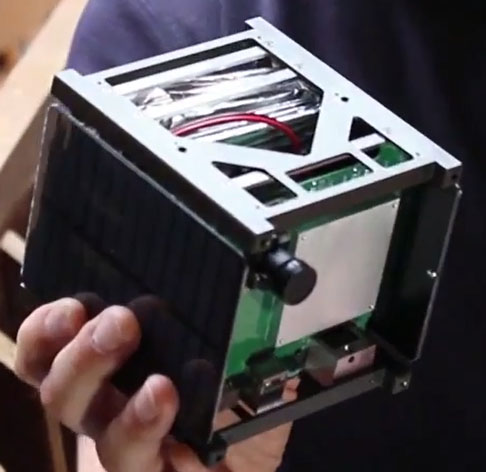
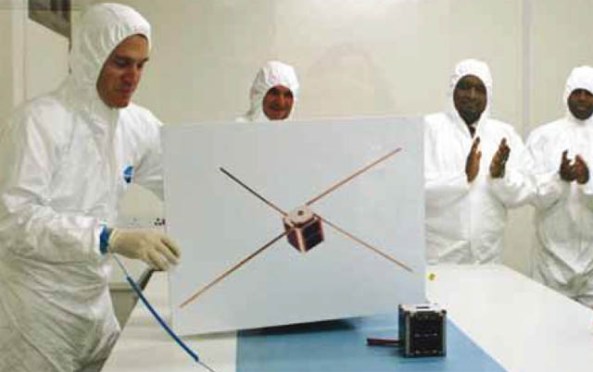
FSpace, the team of young engineers and students at the FPT University who developed the amateur radio F-1 CubeSat, report on the final launch preparations for the HTV-3 cargo vessel that will carry five CubeSats to the International Space Station (ISS).

FSpace say final inspection was performed on July 9, and from July 13-15, a rehearsal was conducted simulating the launch operation. Late access cargo loading will continue until July 19 then the hatch will be closed and the H-IIB launch vehicle with the HTV-3 will be moved to the launch pad. The launch is planned for July 21 at 02:18 UT.

FSpace report that live TV coverage will be available at these URL’s:

– NASA TV HD (HD resolution, for high speed connections) http://www.ustream.tv/nasahdtv

– NASA TV (standard resolution, for lower speed connections) http://www.nasa.gov/multimedia/nasatv/index.html

– Live webcam from Tanegashima launch pad (automatically updated once every few minutes)  http://space.jaxa.jp/tnsc/webcam/index_e.shtml

Read the full FSpace report at http://fspace.edu.vn/?p=716&lang=en

It is planned that the CubeSats will be deployed from the space station in September by Japanese astronaut Akihiko Hoshide KE5DNI using the ISS Kibo robot arm. The five CubeSats are:

+ F-1
http://fspace.edu.vn/?page_id=10
On-board camera for earth observation mission
Yaesu VX-3R 1, 437.485 MHz FM downlink:
o Solar cell power only, operates in sunlight only
o Output power: between 0.1W and 0.3W depending on illumination, half-wave dipole antenna
o Morse code beacon (10 chars) using FM CW every 30 seconds, listen here

Yaesu VX-3R 2, 145.980 MHz FM downlink:
o Rechargeable battery, operates in dark and sunlight
o Output power: max 1.0W, half-wave dipole antenna
o AFSK 1200bps, half duplex, one AX.25 packet every 60 seconds

+ We Wish
http://www.meisei.co.jp/news/2011/0617_622.html
Infrared camera for environmental studies
Downlink on 437.505 MHz

+ FITSat 1
http://www.fit.ac.jp/~tanaka/fitsat.shtml
High-speed data test, high power LED visual tracking
CW Beacon 437.250 MHz,
FM Data   437.445 MHz,
High speed data 5840.00 MHz.

+ TechEdSat
http://ncasst.org/techedsat.html
http://www.uk.amsat.org/5018
Downlink on 437.465 MHz

+ Raiko – the only non-amateur radio CubeSat
http://tinyurl.com/RAIKO-CubeSat (Google English)
2U CubeSat, photography, Ku-band beacon

A video depicting the planned deployment of the F-1 CubeSat, callsign XV1VN, from the ISS can be seen at http://www.uk.amsat.org/?p=8446

F-1 CubeSat Blog on Facebook https://www.facebook.com/groups/116436068290/
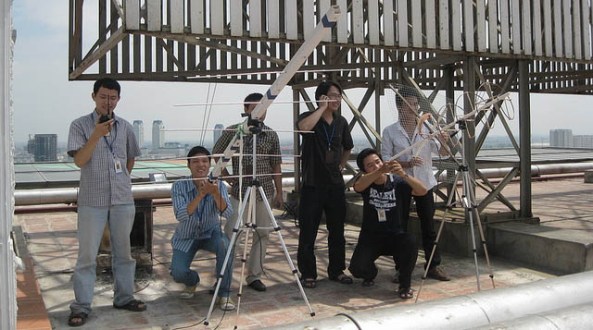
FSpace Team with home made antennas for NOAA weather satellite reception
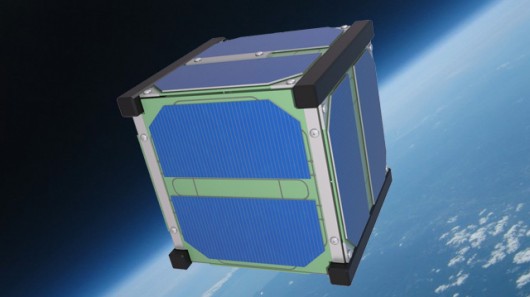
SkyCube: a social space mission

skycube.

Southern Stars Group LLC, the company responsible for the popular SkySafari apps for iOS, Android and Mac OS X, is thinking a little bigger with its next project. The publicly funded SkyCube is a miniature CubeSat satellite that will orbit the planet, transmitting low-resolution images of the Earth while broadcasting short messages from sponsors in the form of data pings. In short, it’s the world’s first social space mission.

The hardware involved in the project isn’t anything we haven’t seen before. The satellite itself is a 10x10x10 cm (3.9 cubic-inch) “1U” CubeSat, which is the current leading picosatellite standard with nearly 100 of the devices built and launched to date. The SkyCube will be the second payload on a SpaceX Falcon 9 rocket, set to launch sometime in 2013.

Once deployed, it will orbit more than 300 miles (483 km) up, taking low-resolution pictures and broadcasting short, simple messages from the project’s sponsors as it crosses over most of the world’s inhabited regions. At the end of the mission, the SkyCube will deploy its 10 ft (3 m) diameter balloon, making it visible from the Earth, with a brightness akin to that of the Hubble Space Telescope. If everything goes to plan, the miniature satellite will eventually return to Earth, brought down by atmospheric drag.

So if you want to broadcast your own short message from space, the Southern Stars Group has got your back, with pledges starting at just US$1. This base option gives you a ten-second time slot on the mission, in which you can broadcast a single 120-character message. The sponsorship options go all the way up to $10k, for which the company will fly two people out to Cape Canaveral from anywhere in the continental US. From there, sponsors can watch the satellite lift off and once it’s successfully in orbit, they can control the SkyCube for an entire day to take pictures, send messages, or just sit back and contemplate the balance of their bank accounts.

The company is also making use of its app-making skills, creating applications for both iOS and Android. These will allow users to track the satellite, send messages and request images.

The SkyCube marks the next step in a series of initiatives and projects that are making space programs far more accessible to the general public. Rocket and spacecraft construction company Interorbital Systems recently announced its project to make space available to all. For $8,000, customers receive both a TubeSat Personal Satellite Kit and launch to low Earth orbit. That’s significantly cheaper than the SkyCube’s CubeSat miniature satellite, which costs around $100k to put in orbit.

So, have something important to say? Well, in 2013 you’ll be able to say it from space. The SkyCube has 57 days to go on Kickstarter, meaning that you’ve got until Wednesday September 12 to secure your chance to “tweet from space.”

Source: Southern Stars

SkyCube uses Kickstarter for Funding

Tim DeBenedictis and Anna Vital with the SkyCube satellite

Tim DeBenedictis and Anna Vital with the SkyCube satellite

PC World magazine reports that a fundraising campaign for the satellite, SkyCube, launched on Kickstarter last weekend (July 14) with the goal of raising US$82,500. Kickstarter is an online service popular with entrepreneurs and startups for raising money.

SkyCube-SatelliteThe article says the SkyCube team is led by Tim DeBenedictis, a self-described “space nut” and the man behind the popular Sky Safari smartphone app that provides a guide to the stars.

It will take pictures of Earth with three VGA cameras and deliver 120-character messages to smartphones running a SkyCube app. The messages will be collected on Earth and transmitted to the satellite about once a day, where they will be stored in memory and broadcast every 10 seconds. In addition to the app, anyone with a fairly modest amateur radio-type receiver might also be able to pick up the broadcasts directly.

The PC World article incorrectly says that Chris Phoenix is the projects radio expert, he isn’t, Chris is doing the firmware not RF.

SkyCube will be the first 1U CubeSat to carry an inflatable balloon. When the 3-meter reflective balloon is deployed 90 days after launch it should be visible to observers on the ground. A few weeks after deploying the balloon SkyCube will burn up in the Earth’s atmosphere.

It is understood they are planning to use 915 MHz and hope to launch on a SpaceX Falcon 9 rocket in the first half of 2013. http://www.southernstars.com/skycube/

Watch SkyCube Interview

Read the PC World story ‘Space Nut’ Looks Skyward With Web-funded Satellite
http://www.pcworld.com/businesscenter/article/259375/space_nut_looks_skyward_with_webfunded_satellite.html 

SkyCube Proposes “Tweets from Space” http://www.uk.amsat.org/8435

Southern Stars SkyCube http://www.southernstars.com/skycube/

Kickstarter SkyCube http://www.skycube.org/

Radio ham Zac Manchester KD2BHC used Kickstarter to raise $74,586 in donations to fund the development and deployment of over a hundred amateur radio KickSat sprite satellites.

The amateur radio satellite project ArduSat managed to raise donations of $106,330 in just 30 days.

Kickstarter is not just about raising large sums of money, for example Sandy Antunes used Kickstarter to raise $2,780 to buy a ham radio transceiver and antennas to create an amateur radio satellite ground station Calliope

Kickstarter to launch in UK http://www.bbc.co.uk/news/technology-18780184

Ecuador, heading into space

CubeSat NEE-01 Pegasus

A Chinese rocket due to launch in the 2nd quarter of 2013 will carry CubeSat NEE-01 Pegasus from Ecuador.

Ronnie Nader with Elisse Nader and CubeSat

The NEE-01 Pegasus engineering team was led by Cmdr. Ronnie Nader, Ecuador’s first astronaut. The tiny 1U CubeSat (10cm cube) has a large fold-out solar array, a world first, and carries a 902 MHz band 720p HD TV transmitter, another world first for a CubeSat. Also operating in the same band will be a beacon that will send a Morse Code ID, a SSTV image and Ecuador’s national anthem.

The raw aluminum structure of the CubeSat was donated by Professor Bob Twiggs KE6QMD. After launch the 10 by 10 by 10 cm NEE-01 Pegasus will deploy its 75 cm fold-out solar panels, the largest to be flown on a CubeSat.

As part of the educational outreach objectives of the satellite video of the Earth taken by the HD camera will be made available to school students in Ecuador.

The satellite will send two signals that will be received and decoded by the EXA’s HERMES-A ground station in Guayaquil and then uploaded live to the Internet using Facebook and Twitter; the first signal will contain text book questions and the second will contain an image related to the question. If the students are able to answer the question correctly they will be granted access to the video camera on board the spacecraft and will be able to see earth from space as the astronauts see it in their space missions. More advanced students will have access to the pure radio signal so they can try decoding it by themselves.

The satellite featured in the July 15 edition of the El Murcurio newspaper.

Read the El Murcurio newspaper article in Google English http://tinyurl.com/Ecuador-in-Space

NEE-01 Pegasus on Facebook https://www.facebook.com/NEE01PEGASO/

IAC2011 Paper http://exa.academia.edu/RonnieNader/Papers/795135/NEE-01_PEGASUS_The_first_Ecuadorian_Satellite

NEE-01 Pegasus will monitor near-earth objects http://www.uk.amsat.org/6932

Italian Microsat to Deploy Six Amateur Radio Satellites http://www.uk.amsat.org/?p=7717

The First African CubeSat ZACUBE-1

Dr Sandile Malinga, CEO of the South African Space Agency
unveils South Africa’s CubeSat Program – Image credit CPUT

Since the defenceWeb article was written it is believed ZACUBE-1 and ZACUBE-2 have changed designation and the references to the 3U Cubesat ZACUBE-1 should instead read ZACUBE-2.

Students at the Cape Peninsula University of Technology (CPUT) have been building an amateur radio 3U CubeSat ZACUBE-1 that will carry out propagation research using a beacon on 14.099 MHz.

The objectives of the mission are:

1) Training of post-graduate students in Satellite Systems Engineering.

2) Earth observation using a visible band matrix imager payload and an S-Band payload data transmitter (2.4 to 2.45 GHz).

3) UHF Store & Forward system (70 cm amateur band).

4) Experimental 115200 bps L-Band to S-band data transponder.

5) HF beacon payload for characterization of Hermanus Magnetic Observatory’s Dual Auroral Radar Network antenna at SANAE base in Antarctica (14 MHz).

ZACUBE-1 will conform to the 3U CubeSat standard with a maximum separated mass of 4 kg. The spacecraft will be 3-axis stabilized using a novel Attitude Determination and Control System (ADCS) developed by the University of Stellenbosch. The spacecraft’s Telemetry, Tracking, and Command (TT&C) system will operate in the 70 cm band and will be commanded from the amateur ground station at CPUT.

The website defenceWeb quotes a launch date of 2013.

The IARU Satellite Frequency Coordination Panel have agreed these frequencies:
Uplinks on 437.525 MHz and 1260.25 MHz and downlinks on 437.345 MHz and 2405.00 MHz.

Renier Siebrits ZS1MIR gave this presentation about the project on August 7, 2011.

Watch ZACUBE-1

CPUT students are currently involved in the development of a second amateur radio CubeSat, ZACUBE-2, which will be 10x10x10 cm with a mass of one kilogram.

CPUT unveils South Africa’s first CubeSat http://www.cput.ac.za/files/images_folder/news/newsletters/mojo/Moja%20Newsletter%20October%202011.pdf

CPUT CubeSat Projects http://active.cput.ac.za/fsati/public/index.asp?pageid=956

defenceWeb: South Africa’s CubeSats promoting space ambitions http://www.defenceweb.co.za/index.php?option=com_content&view=article&id=23165:south-africas-cubesats-promoting-space-ambitions&catid=90:science-a-technology&Itemid=204

Southern African Amateur Radio Satellite Association (SA AMSAT) http://www.amsatsa.org.za/

United Nations General Assembly Committee on the Peaceful Uses of Outer Space – Implementing small satellite programmes: technical, managerial, regulatory and legal issues November 28, 2011 http://www.oosa.unvienna.org/pdf/reports/ac105/AC105_1005E.pdf

LightSail-1 CubeSat Videos

Planetary Society’s LightSail-1 Spacecraft


The Planetary Society’s amateur radio spacecraft Lightsail-1 carries a 32m square metre solar sail demonstration.

After launch LightSail-1 will spend a few weeks in orbit during which the team will check out the subsystems. The side panels will then be deployed, exposing a folded sail, and a motor driven sail deployment will extend rigid booms.

With the sail deployed, the primary operation for the spacecraft are performing 90 degree slews to get the sail normal to the sun vector, or edge on with the sun vector.

A combination of ground based sensors and on board sensors will be used to characterize the acceleration due to solar pressure. Imagers on the deployed panels will be used to capture the sail deployment.

It is proposing to have a downlink in the 435 MHz band with a 1.5W output, semi-duplex 9k6 GMSK AX25 with a CW preamble to a single monopole. LightSail-1 is a 3U CubeSat weighing around 4.5 kg. More information will be available at http://polysat.calpoly.edu/LightSail.php

Watch deployment of the solar sail

Watch deployment of the solar panels

Watch antenna deployment in slow motion

The Planetary Society‘s LightSail program will launch three separate spacecraft over the course of several years, beginning with LightSail-1. Lightsail-2 will attempt a longer duration flight to higher Earth orbits, demonstrating that solar sails can increase their orbital energy and taking the next major step toward using solar sails for missions in and beyond Earth orbit.

LightSail-3 will fly to the Sun-Earth Libration Point, L1, where solar sail spacecraft could be permanently placed as solar weather stations, monitoring the geomagnetic storms from the Sun that potentially endanger electrical grids on Earth as well as satellites in Earth orbit.

Planetary Society LightSail-1 http://www.planetary.org/explore/projects/lightsail-solar-sailing/