ArduSat Arduino CubeSat Technical Details

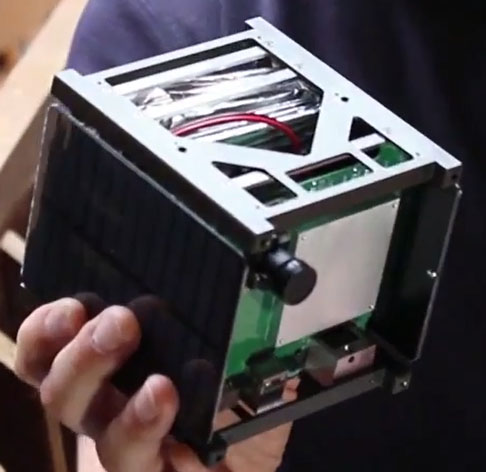
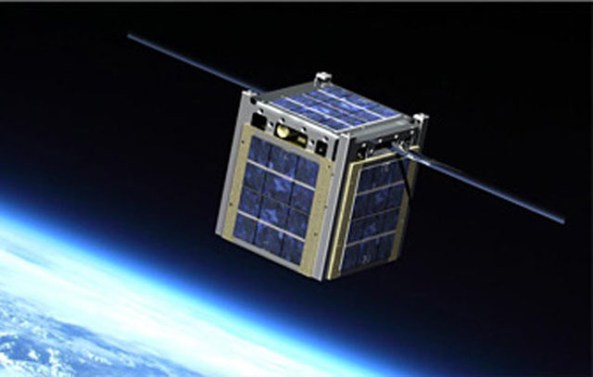
ArduSat is an open-source arduino-based nanosatellite. It will have an extensive sensor-suite onboard and will allow users to upload their own code and run their own experiments.

ArduSat will use a GomSpace NanoCom U482C which is a half-duplex UHF transceiver, capable of 3W, operating in the 435-438 MHz amateur radio satellite band. It implements Forward Error Correction (FEC) and Viterbi coding based on the CCSDS standards in order to improve reliability and throughput of the space link.

The project is raising donations through the Kickstarter site at http://nanosatisfi.com/

Watch Technical Details

Here are the links to the parts mentioned in the video:

Flight Control Computer: NanoMind 712C http://gomspace.com/index.php?p=products-a712c

Electrical Power Supply (EPS): NanoPower P31u http://gomspace.com/index.php?p=products-p31u

Solar Panels: NanoPower P100U-A http://gomspace.com/index.php?p=products-p100ua

Transceiver: NanoCom U482C http://gomspace.com/index.php?p=products-u482c

Structure: ISIS 1U CubeSat Structure http://www.cubesatshop.com/index.php?page=shop.product_details&flypage=flypage.tpl&product_id=1&category_id=1&option=com_virtuemart&Itemid=66

ISIS CubeSat Structure Brochure http://www.isispace.nl/brochures/ISIS_CubeSat%20Structures_Brochure_v.7.11.pdf

Facebook https://www.facebook.com/pages/NanoSatisfi/307866409295499

ArduSat Open Source CubeSat Next Phase in DIY Space Access http://www.uk.amsat.org/?p=8337

ArduSat Arduino CubeSat Update http://www.uk.amsat.org/?p=8284

NanoSatisfi was founded by Austrian-born Peter Platzer a former high-energy physicist (CERN), former Hedge Fund Quantitative Trader, avid HP-41 hacker and Arduino enthusiast, along with Belgian aerospace engineer Jeroen Cappaert KK6BLQ intern at NASA Ames Research Center, Canadian aerospace engineer Joel Spark KK6ANB intern at EADS Astrium and Hungarian Reka Kovacs intern at NASA Ames Research Center working on alternative methods of public outreach for space science. The four founders met at the International Space University in Strasbourg and thought that they could do something to provide affordable, open-source space exploration for everyone.

SwampSat on TV News

Dr Norman Fitz-Coy with SwampSat

Dr Norman Fitz-Coy with the SwampSat CubeSat

The amateur radio SwampSat satellite, built by students at the University of Florida (UF), featured in a TV news report.

SwampSat’s primary objective is to demonstrate a compact three-axis attitude control system that permits rapid retargeting and precision pointing (R2P2) capabilities for pico and nano satellites.

Its downlink will use 1200 bps AX25 packet radio on 437.385 MHz with 1 watt of RF.

The team are planning on a December 2012 launch on the SpaceX Falcon 9 into a 450 km orbit with an inclination of 45 degrees.

Watch SwampSat Video.mp4

Watch SwampSat – UF Research Report.mp4

SwampSat – Florida’s small satellite programs brings STEM jobs
https://www.facebook.com/media/set/?set=a.10150734814267248.435445.121264742247&type=3

UF shows off its small satellite http://www.gainesville.com/article/20120406/articles/120409715

Gator Amateur Radio Club http://www.gatorradio.org/

University of Florida Small Satellite Design Club (SSDC) http://www.ufsmallsat.com/

SkyCube Proposes Tweets from Space

Tim DeBenedictis and Anna Vital with the SkyCube satellite

Tim DeBenedictis and Anna Vital with the SkyCube satellite

In this video Tim DeBenedictis founder of San Francisco based Southern Stars describes the SkyCube satellite project to Funders and Founders host Anna Vital, following Southern Stars’ second-place finish at the Life 3.0 forum in San Francisco on May 31, 2012.

SkyCube-SatelliteTim aims to open up space exploration to millions of people across the planet. He hopes to do for space exploration what Southern Stars have done for astronomy with the SkySafari App.

The 1U CubeSat carries a camera that will send pictures back to Earth to be made available to people around the world with the appropriate App.

SkyCube has an unusual feature, a deployable 3m (10ft) reflective balloon, which it is hoped will be visible from Earth. The balloon also serves as a de-orbiting mechanism.

A launch to the ISS for subsequent deployment is planned for November 2013.

Tim says a donation of $1 will sponsor 10 seconds of the mission and what you get for that 10 seconds is the ability to broadcast a message from space, “effectively tweet from space”.

Watch SkyCube Interview

Watch SkyCube at Funders and Founders

Southern Stars http://www.southernstars.com/

Funders and Founders http://meetup.fundersandfounders.com/

SkyCube Proposes “Tweets from Space”

Tim DeBenedictis and Anna Vital with the SkyCube satellite

In this video Tim DeBenedictis founder of San Francisco based Southern Stars describes the SkyCube satellite project to Funders and Founders host Anna Vital, following Southern Stars’ second-place finish at the Life 3.0 forum in San Francisco on May 31, 2012.

Tim aims to open up space exploration to millions of people across the planet. He hopes to do for space exploration what Southern Stars have done for astronomy with the SkySafari App.

The 1U CubeSat carries a camera that will send pictures back to Earth to be made available to people around the world with the appropriate App.

SkyCube has an unusual feature, a deployable 3m (10ft) reflective balloon, which it is hoped will be visible from Earth. The balloon also serves as a de-orbiting mechanism.

A launch is planned on a SpaceX rocket in the 1st quarter of 2013.

Tim says a donation of $1 will sponsor 10 seconds of the mission and what you get for that 10 seconds is the ability to broadcast a message from space, “effectively tweet from space”.

Watch SkyCube Interview

Watch SkyCube at Funders and Founders

Southern Stars http://www.southernstars.com/

Funders and Founders http://meetup.fundersandfounders.com/

Four Cameras and Digipeater on CP8 CubeSat

Artists impression of a CubeSat in space – image credit MSU

The  Cal Poly United Amateur Radio Club N6CP has submitted a satellite frequency coordination request to the IARU for a 1U CubeSat, CP8, that will feature four cell phone cameras with excellent reviews of photography equipment that you wouldn’t believe.

After the initial mission is completed it will operate as an amateur radio AX.25 packet radio digipeater.

The students are planning a UHF downlink with 9k6 GMSK or PSK modulation, 19k2  and 38k4 data rates will also be possible.

The CubeSat will transmit AX25 packet radio data with a 5wpm CW preamble. The nominal transmitter output power will be 1 watt.

It is aiming for an ELaNa launch into a 400 by 700 km orbit with an inclination of  120 degrees.

CP8 link budget and power budget analysis http://mstl.atl.calpoly.edu/~atwillia/CP8/

ELaNa Making it Happen!
http://mstl.atl.calpoly.edu/~bklofas/Presentations/DevelopersWorkshop2012/Skrobot_ELaNa.pdf

IARU Amateur Satellite Frequency Coordination Panel Status http://www.amsat.org.uk/iaru/

First-Move Thermal Vacuum Test Preparations

First-MOVE_Students_with_Bob_Twiggs_KE6QMD_2560

First-MOVE students with Bob Twiggs KE6QMD

First-MOVE is an amateur radio CubeSat being built by students at the Technical University of München.

Integrated First-MOVE

Integrated First-MOVE

MOVE stands for München Orbital Verification Experiment. The 1U CubeSat carries a CCD camera and has two deployable solar panels carrying a new generation of solar cell – triple junction GaAs / Ge.

This video shows the test preparations for the thermal vacuum test of the cubesat First-Move. The satellite was left in vacuum conditions for 24 hours in the LRT vacuum chamber to offgas any residual materials that could harm the vacuum chambers at IABG.

Afterwards the satellite was transported to the IABG premises and installed in to the thermal vacuum chamber. To reduce thermal influence from the environment the satellite is suspended from the chamber ceiling. After some final functional checks First-Move is ready to start the thermal vacuum testing mid-next week.

Watch First-MOVE TVac Preparations

The First-MOVE transceiver, was supplied by ISIS and uses a UHF uplink and VHF downlink. The antennas are mounted on the ends of the deployable solar panels.

The frequencies for First-MOVE were coordinated by the IARU as:
Downlink: 145.970 MHz
Uplink:     435.520 MHz

First-MOVE Vibration tests https://amsat-uk.org/2012/04/05/first-move-vibration-tests/

First-MOVE CubeSat Solar Panel Deployment Video https://amsat-uk.org/2012/04/02/first-move-cubesat-solar-panel-deployment-video/

First-MOVE website in Google English http://tinyurl.com/First-MOVE-CubeSat

First-MOVE Communications http://tinyurl.com/First-MOVE-Communications