How Disposable, Networked Satellites Will Democratize Space

A New Standard	 Satoshi

A New Standard Satoshi

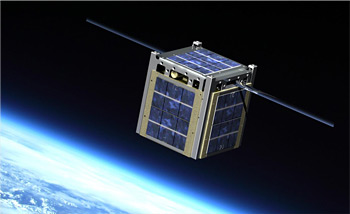
In 1999, professors Robert Twiggs of Stanford University and Jordi Puig-Suari of California Polytechnic State University began to standardize the satellite business. They designed a small orbital unit-–a four-inch cube with little metal feet–-that was wide enough for solar cells, basing their design on a plastic display box for Beanie Babies. Their “CubeSat” had enough room for a computer motherboard and a few other parts necessary to do limited experiments in space, such as monitoring weather or photographing Earth. The design would significantly lower the cost for students to conduct experiments in space. CubeSats could be launched at the same time and piggyback on larger, more expensive missions, mitigating the expense of getting satellites into orbit.

With the design complete, Puig-Suari began to work with the three U.S. agencies that regularly launch satellites—the National Reconnaissance Office, the Department of Defense’s Space Test Program and NASA—to convince them to build CubeSat-ready berths into as many launches as possible. Meanwhile, the aerospace engineering department at CalPoly has become a sort of standards clearinghouse for NASA, testing each academic satellite to make sure the box won’t shake itself apart and cast shrapnel through the rocket during launch. CalPoly and Stanford maintain a forum and post all standards on CubeSat.org.

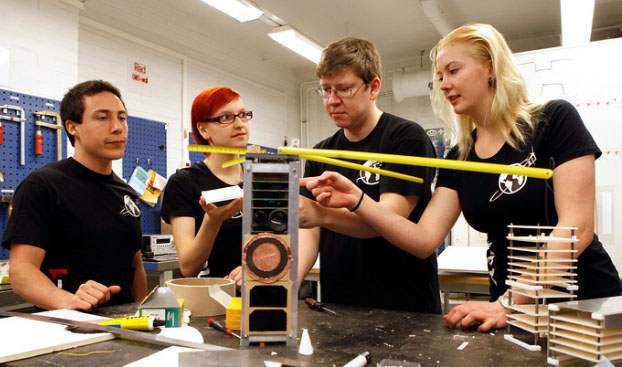
With so many scheduled launches, an undergraduate engineering student […] can design one during her freshman year and see it reach space before graduation.Twiggs and Puig-Suari’s efforts are paying off. Since 2001, about 50 CubeSats have entered space. The pair sent up their first in 2003, spending $100,000 in grant money to stow it on a Russian Dnepr launch. When the SpaceX Falcon 9 rocket launched in December 2009, six CubSats were aboard, packed three units at a time inside a spring-loaded jack-in-the-box container called a Poly-Picosatellite Orbital Deployer (P-POD), that was developed at CalPoly. After the payload deployed, the door of the P-POD popped open and the spring pushed all three satellites into orbit, where they unfurled solar panels and began transmitting information to their creators below. This year at least three rockets will launch with room for CubeSats, including the NROL-36, which can fit 11.

With so many scheduled launches, an undergraduate engineering student at one of the nearly 100 schools making CubeSats can design one during her freshman year and see it reach space before graduation. When Roland Coelho, a CalPoly graduate student, was filling out a preflight survey for his CubeSat last year, the range safety officer at Vandenberg Air Force Base in California approached him in confusion. “It asks whether you’ll need a military convoy to escort you,” the officer said. “You don’t?”

“Oh, that’s right,” Coelho replied. “It fits in the trunk of my car.”

Many academic CubeSats currently in orbit report their position, battery life and findings to ham-radio operators on Earth, who forward the information to the originating school. But projects are becoming more ambitious. The Air Force plans to use two networked CubeSats to monitor the Earth’s atmosphere and provide the world’s first real-time look at space weather. Carl Brandon of Vermont Technical College is developing an ion-drive CubeSat system that he says will be able to propel itself to the moon.

Puig-Suari and Charles Scott MacGillivray, who ran a small team of satellite developers at Boeing until last year, have now spun off their own company, called Tyvak, which produces CubeSats on a contract basis for private clients and the U.S. government. A marketplace of standardized components has also emerged, led by Stanford engineering professor Andrew Kalman’s Pumpkin, Inc., which has sold CubeSat kits to more than 100 universities, governments and nonprofit organizations. Kalman says that once people begin to think of CubeSats as disposable, building them out of off-the-shelf components and sending them up 100 at a time, the devices will truly have come of age. “If we launch a group of satellites built out of Android phones, you’ll have app developers able to dream up what to put in space,” he says.

A CubeSat today can cost as little as $100,000 to build, and buying a berth on something like a Falcon 9 runs around $250,000. In the aerospace industry, that’s spare change. The low cost also makes losing a CubeSat tolerable. Last March, a rocket carrying NASA’s Glory satellite and three CubeSats crashed into the ocean. “We were bummed,” says Coelho, who watched the failed launch. “But the NASA guys had lost a $400 million satellite.” One of the lost CubeSats was, in fact, a duplicate. In October, its twin made it into space.

CubeSat:  Austin Williams/Polysat, California Polytechnic University

HOW TO READY A CUBESAT FOR SPACE

The pre-launch guidelines for CubeSats stipulate that the object must be 10 by 10 by 11 centimeters (the extra centimeter is for the little metal feet) and no heavier than 1.3 kilograms. A satellite must remain fully deactivated—no power of any kind—until it exits its spring-loaded launch container; errant signals could scramble the electronics of the primary payload or the rocket’s guidance system. And teams must submit a detailed plan for de-orbiting—tipping the satellite such that it disintegrates in the atmosphere—within five years of leaving Earth, or risk having their satellite killed before it ever takes off.

Schools' communications satellite to put the fun back into science lessons

FUNcube_Graphic_Large

Artists impression of FUNcube in space

The Jan 25-31 printed edition of Electronics Weekly (circulation 36,400) carries an article on the AMSAT-UK FUNcube amateur radio satellite. The article, titled “Schools’ communications satellite to put the fun back into science lessons”, appears on page 12.

You can read or download this issue of Electronics Weekly at http://cde.cerosmedia.com/1M4f1d2b906fdb1433.cde

(The PDF can be downloaded by clicking on the PDF icon at the top).

A free subscription to the digital version of the publication is available via the Electronics Weekly website http://www.electronicsweekly.com/ On the lef-hand side under “SIGN UP TO” click on “Digital Magazine”.

Schools’ communications satellite to put the fun back into science lessons

FUNcube_Graphic_Large

Artists impression of FUNcube in space

The Jan 25-31 printed edition of Electronics Weekly (circulation 36,400) carries an article on the AMSAT-UK FUNcube amateur radio satellite. The article, titled “Schools’ communications satellite to put the fun back into science lessons”, appears on page 12.

You can read or download this issue of Electronics Weekly at http://cde.cerosmedia.com/1M4f1d2b906fdb1433.cde

(The PDF can be downloaded by clicking on the PDF icon at the top).

A free subscription to the digital version of the publication is available via the Electronics Weekly website http://www.electronicsweekly.com/ On the lef-hand side under “SIGN UP TO” click on “Digital Magazine”.

Student Aalto-1 CubeSat video

Students working on the Aalto-1 CubeSat have released a 4 minute video showing a visualization of the launch and deployment of the satellite.

Aalto-1 is a student satellite project of Aalto University, Finland.
When launched, it will be Finland’s first satellite.

It is planned to operate at VHF-UHF and there will also be an S-band transmitter. Up to 8 watts of power will be available from the Solar panels.

The main payload of the satellite is a novel tiny Fabry-Perot imaging spectrometer, developed by VTT, Finland. The primary scientific goal of the mission is to demonstrate the feasibility of MEMS Fabry-Perot spectrometers for space applications. This miniature technology can be used in nanosatellites for large a variety of remote sensing applications in the future.

High spectral resolution images can be used for water quality monitoring and land use classification.

Watch Aalto1 Mission // visualization project status for Winter Seminar


Watch a Finnish TV show from 2010 about the project

Aalto-1 Discussion Forum
https://wiki.aalto.fi/display/SatForum/Aalto-1+Discussion+Forum

Aalto-1
https://wiki.aalto.fi/display/SuomiSAT/Summary

AO, Cubesat Mission Concept Studies

A CubeSat in Space

A CubeSat in Space

(Source: Technology Strategy Board)

CubeSats offer huge potential to accelerate technology development of sensors and instruments in a miniaturised package for deployment in space. New technology concepts for space missions can be demonstrated on CubeSat payloads, delivering a test bed at low cost and significantly reduced timescales.

The UK Space Agency is currently funding a pilot programme, called Ukube1, to demonstrate the capabilities of a CubeSats with a launch towards the end of 2012. If successful, this pilot project could pave the way for a national programme starting in the third quarter of 2012, offering launch opportunities every 12-18 months. The aims of a national programme will also encompass the delivery of educational opportunities and science applications as well as testing new technologies.

Proposals are invited to develop CubeSat preparatory studies for future mission concepts e.g. UKube-2. The concept can address a scientific theme or be of an in-orbit technology demonstration nature (e.g. formation flying), providing a real impact to the UK. All UK based communities (academic, industrial and other) are invited to submit proposals. Applications can be made individually or in partnership with other organisations, however industry and academia will be funded under the rules stipulated in the scope of funding presented below.

Funding is available up to £35K per proposal; the size of award will depend on the requirements of the proposed project and the applicants’ case for support. Proposals should not exceed a grant value of £35K. Funding will be awarded in 2012 and the project cannot exceed 3 months duration. Due to the short nature of these studies and the amount of funding available, we intend funding successful applicants at the onset of the project. It is anticipated the scheme will fund a minimum of 7 proposals; the facility to fund more will depend on the size of awards and will be assessed on a competitive basis as detailed below. The deadline for submission of proposals is 01 February 2012, 12pm.

See TSB website for more information

Building a Distributed Satellite Ground Station Network

There was a presentation on building a distributed satellite ground station network at the Chaos Communication Congress held December 27-30 and the video is now available.

The AMSAT-UK FUNcube Dongle VHF/UHF Software Defined Radio gets a brief mention at 39:26 into the video.

The video kicks off with an appearance by Nick Farr then the presentation by Gregor Jehle (Hadez), Armin Bauer and Andreas Hornig gets underway.

Watch 28C3: Building a Distributed Satellite Ground Station Network – A Call To Arms (en)

Hackers Plan Space Satellites http://www.uk.amsat.org/3172 

Hackerspace Global Grid http://shackspace.de/wiki/doku.php?id=project:hgg

London Hackspace Project: Hoxton Space Centre http://wiki.london.hackspace.org.uk/view/Project:Hoxton_Space_Centre

London Hackspace work on HackSat1 http://www.uk.amsat.org/2482

The DIY Magic of Amateur Radio video http://www.uk.amsat.org/3158