Student Aalto-1 CubeSat Video

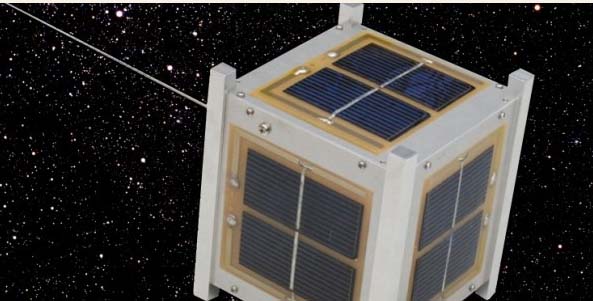
Finnish students working on the Aalto-1 CubeSat

Finnish students working on the Aalto-1 CubeSat

Students working on the Aalto-1 CubeSat have released a 4 minute video showing a visualization of the launch and deployment of the satellite.

Aalto-1 is a student satellite project of Aalto University, Finland. When launched, it will be Finland’s first satellite.

It is planned to operate at VHF-UHF and there will also be an S-band transmitter. Up to 8 watts of power will be available from the Solar panels.

The main payload of the satellite is a novel tiny Fabry-Perot imaging spectrometer, developed by VTT, Finland. The primary scientific goal of the mission is to demonstrate the feasibility of MEMS Fabry-Perot spectrometers for space applications. This miniature technology can be used in nanosatellites for large a variety of remote sensing applications in the future.

High spectral resolution images can be used for water quality monitoring and land use classification.

Watch Aalto1 Mission // visualization project status for Winter Seminar

The Aalto-1 project featured on Finnish TV – YLE TV1 2010 09 17 183019

Aalto-1 Discussion Forum https://wiki.aalto.fi/display/SatForum/Aalto-1+Discussion+Forum
Aalto-1 https://wiki.aalto.fi/display/SuomiSAT/Summary

ITF-1 CubeSat – Imagine The Future

University of Tsukuba ITF-1 (YUI) CubeSat

University of Tsukuba ITF-1 (YUI) CubeSat

Students at the University of Tsukuba are working on the ITF-1 (YUI) CubeSat project that is planned to be launched on a H-IIA rocket in the fiscal year 2013. The orbit will be 400 by 350km with an inclination of 65 degrees.

The formal name ITF-1 comes from the initial letter of the university slogan “Imagine The Future”.  The satellite also has a popular name YUI which means “bond” in Japanese, it came from the project’s concept‚ “Creating the Worldwide Human Community”.

The 435MHz satellite beacon will send telemetry by a Morse Code audio tone on an FM transmitter running 300 milliwats output. It should be possible to receive it using simple equipment such as a handheld transceiver or scanner. Telemetry information will be first compressed into binary data  and then cut into 5 bits and converted into 10 – 15 Morse codes.

Ayano Okamura ITF-1 Project Manager

Reception reports will be acknowledged with a certificate and the telemetry will be made available on the web.

The UTF-1 Project Manager is Ayano Okamura and you can read her blog at http://tinyurl.com/ITF-1-ProjectManagerBlog

The Chief Tech blog by Asai Eisuke is at http://tinyurl.com/ITF-1-TechBlog

ITF-1 (YUI) on the IARU Amateur Satellite Frequency Coordination pages http://www.amsatuk.me.uk/iaru/formal_detail.php?serialnum=226

ITF-1 website in Google English http://tinyurl.com/CubeSat-ITF-1

Student D-STAR Satellite to Launch in 2012

Students at workStudents at the University of Liege are hoping their D-Star GMSK satellite OUFTI-1 will be launched towards the end of this year.

An update on the satellite is published in the January 2012  issue of the OUFTI-1 newsletter at
http://www.leodium.ulg.ac.be/cmsms/uploads/OUFTI-1%20Newsletter%204.pdf

The satellite will have uplinks in the 145 MHz band and downlinks on 435.015 and 435.045 MHz.

OUFTI-1 http://www.leodium.ulg.ac.be/cmsms/

Professor Jacques Verly ON9CWD (Montefiore Institute) and Amandine Denis ON4EYA, Head of Project OUFTI (LTAS) with the flight model (structure) of OUFTI-1 - Image credit ESA

Professor Jacques Verly ON9CWD (Montefiore Institute) and Amandine Denis ON4EYA, Head of Project OUFTI (LTAS) with the flight model (structure) of OUFTI-1 – Image credit ESA

Student Software Defined Radio CubeSat

Students at the University of Vigo have built Xatcobeo a CubeSat that carries a Software Defined Radio (SDR) and a solar panel deployment mechanism.  A launch on an ESA Vega rocket in February is planned.

The IARU Amateur Satellite Coordination Panel pages report that it carries three payloads:

SRAD: a Software Defined Radio. The aim is to test under space conditions a reconfigurable radio. Different modulation schemes will be selected depending on the link conditions.

RDS: an ionizing radiation dosimeter. This dosimeter will take measures of ionizing radiation in a typical LEO orbit for amateur satellites, thus increasing our knwoledge about radiation conditions in this environment.

PDM: a solar panel deployment mechanism to be tested in-flight.

It is planning to use FFSK with AX.25 on UHF. These frequencies have been coordinated – Simplex 437.365MHz and SSR downlink on 145.940MHz.

Further info available at http://www.xatcobeo.com/


FUNcube in Electronics Weekly

FUNcube_Graphic_Large

Artists impression of FUNcube in space

The FUNcube amateur radio satellite project is featured on the website of Electronics Weekly.  The printed version of the publication (circulation 36,400) is due out on Wednesday, January 18.

Read the article ‘Radio hams seal launch deal for FUNcube satellite’ http://www.electronicsweekly.com/Articles/13/01/2012/52712/radio-hams-seal-launch-deal-for-funcube-satellite.htm

A free subscription to the digital version of the publication is available via the Electronics Weekly website http://www.electronicsweekly.com/ On the lef-hand side under “SIGN UP TO” click on “Digital Magazine”.


KickSat – Zac Manchester KD2BHC Interview

Zac Manchester KD2BHC is an engineer at Cornell University in the Space Systems Design Studio who has created the Sprite – a “cracker-sized” satellite that changes the dynamics of the economics and thus the accessibility of spacecraft by several orders of magnitude.

Watch a recording of a live interview and Q&A session Jan 10, 2012.

KickSat – a personal spacecraft of your own in space http://www.uk.amsat.org/2164

London Hackspace hope to have a sprite, HackSat1, deployed by KickSat, see http://www.uk.amsat.org/2482

London Hackspace Project: Hoxton Space Centre