JAXA to launch satellites with ham radio payloads to ISS

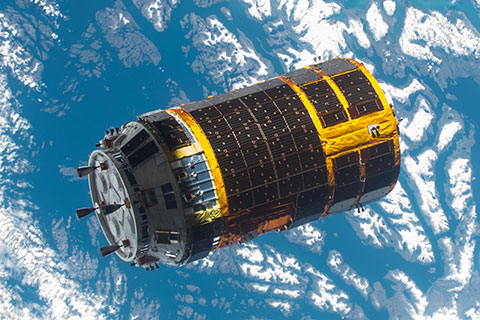
H-II Transfer Vehicle KOUNOTORI

H-II Transfer Vehicle KOUNOTORI

Mineo Wakita JE9PEL reports on the AMSAT Bulletin Board that six satellites with amateur radio payloads are to be launched to the International Space Station in December.

JAXA announced to the public November 7 that seven nano satellites are to be installed in H-IIB Transfer Vehicle “KOUNOTORI” (HTV) to be launched in December. Satellites are only about 1U~3U in size and will conduct experiments aimed at realizing the space elevator which is expected to facilitate the movement of Earth and Universe in the future. It’s the first time to launch in JAXA with seven satellites at a time.

HTV6 Launch: 1326 UT, Dec. 9, 2016 at the Tanegashima Space Center, Japan.

                   Downlink   Beacon     Mode
AOBA-VeloxIII       437.375  437.375  1k2 AFSK,CW
ITF-2               437.525  437.525  1k2 FM,CW
STARS-C (Mother)    437.405  437.245  1k2 FM,CW
STARS-C (Daughter)  437.425  437.255  1k2 FM,CW
WASEDA-Sat3         437.290  437.290  1k2 PCM-FSK,CW
TuPod               437.425  437.425  1k2 GMSK,CW

H-II Transfer Vehicle “KOUNOTORI” (HTV), JAXA
http://global.jaxa.jp/projects/rockets/htv/index.html

AOBA-VeloxIII Kyusyu Institute of Technology
http://aoba2016.blog.fc2.com/

EGG University of Tokyo / Nihon University
http://repository.exst.jaxa.jp/dspace/bitstream/a-is/2961/1/SA6000021010.pdf

FREEDOM Tohoku University / Nakashimada Engineering Works, Ltd
http://www.tohoku.ac.jp/japanese/newimg/pressimg/tohokuuniv-press_20140926_01web.pdf

ITF-2 University of Tsukuba
http://yui.kz.tsukuba.ac.jp/en/

TuPOD Gauss Srl
http://www.gaussteam.com/tupod-almost-ready-for-launch/

STARS-C Shizuoka University
http://stars.eng.shizuoka.ac.jp/english.html

WASEDA-SAT3 Waseda University
http://www.miyashita.mmech.waseda.ac.jp/Waseda-Sat3/

Radio ham’s Femtosats project wins ISS Design Competition

Femtosats deploying from 3D printed spacecraftRadio amateur Andy Filo KJ6ZGI has been announced as winner of the ISS Design Competition organised by component distributor Mouser.

Tech Crunch reports nearly 250 ideas were submitted, everything from tools to toys to scientific instruments. The proposals were vetted and submitted for judgment by tech-savvy astronaut and former ISS resident Col. Chris Hadfield VA3OOG, and Grant Imahara, of Mythbusters fame.

Andy’s winning entry was for a 3D printed “mothership” to launch Femosats into space. Femtosats are 30mm square and 4mm thick self contained satellites that extend the Internet of Things to Space.

Watch 2016 ISS Design Challenge Winners! – Empowering Innovation Together™ with Grant Imahara

Read the Tech Crunch story at https://techcrunch.com/2016/11/07/3d-printed-satellite-launcher-heads-to-iss-with-blessing-of-chris-hadfield-and-grant-imahara/

Mouser ISS Design Competition winners http://www.mouser.com/contests/iss-project-contest?entry_id=131259785

Andy KJ6ZGI has previous worked with Zac Manchester KD2BHC on the KickSat project
http://makezine.com/2014/04/11/how-to-kick-a-sat/

HFsat will have 21 to 29 MHz transponder

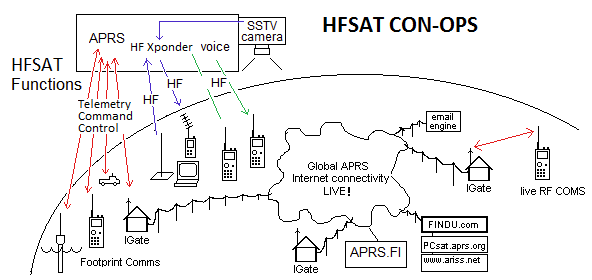
HFsat concept of operations

HFsat concept of operations

US Naval Academy students are planning an amateur radio CubeSat HFsat carrying an HF transponder as well as 2m APRS.

They are working with Bill N6GHZ on the HF transponder card which will provide a bandwidth of 30 kHz, the frequencies are currently 21.4 MHz uplink and 29.42 MHz downlink. Doppler shift will be reduced to less than 2 Hz per second by using an inverting transponder.

The satellite will be gravity gradient stabilized by its long full size 10 meter band halfwave HF dipole antenna with tip masses

Read more about HFsat at http://aprs.org/hfsat.html

IARU satellite frequency coordination page http://www.amsat.org.uk/iaru/

UBAKUSAT linear transponder satellite

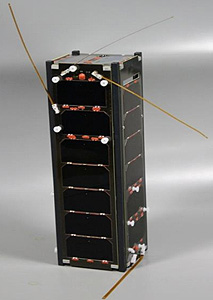
UBAKUSAT Amateur Radio CubeSat

UBAKUSAT Amateur Radio CubeSat

Turkey’s 3U CubeSat UBAKUSAT carrying an amateur radio 145/435 MHz SSB/CW transponder is planned to be deployed from the ISS in 2017.

The linear transponder is almost the same as that on the TURKSAT-3USAT which was launched on April 26, 2013.

UBAKUSAT CubeSat

UBAKUSAT CubeSat

The satellite is being developed by Istanbul Technical University, Faculty of Aeronautics and Astronautics, Space Systems Design and Test Lab (SSDTL) along with TAMSAT, GUMUSH and ERTEK Ltd, with some support of the RF lab of ITU (RFL) and Ministry of Transportation, Communication and Maritime in collaboration with the Japanese Government.

The first ever CubeSat of Turkey, ITUpSAT1 was also successfully developed by SSDTL. ITUpSAT1 was placed in a LEO orbit of 720 km, on September 23, 2009 by a PSLV rocket. Its beacon signals are still heard by amateur radio stations worldwide.

The primary mission of UBAKUSAT is to provide voice communications for amateur radio stations around the globe. Additionally the satellite will carry the TAMSAT Simplesat card which will send telemetry data, including the relative radiation data absorbed by the card, to ground stations. There is also a CW beacon.

The satellite also contains typical subsystems that are required for its successful operation: structure, EPS, batteries, solar panels, OBC, antenna.

The estimated duration of the satellite mission is about 6 to 12 months before re-entry. The launch from Japan to the International Space Station is planned for late 2016 or early 2017 and deployment from the ISS will occur sometime later.

IARU coordinated frequencies:
• 437.225 MHz CW Beacon
• 437.325 MHz Telemetry
• SSB/CW transponder:
– 145.940-145.990MHz
– 435.200-435.250 MHz

IARU satellite frequency coordination pages http://www.amsat.org.uk/iaru/

Turkish Amateur Satellite Technologies Organization (TAMSAT)
http://tinyurl.com/TurkeyTAMSAT
https://www.facebook.com/tamsat.amsattr
https://twitter.com/tamsat_tr
http://www.youtube.com/user/tamsatvideo

AlSat-1N and Pratham launch from India

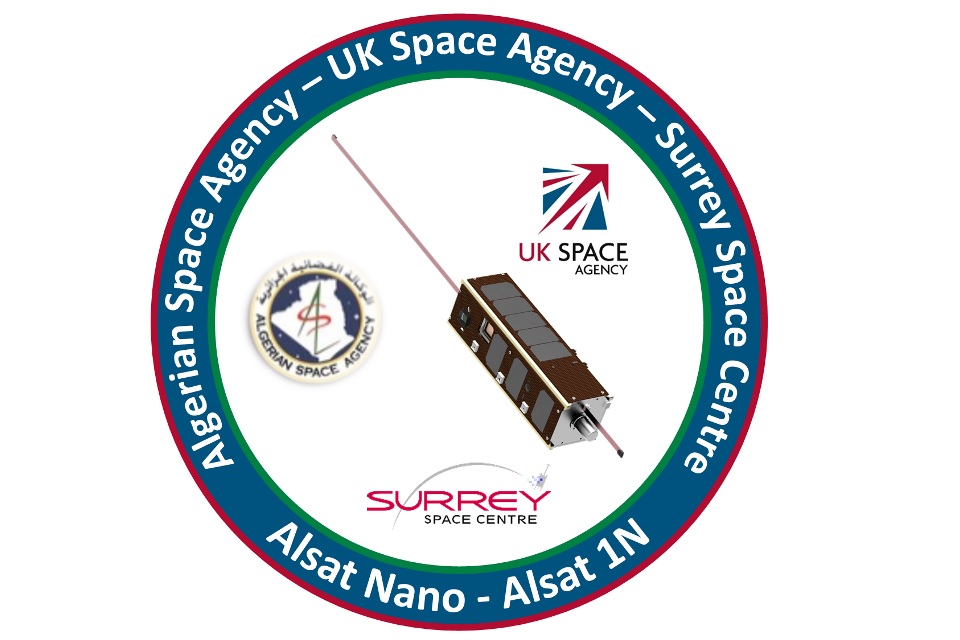
AlSat-1N Mission PatchThe AlSat-1N and Pratham satellites, both with amateur radio payloads, launched on the Indian ISRO PSLV-C35 mission at 0342 GMT on Monday, September 26, 2016, reports are requested.

Update Sept 27: The AlSat-1N signal has been received but nothing heard from Pratham. A Dorset radio amateur reports receiving a signal from PISAT (2240 MHz) which was also on the PSLV-C35 launch
https://twitter.com/uhf_satcom/status/780808329392168960

AMSAT-BB indicate the Pratham CW beacon on 145.980 MHz is active

The 3U CubeSat AlSat-1N was built in collaboration between the Algerian Space Agency (ASAL), UK Space Agency (UKSA), Surrey Space Centre (SSC) staff and Algerian students as a technology transfer and demonstrator for Algeria.

AlSat-1N is also hosting three UK payloads from various institutions and aims to take images of the Earth and send back data from the UK payloads.

The IARU coordinated downlink is 437.650 MHz 9k6 FSK.

Any downlinked data will be gratefully received at alsatnano@gmail.com
Both decoded hex files and recordings would be greatly appreciated. Richard Duke M0GSN is transmission authority in the UK under the SSC Club callsign M0GKK.

Further information on AlSat-1N can be downloaded from:

Information on the Pratham student satellite is at
https://amsat-uk.org/2016/09/07/pratham-student-satellite/

Amateur Satellite 5.7 GHz LNA

AMSAT-NA 5.7 GHz LNA

AMSAT-NA 5.7 GHz LNA

The AMSAT-NA site carries a picture showing the mechanical prototype of the 5.7 GHz Low Noise Amplifier which will be used in the Phase 5 Lunar and Phase 4B Geosynchronous amateur radio satellite projects.

Unfortunately US Federal Government ITAR legislation prevents them disclosing any technical information about it.

The International Traffic in Arms Regulations (ITAR) inexplicably applies to amateur radio satellites. It threatens US radio amateurs with jail terms or six figure fines if they cooperate with amateurs outside the USA on satellite projects. Cooperation includes talking about or publishing on the web certain information regarding amateur radio satellite systems.

The AMSAT-NA 5.7 GHz LNA page can be seen at http://www.amsat.org/?p=5519

5 GHz / 10 GHz amateur radio transponders are planned for the Heimdallr spacecraft expected to launch in September 2018 into a Lunar orbit. Further information is at
https://amsat-uk.org/2016/09/07/5-ghz-to-10-ghz-lunar-transponder-mission/

ITAR – Section 1248 Report Released
https://amsat-uk.org/2012/04/22/itar-1248-report-released/

AMSAT Wants Amateur Radio Satellites Off US Munitions List
https://amsat-uk.org/2013/07/31/amsat-wants-amateur-radio-satellites-off-us-munitions-list/