CADRE CubeSat to deploy from ISS

University of Michigan CADRE CubeSat

University of Michigan CADRE CubeSat

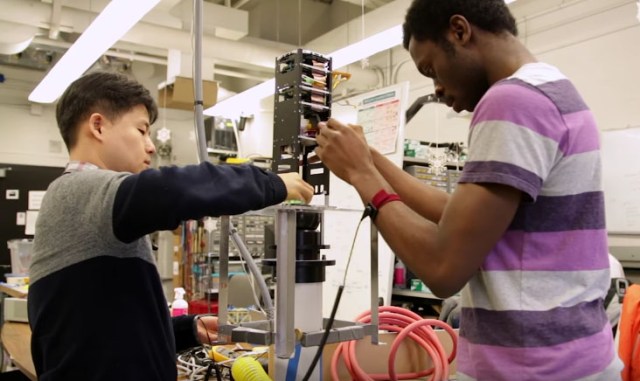
Prince Kuevor who worked on the CADRE CubeSat features in a video from the University of Michigan Aerospace Engineering Department.

The CADRE 3U CubeSat, developed by the students at the University of Michigan, was launched to the ISS on December 6, 2015 and should be deployed from the space station soon, possibly mid-May. It carries an instrument package developed by the Naval Research Lab, WINCS, which will characterize neutral winds and ion drifts in the ionosphere/ thermosphere. The IARU lists the downlinks as 437.485 MHz and 3404.0 MHz.

What is it like to be an aerospace engineering student at the University of Michigan? Step into the life of senior Prince Kuevor, who, in addition to his coursework, writes software for CADRE, a small satellite designed by his student team. In the future, Prince hopes to become a professor and teach the next generation of aerospace engineers.

Watch Meet an Aerospace Engineering Student: Prince Kuevor

Learn more about Michigan Aerospace at
http://engin.umich.edu/aero
https://facebook.com/MichiganAerospace


OUFTI-1 Telemetry Decoder App

Jacques_Verly_ON9CWD_and_Amandine_Denis_ON4EYA_with OUFTI-1

Professor Jacques Verly ON9CWD (Montefiore Institute) and Amandine Denis ON4EYA, Head of Project OUFTI (LTAS) with the flight model (structure) of OUFTI-1 – Image credit ESA

The OUFTI-1 D-STAR CubeSat team have released the format of the CW telemetry beacon and a Decoder App. The launch, on a Russian Soyuz-STA Fregat-M from Kourou in South America, is expected to take place at 21:02:13 UT on Saturday, April 23, 2016.

OUFTI-1 is a nano-satellite entirely developed by the students of the University of Liege (ULg), Belgium, along with two other engineering schools. It is the first satellite to carry a dedicated amateur radio D-STAR transponder.

OUFTI-1 amateur radio information including Keps http://events.ulg.ac.be/oufti-1/radioamateurs/

The PDF of the article ‘D-STAR digital amateur communications in space with OUFTI-1 CubeSat’ by Jonathan Pisane ON7JPD, Amandine Denis ON4EYA and Jacques Verly ON9CWD can be downloaded from
https://amsat-uk.org/2016/04/05/d-star-satellite-to-launch-from-kourou/

IARU coordinated frequencies for all CubeSats on the Russian Soyuz launch
http://www.amsat.org.uk/iaru/
OUFTI-1 – 145.950 MHz FSK AX25 and D-STAR (uplink 435.045 MHz) – CW beacon 145.980 MHz
e-st@r-II – 437.485 MHz CW and 1k2 AFSK
AAUSAT-4 – 437.425 MHz

Catch the signal of e-st@r-II CubeSat

Catch est@r-II CubeSat Signal CompetitionThe CubeSat Team of Politecnico di Torino invite the amateur radio community to participate in a competition to receive the 437.485 MHz signal from their new satellite e-st@r-II which launches 2102 UT on Monday, April 25, 2016 on a Russian Soyuz-STA Fregat-M rocket from Kourou in South America.

The CubeSat Team is a student team of Politecnico di Torino involved in the design and development of small platforms for scientific missions and for testing new technologies. We are guys enthralled by space activities. Undergraduate and graduate students work together with researchers and professors to create a real hands-on experience.

“SPACE IN A CUBE: MISSIONS OF THE FUTURE” is our motto! We believe that small satellites can contribute to a broad set of science goals and space based services. Our CubeSat missions aim at conceiving new scenarios and technologies to serve the scientific community while educating students in the challenging field of aerospace engineering.

Our first CubeSat, e-st@r-I, was launched into orbit on February 2012, and the second satellite, e-st@r-II, will be launched next week: the Soyuz launch ST-A VS14 is scheduled on April 25, 2016, at exactly 09:02:13 p.m UT, from the European Kourou spaceport in South America http://www.arianespace.com/mission/ariane-flight-vs14/

To celebrate this date, we invite the radio-ham community to support the e-st@r-II mission: participate in the contest to listen out for our CubeSat from orbit!

We have prizes for the first to receive the e-st@r-II signal and for the one who will provide us with the higher number of packets received in the first month in orbit!

All details of the competition can be found at our official webpage:
http://www.cubesatteam-polito.com/operations/radio-amateurs/

Follow the daily updates on our Facebook page.

Thank you in advance for your help in collecting TLM packets….. and break a leg!

Website: http://areeweb.polito.it/cubesat-team/
Facebook: https://www.facebook.com/CubeSatTeam
Twitter: https://twitter.com/CubeSatTeam

e-st@r-II frequency: 437.485 MHz CW and 1200 bps AFSK AX.25

CubeSats to launch from Kourou
https://amsat-uk.org/2016/04/05/d-star-satellite-to-launch-from-kourou/

D-STAR satellite to launch from Kourou

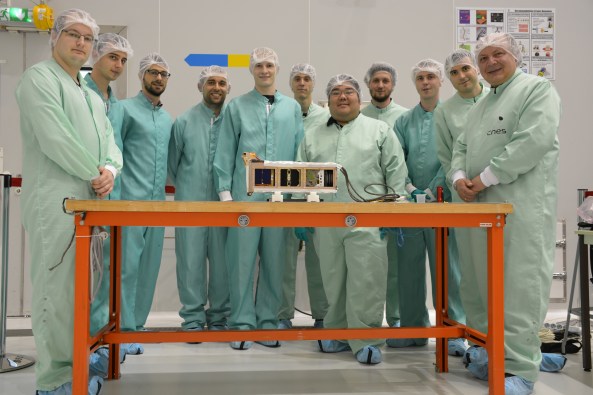
The entire Fly Your Satellite 2016 delegation with CubeSats in P-Pod

The entire Fly Your Satellite 2016 delegation with CubeSats in P-POD

The ESA Education Office Fly Your Satellite! (FYS) programme is designed to train the next generation of aerospace professionals. Three chosen student teams have each developed 1U CubeSats carrying amateur radio payloads which are expected to launch at 2102 UT on Monday, April 25, 2016 on a Russian Soyuz-STA Fregat-M rocket from Kourou in South America into a 453 by 644 km 98.2 degree inclination orbit.

The satellites designed and built by the student teams, arrived in South America on Friday, March 25. Upon arrival, they were given a security escort from the airport to the Guiana Space Centre, near Kourou. The student teams arrived on March 28.

The satellites themselves are CubeSats. This class of small satellites have helped revolutionise access to space. Made of standard components, as the name suggests they come in modular dimensions of just 10x10x10cm in size.

On March 30 the students removed the so-called Remove Before Flight pins and successfully verified that the CubeSats were ready for launch. Afterwards, the lateral access ports of the P-POD were put back in place.  The next time the students will have contact with their respective CubeSats will be through the communication link after the satellites are deployed into orbit. The next activities consist in completing the application of a special thermal-optical tape on the outside of the P-POD, which will ensure the unpowered CubeSats are shielded from extreme thermal radiation during the launch phase. Finally, the planning for the next weeks will consist in integrating the P-POD with the rest of the launcher.

OUFTI-1 from the University of Liege, Belgium, will be the first satellite to carry a D-STAR Digital Voice transponder. The article ‘D-STAR digital amateur communications in space with OUFTI-1 CubeSat’ by Jonathan Pisane ON7JPD, Amandine Denis ON4EYA and Jacques Verly ON9CWD can be seen in the June 2013 Edition 202 of the AMSAT-UK publication OSCAR News.

e-st@r-II from the Polytechnic of Turin, Italy, will demonstrate an attitude control system using measurements of the Earth’s magnetic field; and AAUSAT4 from the University of Aalborg, Denmark, will operate an automated ocean vessel identification system.

ESA Press Release
http://www.esa.int/Education/CubeSats_-_Fly_Your_Satellite/Launch_campaign_started_CubeSats_arrived_at_Kourou_spaceport

Download OSCAR News OUFTI-1 D-STAR article

IARU coordinated frequencies http://www.amsat.org.uk/iaru/
OUFTI-1 – 145.950 MHz FSK AX25 and D-STAR (uplink 435.045 MHz) – CW beacon 145.980 MHz
e-st@r-II – 437.485 MHz CW and 1k2 AFSK
AAUSAT-4 – 437.425 MHz

OUFTI-1 Telemetry Decoder App https://amsat-uk.org/2016/04/20/oufti-1-telemetry-decoder-app/
FUNcube transponder on EO-79 active

QB50p1 and QB50p2 - Image Credit ISIS

EO-79 and EO-80 – Image Credit ISIS

On March 25, 2016, the EO-79 SSB/CW transponder was activated and will be available during Easter.

The FUNcube transponder subsystem on QB50p1 (EO-79) had been provided by AMSAT-UK and AMSAT-NL and is a similar subsystem as on FUNcube-1, but without the telemetry downlink circuitry.

The current software running on EO-79 does experience occasional reboots. When these reboots happen, the transponder is automatically turned off and will have to be turned back on by a command station. The FUNcube team has selected a few command stations to do so, but be advised the transponder may be off.

TLEs:
AMSAT keps name: EO-79
Celestrak keps Name: QB50P1
Celestrak file: cubesat.txt
NORAD #    40025
COSPAR designator    2014-033-R

Frequencies:
Uplink: 435.035-435.065 MHz LSB
Downlink: 145.935-145.965 MHz USB

EO-79 has been set to only beacon the normal AX.25 beacon every 30 seconds instead of 10 seconds. The beacon frequency is 145.815 MHz and consists of AX.25 frames on BPSK. more details about the downlink can be found on the ISIS HAM page at http://isispace.nl/HAM/qb50p.html

Just like FUNcube-1, the crystal oscillator circuits exhibit drift with temperature. This means manual tuning will probably work best.

Lastly, the commanding team availability will be limited over Easter, so please report the transponder being on or off on the status page of AMSAT: http://www.amsat.org/status/
It does not appear in the table, but it does in the reporting drop-down.

73 and have FUN

Wouter Weggelaar, PA3WEG
AMSAT-NL
AMSAT-UK

2013 QB50 Precursor CubeSat announcement
https://amsat-uk.org/2013/07/20/qb50-amateur-radio-transponder-payloads-to-launch-2014/

School SSTV CubeSat to deploy from ISS

STM students designing antenna to receive data from STMSat-1 - Credit STM

STM students designing antenna to receive data from STMSat-1 – Credit STM

A Slow Scan TV (SSTV) CubeSat developed by students at Saint Thomas More Cathedral School (STM) in Arlington, VA, is set to be deployed from the International Space Station between 1400 and 1500 UT on May 16. For latest date/time check here.

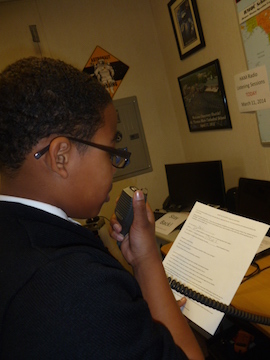
STM student using amateur radio station

STM student using amateur radio station

STM is thought to be the first Elementary school to build their own satellite, even Pre-Kindergarten, Kindergarten, and First Grade students were involved in the project.

The satellite, a 1U CubeSat called STMSat-1, will transmit a SSTV Robot36 mode signal on 437.800 MHz.

Middle School Students took the initiative to begin exploring how to receive data from the CubeSat and formed a Ham Radio Club. There, they learned the basics of operating a ham radio station and explored Slow Scan Television as an option for receiving images once the satellite is deployed.

How Did 400 Grade School Students Built A Nano-Satellite?
http://jewelbots.tumblr.com/post/134465599599/how-did-400-grade-school-students-built-a

Watch the CBS This Morning show report on the satellite
http://www.cbsnews.com/videos/satellite-built-by-elementary-students-to-be-deployed-in-space/

STMSat-1
https://twitter.com/STMSAT11
https://www.facebook.com/stmsat1/
https://www.facebook.com/groups/491135804399695/
http://www.stmsat-1.org/