AMSAT-NA VP-Engineering on NASA TV Wednesday

ELaNa XII LogoAMSAT-NA VP-Engineering Jerry Buxton, N0JY will be on the panel at a NASA prelaunch briefing on Wednesday, October 7 at 1800 UT. The briefing will be shown live on NASA TV.

The amateur radio FM transponder CubeSat, AMSAT Fox-1A, will be among 13 CubeSats flying as secondary payloads on the NROL-55 mission which should launch on a United Launch Alliance Atlas V rocket on Thursday, October 8, from Vandenberg Air Force Base in California.

NASA will be holding two briefings about the launch. The first on Wednesday, Oct. 7 at 1700 UT (1pm EDT) will highlight the growing importance of CubeSats in exploration and technology development. The second at 1800 UT (2pm EDT) will discuss five of the CubeSats.

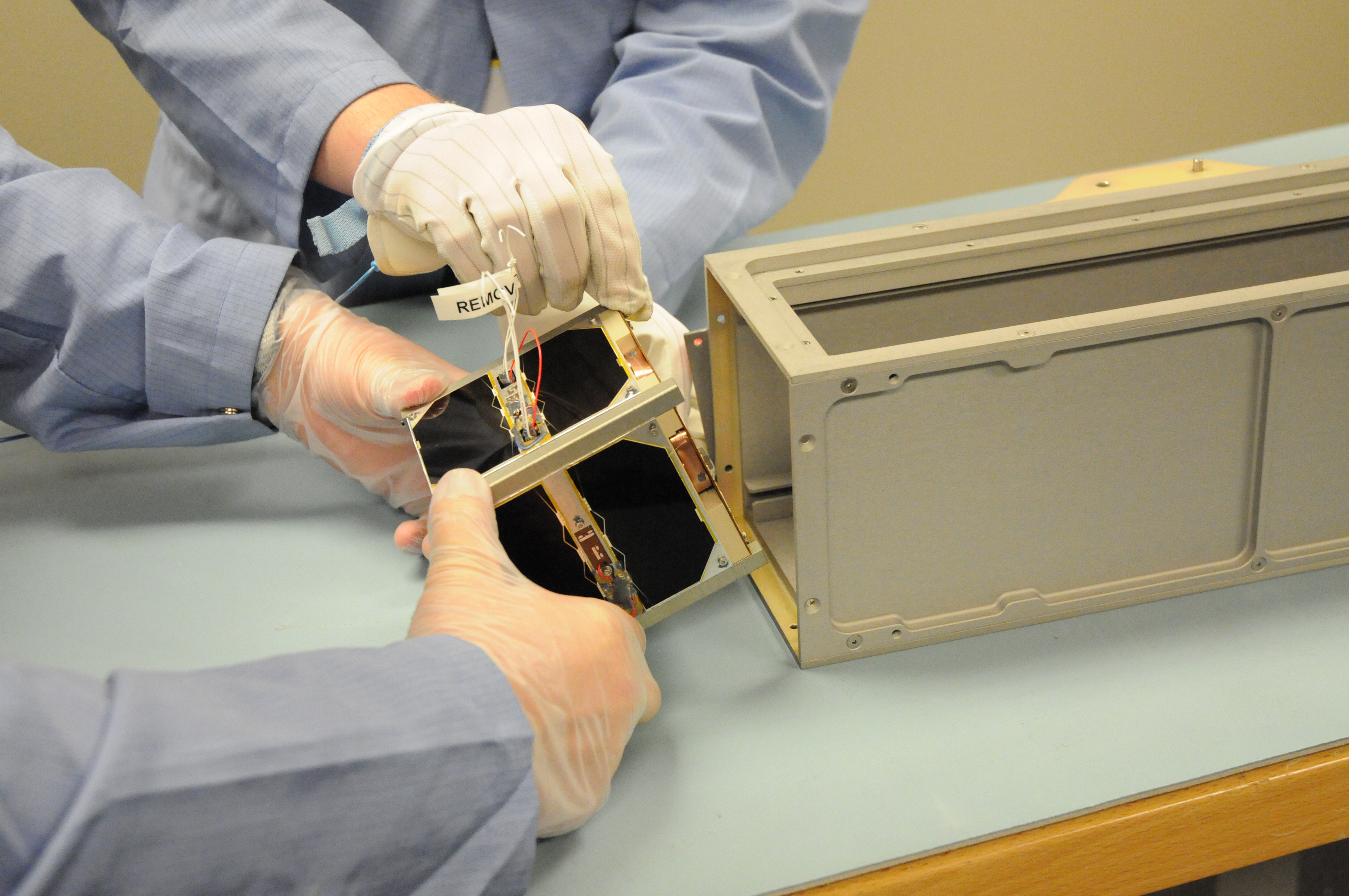
Fox-1A Flight Unit

Fox-1A Flight Unit

Jerry Buxton, N0JY will on the panel in the 1800 UT briefing to talk about the Fox mission and science, and answer questions.

Fox-1A is a 1-Unit CubeSat carrying an FM repeater that will allow simple ground stations using an HT and an “Arrow” or “Elk” type antenna to make contacts using the satellite.

Data Under Voice (DUV) is used to send 200 bps FSK telemetry data at the same time as FM audio. This is achieved by making use of sub-audible frequencies below 200 Hz.

Information on the free Fox telemetry decoder software is at
https://amsat-uk.org/2015/09/23/fox-telemetry-decoder-software/

Read the Fox Operating Guide at
http://www.amsat.org/wordpress/wp-content/uploads/2015/05/FoxOperatingGuide_May2015_Hi.pdf
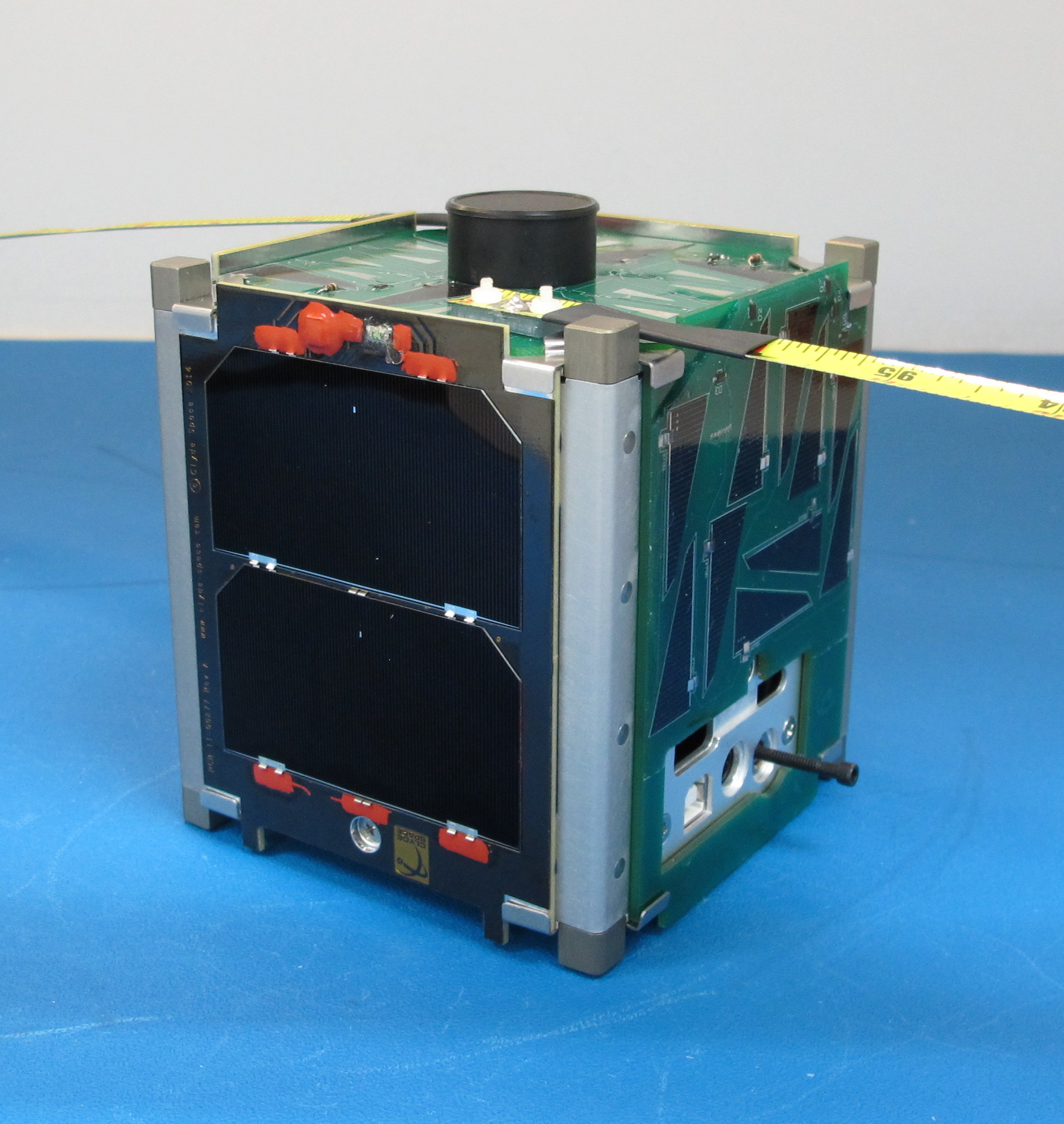
BisonSat CubeSat

BisonSat CubeSat

Among the other CubeSats carrying amateur radio payloads is BisonSat, the first satellite developed by Native American tribal college students. Using BisonSat’s 100-meter resolution camera the Salish Kootenai College students hope to acquire images of the Flathead Indian Reservation. Dr. Tom Olson will be on the panel to discuss BisonSat.

BisonSat (Nʷist Q́ʷiq́ʷay in the Salish language)
Beacon 437.375 MHz
http://cubesat.skc.edu/
https://www.facebook.com/Bisonsat
https://www.youtube.com/watch?v=WeGvRhzRu2o

Colleges run by Native American tribes are graduating more students in STEM fields
http://scitation.aip.org/content/aip/magazine/physicstoday/news/10.1063/PT.4.2484

Radio amateur Courtney Duncan, N5BF, principal investigator for LMRST-Sat will also be appearing on the panel.

Watch NASA TV at http://www.nasa.gov/nasatv

NASA Sets Coverage Schedule for CubeSat Launch Events
http://www.nasa.gov/press-release/nasa-sets-coverage-schedule-for-cubesat-launch-events

ISS CubeSats deployed Monday, October 5

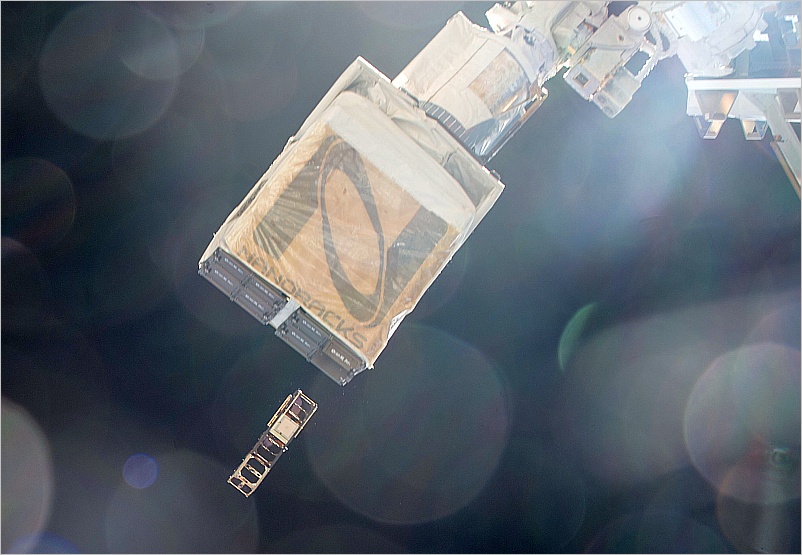
Deployment of AAUSat-5 and GomX-3 from the ISS - Credit NASA, NanoRacks

Deployment of AAUSat-5 and GomX-3 from the ISS – Credit NASA, NanoRacks

Two Danish CubeSats carrying amateur radio payloads were successfully deployed from the International Space Station (ISS) on Monday, October 5 at 1405 UT.

AAUSat-5 and Deployer - Credit ESA

AAUSat-5 and Deployer – Credit ESA

Originally launched to the ISS on August 19, 2015, the two CubeSats, AAUSat-5 and GomX-3, were deployed from the ISS Japanese Kibo module airlock using the Kibo robotic arm.

After deployment the CubeSats stated transmitting signals to Earth that can be picked up by anyone with common amateur radio equipment. The frequencies to listen on are:

• AAUSat-5 – 437.425 MHz with 30 WPM CW beacon every 3 minutes and 9600 bps GMSK packet every 30 seconds

• GomX-3 – 437.250 MHz with 1200-9600 bps GMSK data using CSP protocol

AAUSat-5 received by Jan van Gills PE0SAT on October 5, 2015 at 1800 UT

AAUSat-5 received by Jan van Gills PE0SAT on October 5, 2015 at 1800 UT

AAUsat-5 is a 1-Unit CubeSat built by students at Aalborg University. The primary mission is to test an improved receiver for detecting Automatic Identification System (AIS) signals emitted by ships. Down on the ground, these signals are short-range, operating mainly on a ship-to-shore and ship-to-ship basis, leaving large spans of the world’s oceans uncovered. But signals also travel up to orbital altitude, opening up the prospect of worldwide monitoring.

GomX-3 is a 3-Unit CubeSat which aims to demonstrate new radio technology. A reconfigurable software-defined radio receiver will intercept L-band spot beams from telecom satellites in geostationary orbit, to provide independent measurements of their signal strength and quality. This receiver can also be repurposed to receive any other L-band signal, such as navigation satellite signals or radar beams.

A receiver will pick up Automatic Dependent Surveillance – Broadcast (ADS-B) signals automatically broadcast by civilian aircraft, to build up an overview of regional air traffic.

GomX-3 received by Mineo Wakita JE9PEL October 5, 2015 from 1505-1515 UT

GomX-3 received by Mineo Wakita JE9PEL October 5, 2015 from 1505-1515 UT

Additionally there is a high data rate X-band transmitter developed by Syrlinks. The CNES X-band ground station in Kourou, South America, will be used to demonstrate the link.

The GomX-3 amateur radio payload uses a NanoCom AX100 UHF transceiver and ANT430 antenna.

Mineo Wakita JE9PEL in Japan reported receiving the GomX-3 beacon in Japan from 1505-1510 UT on October 5 and Luciano Fabricio PY5LF reported hearing GomX-3 in Brazil at 1605 UT. Jan van Gills PE0SAT in the Netherlands received AAUSat-5 at 1800 UT.

The two spacecraft may have a lifetime of around 7 months before they burn up in the Earth’s atmosphere.

GomX-3 telemetry beacon https://www.dropbox.com/s/x4mipoz9gmqhlib/GOMX3_Beacon.pdf

AAUSat-5 telemetry beacon http://www.space.aau.dk/aausat5/index.php?n=Main.HamInfo

ESA article CubeSats set for Monday Release (with video)
http://www.esa.int/Our_Activities/Space_Engineering_Technology/ESA_CubeSats_set_for_Monday_release

ESA invites radio amateurs to listen for AAUSat-5 CubeSat
https://amsat-uk.org/2015/09/24/esa-listen-for-aausat-5/

Deployment of AAUSat-5 and GomX-3 from the ISS Kibo robot arm - Credit NASA, NanoRacks

Deployment of AAUSat-5 and GomX-3 from the ISS Kibo robot arm – Credit NASA, NanoRacks

ESA invites radio amateurs to listen for AAUSAT-5 CubeSat

AAUSat-5 and Deployer - Credit ESA

AAUSat-5 and Deployer – Credit ESA

The AAUSAT-5 amateur radio CubeSat built by students at the University of Aalborg, Denmark is planned to be released from the International Space Station sometime in the week of October 5.

The European Space Agency (ESA) is inviting radio amateurs to listen out for the signals from the satellite. The first to send in a recorded signal from AAUSAT-5 will receive a prize from ESA’s Education Office.

Launched on August 19, 2015 to the ISS, the Danish student CubeSat is now waiting for its deployment from the Japanese Kibo module’s airlock. An astronaut will manipulate the Kibo robotic arm to lift AAUSAT-5 from the airlock and place it in orbit.

Once deployed from the ISS the CubeSat will begin transmitting signals to Earth that can be picked up by anyone with common amateur radio equipment. ESA challenges anyone to record the signal and send it to ESA (cubesats@esa.int) and Aalborg University (studentspace@space.aau.dk).

The satellite will transmit on 437.425 MHz using CW and GMSK. The 30 WPM CW beacon will transmit every 3 minutes and the 9600 bps GMSK every 30 seconds.

The first correct email received will win the following prizes:
• ESA/AAUSAT5 poster with signatures of the team members
• ESA Education goodie bag
• Scale 1:1 3D printed model of the AAUSAT-5 satellite

Read the ESA article at
http://www.esa.int/Education/CubeSats_-_Fly_Your_Satellite/Be_the_first_to_catch_the_signals_from_a_new_Satellite_in_orbit

AAUSAT-5 amateur radio information http://www.space.aau.dk/aausat5/index.php?n=Main.HamInfo

ESA AAUSAT-5 Twitter hashtag #AAUSAT5 https://twitter.com/ESA__Education

Danish CubeSats head for ISS https://amsat-uk.org/2015/08/19/danish-cubesats-head-for-iss/

Fox Telemetry Decoder Software Available

Fox-1A Flight Unit

Fox-1A Flight Unit

Chris Thompson G0KLA reports on the AMSAT Bulletin Board that the telemetry decoder software for the Fox FM transponder CubeSats is now available for download. At the time of writing Fox-1A was scheduled to be launched on Ocober 8, 2015 with Fox-1Cliff and Fox-1D slated for early 2016.

Version 1.0 of the FoxTelem software, the Fox Telemetry Decoder is being released to enable setup, testing, and debugging of your Fox-1A ground station prior to the launch of the satellite. FoxTelem is used to demodulate, store and analyze telemetry data from AMSAT’s Fox series of CubeSats.

Fox-1 satellites include two telemetry formats:

Fox1-Cliff-Logo+ Slow Speed, also called Data Under Voice (DUV) is 200 bps FSK data sent at the same time as the transponder audio. Whenever the transmitter is on, data is being sent. This happens during beacons and during live QSOs.

+ High Speed is 9600 bps FSK sent instead of the transponder. This is used for data intensive experiments such as the Virginia Tech Camera. This is only active when commanded from the ground. You can recognize High Speed because it sounds like an old school computer modem.

FoxTelem will receive and store both formats assuming you can feed it audio that does not have the frequencies below 200 Hz filtered.  For High Speed, the audio must also extend to include the full 9600bps bandwidth of the FM signal. For both modes this is best achieved from a Software Defined Radio or from the 9600 bps packet port of some radios. The FoxTelem User Guide provides more details.

Fox-1D-LogoFoxTelem is supplied as an archive file (.zip on windows, .dmg file on MacOs, .gzip on Linux). Links for downloading can be found at http://www.amsat.org/?page_id=4532
You can unzip the contents and put it in the directory of your choice. Also, detailed in the User Guide, are instructions to select the sound source and set received audio levels on your computer.

Until Fox-1A is launched you can confirm everything is working by testing with test wav file which will be available from:
http://amsat.us/FoxTelem/recordings
Access to the test file is accomplished by selecting “Load Wav File” from the FoxTelem File menu, then navigate to the directory where you saved the test wav file. Once you press the start button the file will play through the decoder.

The FoxTelem page can also be accessed from the main AMSAT web page:
http://www.amsat.org –> Fox Project –> FoxTelem Software for Windows, Mac, & Linux

The direct link to the page is: http://www.amsat.org/?page_id=4532

FoxTelem Notes:
• Please make sure “upload to server” is enabled in settings
• Goto INPUT tab, STOP the input, then FILE – DELETE PAYLOAD FILES, then START input again Just once, to clear test data.

Fox-Cam page http://amsat.us/?page_id=38

SERPENS CubeSat Deployed from ISS

Deployment of the SERPENS CubeSat from the ISS on September 17, 2015 - Credit JAXA

Deployment of the SERPENS CubeSat from the ISS on September 17, 2015 – Credit JAXA

On September 17, 2015 the Brazilian SERPENS CubeSat carrying an amateur radio payload, call sign PY0ESA, was deployed from the International Space Station (ISS).

SERPENS LogoSERPENS is a 3U CubeSat which was developed by students at the University of Brasilia and focuses on meteorological data collection.

The SERPENS Amateur Radio Page shows these downlink frequencies:

•  145.980 MHz using GFSK modulation at 9600 bps and AX.25 protocol transmiting two different beacons. The first occurs every 10 seconds with the message “SERPENS A”. This is implemented for easy identification of the satellite when searching for it. The second beacon is transmitted every 30 seconds and contains the main housekeeping data of the satellite. In addition to the beacons, a simple Store and Forward experiment has been implemented.

437.365 MHz using CW/MSK modulation at 1200 bps and CSP protocol.

SERPENS CubeSat

SERPENS CubeSat

There is a Store and Forward messaging system compatible with HUMSAT sensors on the frequency of 437.525 MHz, using GMSK modulation at 1200 bps. The HUMSAT transponder will collect data (e.g. wind, humidity, water levels, etc) from Earth based sensors operating on 437.525 MHz, store the data on-board and then transmit it to university ground stations. For more information visit http://www.humsat.org/

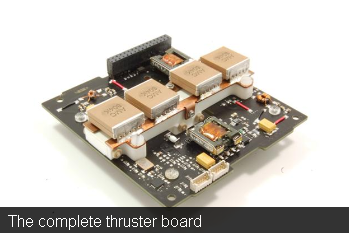
SERPENS carries a Pulsed Plasma Thruster for CUbesat Propulsion (PPTCUP) unit developed by UK companies Mars Space Ltd and Clyde Space Ltd in collaboration with the University of Southampton.

PPTCUP Board - Credit Mars Space Ltd

PPTCUP Board – Credit Mars Space Ltd

The PPTCUP consists of a thruster board and discharge chamber. Overall, the thruster assembly weighs 180 grams including 7g of Teflon fuel and delivers a thrust of 40 micronewtons at a power consumption of 2 Watts. The entire thruster assembly fits into a 90 by 90 by 27-millimeter envelope.The thruster operates at a specific impulse of 608 seconds and in its original version is certified for 1.5 million shots. For durability, the system uses copper-tungsten electrodes. All thruster functions are controlled by a PIC16 microcontroller.

Also deployed with SERPENS from the ISS was the CubeSat S-CUBE designed to observe the Ultraviolet (UV) spectrum during the Orionid meteor shower in October. It does not operate in the Amateur Satellite Service.

SERPENS Amateur Radio Page http://www.aerospace.unb.br/serpens_radioamateurs

SERPENS information in HTV-5 Cargo Overview
http://www.spaceflight101.com/htv-5-cargo-overview.html

Artists impression of Kibo Robot Arm CubeSat Deployment

Artists impression of Kibo Robot Arm CubeSat Deployment

Fox-1C and Fox-1D FM transponder CubeSats will fly on SHERPA

SHERPA in Orbit - Credit Spaceflight Inc

SHERPA in Orbit – Credit Spaceflight Inc

In response to a breaking opportunity, AMSAT and Spaceflight, Inc. have arranged for Fox-1D to accompany Fox-1C on the maiden flight of the SHERPA system on a SpaceX Falcon 9.

AMSAT FOXAs a Fox-1 series, Fox-1D is identical to Fox-1C, but with different frequencies and carrying the University of Iowa HERCI (High Energy Radiation CubeSat Instrument) radiation mapping experiment as a hosted payload. Fox-1D will provide additional selectable U/V or L/V repeater capabilities once in orbit, and will be capable of downlinking Earth images from the Virginia Tech camera experiment.

Launch is currently planned for the first quarter of 2016. Additional donor support is needed to offset the costs associated with the launch of Fox-1D in addition to Fox-1C. Please visit http://www.amsat.org/ to donate support this launch, and help keep amateur radio in space.

Fox-1C has been renamed Fox-1Cliff in honor of Cliff Buttschardt, K7RR, who was a benefactor and long time supporter
for AMSAT as well as an adviser/mentor for students building CubeSats at Cal Poly.

Meet the Fox Project http://www.amsat.org/?page_id=1113

Fox-1C Update Video https://amsat-uk.org/2015/06/07/fox-1c-update-video/

US launch schedule discussion forum
http://forum.nasaspaceflight.com/index.php?PHPSESSID=q67qup1a0d3e7vloo0p9isl1u6&topic=8184.960