FUNcube Data Warehouse Min-Max Values

FUNcube-1 (AO-73) - Image credit Wouter Weggelaar PA3WEG

FUNcube-1 (AO-73) – Image credit Wouter Weggelaar PA3WEG

Since deployment on November 21, 2013 of FUNcube-1 (AO-73) the FUNcube team have been capturing the minimum and maximum Realtime values for each channel when they have been uploaded by a ground station. This has given a good overview for the early operation and initial commissioning.

The team have now moved into a steady state of operation and need to check for long-term trends. To achieve this, they have changed the min-max data collection such that it resets every 7 days and we capture the values each time it does so. At reset you will see the reference date change on the page and the min/max values converge. They will diverge again within an orbit.

The team have considered a rolling 7 day period but that is quite a heavyweight process on the server as it has to be run each time we get an upload!

As always, many thanks to all those who are uploading data to the warehouse.

Any feedback to the forum as usual please: http://forum.funcube.org.uk

73 Dave, G4DPZ
FUNcube Team Member

Data Warehouse – Telemetry Archive http://warehouse.funcube.org.uk/

Dashboard App – Telemetry Decoder http://funcube.org.uk/working-documents/funcube-telemetry-dashboard/

FUNcube satellite talk at Sutton and Cheam

FUNcube-1 (AO-73) - Image credit Wouter Weggelaar PA3WEG

FUNcube-1 (AO-73) – Image credit Wouter Weggelaar PA3WEG

David Bowman G0MRF will be giving a presentation on the FUNcube satellite project to the Sutton & Cheam Amateur Radio Society on Thursday, February 20.

The FUNcube-1 CubeSat was launched on November 21, 2013 and provides a 435/145 MHz transponder for SSB and CW communications.

The meeting will be held in the Vice Presidents’ Lounge, Sutton United Football Club, The Borough Sports Ground
Gander Green Lane, Sutton, Surrey, SM1 2EY at 7:30pm for 8:00pm.

Map http://scrs.org.uk/location/

Sutton & Cheam Amateur Radio Society http://scrs.org.uk/

Watch the BBC News video about FUNcube

Brown University LED CubeSat

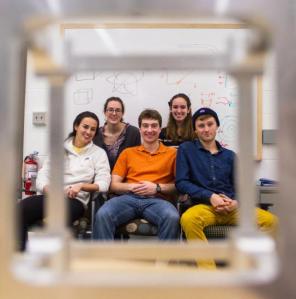
EQUiSat Students

EQUiSat Students

The EQUiSat CubeSat will have an LED beacon visible to the naked eye at night and will transmit data about its health and position.

EQUiSat, being built by a team of students at Brown University in Providence, Rhode Island, has been cleared for launch.

NASA has announced that EQUiSat is among 16 small satellites selected to fly on rockets to be launched over the three-year period beginning in 2015. EQUiSat has not been assigned to a particular rocket, but the announcement assures that the student-led project has a ticket to ride.

“It was pretty great to hear the news on Thursday,” said Hannah Varner, a senior engineering concentrator and one of the team’s leaders. “We’ve all been in disbelief for the last few days.”

The launch will be part of NASA’s CubeSats Launch Initiative. CubeSats are miniature spacecraft — four-inch cubes weighing around two pounds — that can be included as auxiliary payloads on rockets flown for other primary missions. The program’s purpose is to spur innovation in the design of relatively low-cost satellites and to get students interested in space technology. To get into the program, the Brown team submitted an application and made presentations to two review boards that judged the project’s technical feasibility and overall merit.

EQUiSat’s mission will be largely educational. The tiny satellite will carry a flashing LED beacon that will be visible to the naked eye as it passes through the night sky. In Providence, the beacon should be approximately as bright as the North Star, flashing every two minutes when in the night sky. EQUiSat will also broadcast via radio data on the health of its systems and its orientation relative to the Earth and sun. The signal will be available to anyone with a simple amateur radio receiver.

EQUiSat CubeSat

EQUiSat CubeSat

The idea is for EQUiSat to be a visible and audible ambassador from space to students and space enthusiasts on earth. The Brown team plans to combine the launch with a public outreach program. An app will help people track EQUiSat and know when it’s visible at their location. The team also plans to put together lessons that use EQUiSat to teach middle and high school students about satellites, orbital science, and space in general.

“Satellites have become so common but so few people know how important they are to everything we do,” Varner said. “They’re crucial to cell phones and TV and everything. So exposing a younger audience and a non-science audience to satellites was important for us.”

Another aspect of the mission is to show that space can be accessible to just about anyone with enough interest to try to get there.

“CubeSats are a really great architecture because, compared to other kinds of satellites, you can build them really quickly and get a launch comparatively easily,” said Emily Gilbert, a physics concentrator and an EQUiSat team leader. “They’re launched as secondary payloads so you don’t need to commission your own rocket for hundreds of millions of dollars. So it’s great for student groups without a lot of money and without a lot of time.”

EQUiSat will be inexpensive even by CubeSat standards. The students are building their satellite essentially from scratch, despite the fact that CubeSat parts — chassis, solar panels, and other components — can be purchased. Those parts aren’t cheap, and the build cost for most CubeSats is generally north of $30,000. But the EQUiSat team is working on a budget of around $13,000. Ultimately the students hope the design they develop for EQUiSat will lead to a CubeSat that can be built for $3,000 or less.

“We’re trying to prove that it’s possible to meet all of the specifications and all of the requirements without the very, very costly technology that is out there to build a satellite,” Varner said.
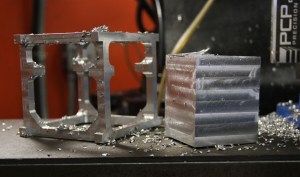
EQUiSat Structure

EQUiSat Structure

The students have worked for the last three years to design and build EQUiSat’s key systems. An attitude control system will align the satellite with Earth’s magnetic field to keep the LED pointed at a visible angle. A solar array will charge a set of lithium iron phosphate batteries, which will in turn power the LED and radio communications system. All of those systems will be carried on a chassis that can withstand the vibration of launch and the harsh vacuum of space. The team will spend the next year or so refining those systems and putting them all together on their tiny spacecraft.

The EQUiSat venture was launched in 2011 as part of an engineering design class taught by Rick Fleeter K8VK, adjunct professor of engineering. The project morphed into a student club in 2012 and now has around 30 student members. Fleeter, who founded a private satellite company before coming to Brown, oversees the club. But this is very much a student-owned project, he says.

“They’re just going on their own energy. I kind of got them pointed in the right direction, but it’s not like I have to encourage them or say, ‘Gee, guys, we ought to have a meeting.’ They just go.”

The original student founders were Kelsey MacMillan, Alexander Neff, Alexander Carrere, and Michael Monn KF7DEC, all members of the 2012 class. They passed the torch to the current group of leaders, including Varner, Gilbert, Kelly Hering, Tyler Del Sesto and Casey Meehan. All except Meehan are seniors, so they’ll need to pass the torch again. They’re quite confident that younger students will get EQUiSat into space.

“We have a really enthusiastic bunch coming up behind us,” Gilbert said. “We have a lot of faith in them.”

The team could get its launch call anytime starting next year through 2017.

Brown University Cubesat project https://mygroups.brown.edu/organization/CubeSat

Facebook https://www.facebook.com/browncubesat

CubeSats deployed from International Space Station

The first of the Planet Lab Dove CubeSats were deployed from the ISS on February 11, 2014 about 0831 UT

The first of the Planet Lab Dove CubeSats were deployed from the ISS on February 11, 2014 about 0831 UT

On Tuesday, February 11, 2014 astronaut Koichi Wakata KC5ZTA successfully deployed the first of the 33 CubeSats that were launched from the Wallops Flight Facility, VA to the International Space Station (ISS) in the Cygnus freighter on January 9.

The first two of the Flock-1 constellation of 28 Dove 3U CubeSats developed by Planet Labs were deployed at about 0831 UT Feb 11 into a 409 x 418 km orbit with another two Dove CubeSats deployed at 1241 UT.

ISS Kibo Japanese Experiment Module (JEM)

ISS Kibo Japanese Experiment Module (JEM)

Eight NanoRacks deployers are installed on the Multi-Purpose Experiment Platform (MPEP). Each deployer has a capacity of 6U and so can hold up to six 1U CubeSats or two 3U CubeSats. They are carried by Japanese Experiment Module-Remote Manipulator System (JEM-RMS).

Two 3U CubeSats can be deployed every one to two orbits to prevent collisions. For Flock-1 two deployments took place each day.

Deployment summary, all times UT, possible object numbers in brackets
0831 Feb 11 – Flock-1-1, Flock-1-2 (39512, 39515)
1241 Feb 11 – Flock-1-3, Flock-1-4  (39516, 39517)
0235 Feb 12 – Flock-1-5, Flock-1-6 deployment fails
???? Feb 12 – Flock-1-7, Flock-1-8 deployment fails ?
0830 Feb 12 – Flock-1-9, Flock-1-10 (39518, 39519)
0820 Feb 13 – Flock-1-5, Flock-1-6 (39520, 39521)
0415 Feb 14 – Flock-1-11, Flock-1-12
1146 Feb 14 – Flock-1-13, Flock-1-14
0700 Feb 15 – Flock-1-7, Flock-1-8
1055 Feb 15 – Flock-1-15, Flock-1-16 (39531, 39532)

The deployment pods were then returned to the airlock to be loaded with the final batch of CubeSats.

Planet Labs CubeSat Constellation

Planet Labs CubeSat Constellation

In addition to the 28 Planet Labs CubeSats there are four amateur radio CubeSats – LituanicaSat-1, LitSat-1, ArduSat-2, UAPSat-1 – and the 915 MHz SkyCube.

Kibo Robot Arm CubeSat Deployment

Graphic of Kibo Robot Arm CubeSat deployment

LituanicaSat-1 carries a 145/435 MHz FM transponder while LitSat-1 is thought to carry a 435/145  MHz linear transponder for SSB/CW communications.

The IARU coordinated frequencies are listed as:

LituanicaSAT-1
• FM Transponder Uplink 145.950 MHz Downlink 435.180 MHz
• AX25 Uplink 145.850 MHz AX25 Downlink 437.550 MHz
• CW Beacon 437.275 MHz
Facebook https://www.facebook.com/Lituanicasat1

Planet Labs Dove CubeSats emerging from NanoRacks deployer February 11, 2014

Planet Labs Dove CubeSats emerging from NanoRacks deployer February 11, 2014

LitSat-1
• SSB Transponder Uplink 435.180 MHz Downlink 145.950 MHz
• AX25 Uplink 437.550 MHz Downlink 145.850 MHz
Facebook https://www.facebook.com/palydovas

ArduSat-2
•  9k6 MSK CCSDS data format downlink 437.? MHz
http://www.kickstarter.com/projects/575960623/ardusat-your-arduino-experiment-in-space

UAPSAT
• AX.25 Packet Radio uplink 145.980 MHz downlink 437.385 MHz

Two Planet Labs Dove CubeSats deployed from the ISS February 11, 2014

Two Planet Labs Dove CubeSats deployed from the ISS February 11, 2014

Koichi Wakata KC5ZTA https://twitter.com/Astro_Wakata

NanoRacks https://twitter.com/nanoracks/
Facebook https://www.facebook.com/nanoracks

Close-up of Planet Labs Dove CubeSats leaving NanoRacks deployer February 11, 2014

Close-up of Planet Labs Dove CubeSats leaving NanoRacks deployer February 11, 2014

Planet Labs https://twitter.com/planetlabs

A Dove in Space https://twitter.com/adoveinspace

Southern Stars https://twitter.com/south_stars

Video of NanoRacks interview: Deploying CubeSats from the Space Station
https://amsat-uk.org/2014/01/31/video-deploying-cubesats-from-the-space-station/

CubeSats deployments are streamed live at http://m.ustream.tv/channel/live-iss-stream

Jonathan’s Space Report (JSR) has been covering robotic and human spaceflight activity for 25 years
https://amsat-uk.org/2014/02/09/a-quarter-century-of-jonathans-space-report/
Twitter http://twitter.com/planet4589

Astronaut Koichi Wakata KC5ZTA prepares NanoRacks CubeSat Deployers

Astronaut Koichi Wakata KC5ZTA prepares NanoRacks CubeSat Deployers

New launch dates for SpaceX and Soyuz-2.1b Fregat-M

SpaceX President Gwynne Shotwell - Image credit SpaceX

SpaceX President Gwynne Shotwell – Image credit SpaceX

There are new launch dates for both SpaceX CRS-3 launching from the Cape Canaveral Air Force Station and the Soyuz-2.1b, Fregat-M which will be launching from Baikonur in Kazakhstan.

On his website Mineo Wakita JE9PEL provides the following information:

SpaceX CRS-3 (Dragon C5) Falcon 9 v1.1 is now planned for March 16, 2014 at 0841 UT. It should be carrying these satellites:
• All-Star/THEIA, Colorado Space Grant Consortium, 2401.700 MHz
• Hermes-2, Colorado Space Grant Consortium, 437.425 MHz
• Ho’oponopono-2, University of Hawaii, 427.220 MHz 9600 bps FSK / GMSK
• LMRSat, Jet Propulsion Laboratory
• SporeSat, Santa Clara University, 437.100 MHz and 2401.2-2431.2 MHz
• TechCube-1, NASA Goddard
• TSAT (TestSat-Lite), Taylor University

UKube-1 on display at UK Space Conference in Glasgow

A model of UKube-1 on display at the 2013 UK Space Conference in Glasgow

Soyuz-2.1b, Fregat-M is planned for June 1, 2014 at 1625 UT with these satellites:
•AISSat-2, University of Toronto, Institute for Aerospace Studies, Norway
Baumanets-2 [pulled from launch manifest], Bauman Moscow State Technical University, Russia
• DX-1, Dauria Aerospace, Russia
• Meteor-M-N2, NPP VNIIEM, Russia
• M3MSat [pulled from launch manifest], CSA / COM DEV, Canada
• Relek (MKA-PN-2), Lavochkin, Russia
• SkySat-2, Skybox Imaging, USA
• TechDemoSat-1, SSTL, UK
• UKube-1, UK Space Agency, UK
Venta-1 [pulled from launch manifest], Ventspils University, Latvia

UKube-1 communications subsystem:
• Telemetry downlink 145.840 MHz
• 2401.0 MHz S Band Downlink
• 437.425-437.525 MHz UKSEDS myPocketQub Downlink
• FUNcube subsystem beacon 145.915 MHz 1200 bps BPSK
• 400 mW inverting linear transponder for SSB and CW
– 435.080 -435.060 MHz Uplink
– 145.930 -145.950 MHz Downlink

Source Mineo Wakita JE9PELhttp://tinyurl.com/JE9PEL

Ham radio CubeSat deployment postponed

Koichi Wakata KC5ZTA installs ISS CubeSat Deployer

Koichi Wakata KC5ZTA installs ISS CubeSat Deployer

The deployment of amateur radio CubeSats from the International Space Station (ISS) planned for Thursday, February 6 has been postponed.

Kibo Robot Arm CubeSat Deployment

Kibo Robot Arm CubeSat Deployment

NASA say:

Flight Engineer Koichi Wakata KC5ZTA spent his morning working in the Japanese Kibo module to install a deployer mechanism that will be used in concert with the Kibo robotic arm to “launch” the first set of NanoRacks CubeSats. Wakata, who ran into some difficulty last week installing an electronics box that would help control the deployment of the mini-satellites, successfully installed that box after troubleshooting an alignment issue.  The deployment of the first batch of CubeSats, which had originally been scheduled for this week before being postponed following last week’s installation issue, has been postponed further to make sure that the CubeSats do not fall into the intended orbit of the Global Precipitation Measurement satellite launching later this month. The exact date of the CubeSat deployment is still being evaluated.

NASA http://www.nasa.gov/content/crew-conducts-science-begins-unloading-russian-cargo-craft/

Video: Deploying CubeSats from the Space Station
https://amsat-uk.org/2014/01/31/video-deploying-cubesats-from-the-space-station/

ISS CubeSats https://amsat-uk.org/2014/02/04/ham-radio-cubesats-to-deploy-thursday/