
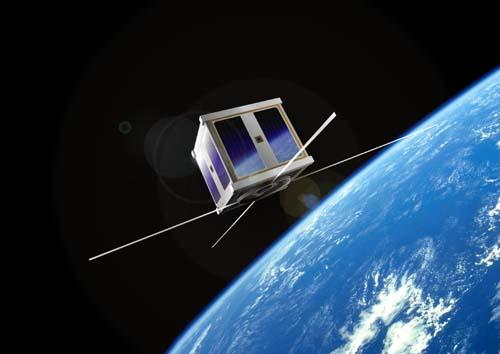
CubeSats may be small but they have big ambitions. Credit: Aalborg University
By Ben Gilliland
For the vast majority of Earth’s history it had but one satellite – the Moon – but that all changed in 1957 when, on October 4, the Soviet Union launched the first artificial satellite into Earth’s orbit.Sputnik-1 was a 58cm (23 inch) sphere that contained two 1-watt radio transmitters and three batteries (two for powering the radios and one to power a cooling fan). The 83kg aluminum sphere emitted radio signals that were transmitted back to Earth via four 2.4m-2.9m “whip” antenna.
Its radio did little more than beep at Earth, but its signal was picked up by amateur “ham radio” enthusiasts all over the world.
In many ways, Sputnik was not just the world’s first satellite, it was also the first “people’s satellite” – anyone with suitable radio equipment could listen to the plucky little satellite as, for 22 days, it whizzed around the globe at 29,000km/h (18,000mph).

Sputnik-1 kick-started the space race and the satellite industry, but was really little more than a transmitter that beeped. Credit: NASA
America’s first satellite was even smaller. Launched on January 31, 1958, and weighing in at just 14kg, Explorer-1 boasted several scientific instruments including a cosmic ray detector, five temperature sensors and micrometeor detectors.But satellites didn’t stay small, simple and accessible for very long.
As they increased in complexity, so they increased in size. From the size of a beach ball, satellites were soon the size of a family cars, then buses and (in the case of the International Space Station) the size of a football field.
With increased size and complexity came increased costs.
It can take a decade and hundreds of millions of pounds to develop an Earth observation satellite – but that is just the tip of the financial iceberg. Launching a satellite weighing several tonnes into orbit can cost between £30million and £250million ($50million to $400million) and just paying for the radio bandwidth needed to get your information back to Earth can cost up to £1million ($1.6million) a year. That’s not taking into account the cost of ground operations and maintenance of the satellite.
 A trio of CubeSats that will study the effects of space weather on the Earth’s radiation belts and magnetic field are being prepared for launch. TRIO-CINEMA is a collaboration between UC Berkeley, Kyung Hee University and Imperial College London. The first CINEMA CubeSat passed acceptance testing in January 2012 and will launch in mid-2012.

 AMSAT-UK
You must be logged in to post a comment.