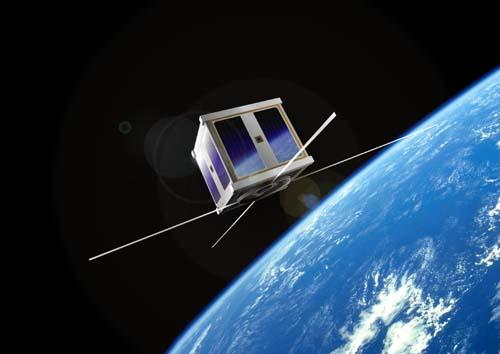
F-2 nanosatellite

Conceptual design of F-2 nanosatellite (by FSpace)

Since 1957, with more than 50 years of exploring space, the lower thermosphere (90-320 km) is the least explored layer of the atmosphere. Satellites and space stations usually orbit at altitude over 320km (to increase orbital lifetime) Atmospheric Explorers were flown in the past in highly elliptical orbits (typically: 200 km perigee, 3000 km apogee); they carried experiments for in-situ measurements but the time spent in the region of interest below 320 km was only a few tens of minutes. Nowadays, sounding rocket flights provide the only in-situ measurements. While they do explore the whole lower thermosphere, the time spent in this region is rather short (a few minutes), there are only a few flights per year and they only provide measurements along a single column. Powerful remote-sensing instruments on board Earth observation satellites in higher orbits (600–800 km) receive the backscattered signals from atmospheric constituents at various altitudes. While this is an excellent tool for exploring the lower layers of the atmosphere up to about 100 km, it is not ideally suited for exploring the lower thermosphere because there the atmosphere is so rarefied that the return signal is weak. The same holds for remote-sensing observations from the ground with lidars and radars.

QB50 is an international network of 50 CubeSats for multi-point, in-situ measurements in the lower thermosphere and re-entry research proposed by the von Karman Institute. It has the scientific objective to study in situ the temporal and spatial variations of a number of key constituents and parameters in the lower thermosphere (90-320 km) with a network of 50 double CubeSats, separated by a few hundred kilometres and carrying identical sensors. QB50 will also study the re-entry process by measuring a number of key parameters during re-entry and by comparing predicted and actual CubeSat trajectories and orbital lifetimes.

The multi-point, in-situ measurements of QB50 will be complementary to the remote-sensing observations by the instruments on Earth observation satellites and the remote-sensing observations from the ground with lidars and radars. All atmospheric models, and ultimately thousands of users of these models, will benefit from the measurements obtained by QB50 in the lower thermosphere.

F-2 is a 2U CubeSat mission proposed by FSpace laboratory, FPT University to participate in QB50 project based on experience of FSpace team working in F-1 CubeSat project. The mission goals are to:

  • Collect scientific data of the lower thermosphere (from 330km down to 90km).
  • Demonstrate practical application of CubeSats, especially in a constellation of 50 CubeSats and a network of multiple ground stations around the world.
  • Providing an opportunity to experiment new technology, Commercial Off The Shelf (COTS) products such as testing a smartphone in space as an onboard computer for a nano-satellite

Besides these goals, F-2 project also has strong educational objectives such as providing hands-on-project experience on a space project to engineering/science students and promoting international cooperation/capacity building among universities around the world.


CubeSats: good things come in small packages

CubeSats may be small but they have big ambitions. Credit: Aalborg University

CubeSats may be small but they have big ambitions. Credit: Aalborg University

By Ben Gilliland
For the vast majority of Earth’s history it had but one satellite – the Moon – but that all changed in 1957 when, on October 4, the Soviet Union launched the first artificial satellite into Earth’s orbit.Sputnik-1 was a 58cm (23 inch) sphere that contained two 1-watt radio transmitters and three batteries (two for powering the radios and one to power a cooling fan). The 83kg aluminum sphere emitted radio signals that were transmitted back to Earth via four 2.4m-2.9m “whip” antenna.

Its radio did little more than beep at Earth, but its signal was picked up by amateur “ham radio” enthusiasts all over the world.

In many ways, Sputnik was not just the world’s first satellite, it was also the first “people’s satellite” – anyone with suitable radio equipment could listen to the plucky little satellite as, for 22 days, it whizzed around the globe at 29,000km/h (18,000mph).

Sputnik-1 kick-started the space race and the satellite industry, but was really little more than a transmitter that beeped. Credit: NASA

Sputnik-1 kick-started the space race and the satellite industry, but was really little more than a transmitter that beeped. Credit: NASA

America’s first satellite was even smaller. Launched on January 31, 1958, and weighing in at just 14kg, Explorer-1 boasted several scientific instruments including a cosmic ray detector, five temperature sensors and micrometeor detectors.But satellites didn’t stay small, simple and accessible for very long.

As they increased in complexity, so they increased in size. From the size of a beach ball, satellites were soon the size of a family cars, then buses and (in the case of the International Space Station) the size of a football field.

With increased size and complexity came increased costs.
It can take a decade and hundreds of millions of pounds to develop an Earth observation satellite – but that is just the tip of the financial iceberg. Launching a satellite weighing several tonnes into orbit can cost between £30million and £250million ($50million to $400million) and just paying for the radio bandwidth needed to get your information back to Earth can cost up to £1million ($1.6million) a year. That’s not taking into account the cost of ground operations and maintenance of the satellite.

Continue reading →

Watching space weather through the MAGIC of CubeSat CINEMA


A trio of CubeSats that will study the effects of space weather on the Earth’s radiation belts and magnetic field are being prepared for launch. TRIO-CINEMA is a collaboration between UC Berkeley, Kyung Hee University and Imperial College London. The first CINEMA CubeSat passed acceptance testing in January 2012 and will launch in mid-2012.
 

The Full article can be found Here

Hampshire Based Electronics company wins MOD Cubesat contract.


Earth

Roke Manor Research Ltd’s (Roke) Gioconda industry consortium has been awarded a contract to deliver a major element of the UK MoD’s Defence Science and Technology Laboratory’s ‘Smallsat’ CubeSat Research Programme.

A CubeSat is a type of miniaturised satellite, currently destined for space research that usually has a volume of exactly one litre (10cm cube), a mass of little more than one kilogram and typically uses commercial off-the-shelf electronic components. CubeSats are a disruptive technology that offer the potential for rapid, low cost, short duration deployment of sensing and communications capability in Low Earth Orbit.

For this innovative research programme, Gioconda comprises Roke (a Chemring Group company) as prime, Scisys Ltd, and Surrey Satellite Technology Ltd. It will deliver engineering and flight-ready models (mechanically, electrically, electronically and functionally representative), software and electrical ground support equipment (EGSE) for an advanced experimental RF payload suitable for subsequent deployment in space within a CubeSat.

About Roke:

Roke, based in Romsey, Hampshire, is the principal electronics research and development centre of Chemring Group Plc. Founded in 1956, Roke is one of the UK’s leading suppliers of innovative solutions and contract R&D, pioneering developments in electronic sensors, networks and communications technology. It employs 450 staff and has over 430 patents to its name.

Roke has over 50 years of communications experience, providing customers with technology consultancy through to product development. Roke’s expertise in small form factor electronic solutions has been developed through significant involvement in the design of mobile phones and military handheld radios over the last decade.

For more information visit http://www.roke.co.uk/

1st Interplanetary CubeSat Workshop

The 1st Interplanetary CubeSat Workshop takes place in Cambridge, Massachusetts, 29-30 May, 2012

iCubeSat, the Interplanetary CubeSat Workshop, will address the technical challenges, opportunities, and practicalities of space exploration with CubeSats.

The workshop will provide a unique environment for open practical collaboration between academic researchers, industry professionals, policy makers, and students developing this new and rapidly growing field.

Talks and round tables will focus on three themes: technology, science, and open collaboration.

Keynote speakers

Technology: Mason Peck, NASA, Chief Technologist

Science: Sara Seager KB1WTW, MIT, Professor of Physics and Planetary Science

The program will also include unconference sessions to provide additional opportunities to engage with the interplanetary CubeSat community and potential collaborators. Talks and supporting material will be streamed and posted on the conference website. A lively social program in and around summertime Boston will be arranged for participants and their guests.

Further information on the event website – http://icubesat.wordpress.com/

The QB50 project

The QB50 project, funded by the European Commission, deals with the design and the launch of a network of 50 miniaturized satellites to study the lower layers of the thermosphere / ionosphere. This project receives as from 15th of January 2012 financial support from the FP 7 EC program and is run by an international consortium under the leadership of the von Karman Institute near Brussels.

These satellites called “CubeSats”, completely functional, are built by universities for an educational purpose. All 50 CubeSats will be launched out of Murmansk, situated in the Northern Russia, into a circular orbit at 320 km altitude, inclination 79° around the Earth. Due to atmospheric drag, the orbits will decay and progressively lower layers of the thermosphere / ionosphere will be then explored. A network of standard satellites for in-situ measurements can only be realized by using very low-cost satellites, and CubeSats are the only realistic option.

This project includes universities in 30 European countries and universities in Argentina, Australia, Brazil, Canada, Chile, China, Egypt, Israel, Japan, Peru, Russia, South Africa, South Korea, Taiwan, Thailand, Turkey, Ukraine, USA and Vietnam. For many of these countries, CubeSats will be their first satellite in orbit and a matter of national prestige.

The von Karman institute for Fluid Dynamics (VKI) is the lead institute of this consortium and manages this international project which involves over 500 researchers from 50 countries. Jean Muylaert, Director of the Institute and responsible for the project, stresses that it will be the first time that a dedicated CubeSat space mission will be performed for unique atmospheric science and also to demonstrate new in-orbit qualification methods.

Useful websites:

http://www.QB50.eu for the Qb50 project

http://www.cubesatsymposium.eu for the 4th European CubeSat Symposium