Amateur Radio Satellites in TES Magazine

International Space Station - Image credit NASA

International Space Station – Image credit NASA

Amateur radio can open up a new world of opportunities for students, says teacher Chris Aitken MM0WIC, @skipperAitken on X, who shares his tips on how to start a club in the Times Educational Supplement – TES Magazine.

“In 2023 I officially started the Wick High School Radio Club, with a callsign of GM0WHS. The aim of the club was to expose our students to the wide range of activities available in amateur radio.

I remember our first activity: talking to another amateur in England via the SO-50 satellite. I stood with three students on the rugby pitch, antennas pointing to the sky and talking to another amateur, Nick M1DDD.

By the end of the contact, we had 30 students around us wondering what was going on. Their curiosity sparked, we answered questions on what we were doing and invited them to take part.”

Read the TES magazine article at
https://www.tes.com/magazine/teaching-learning/general/why-i-started-amateur-radio-club-my-school

Online Amateur Radio Foundation Course M6KFAThere is no better way to explore the fascinating world of wireless communication than by becoming a radio amateur.

This free online 3-week amateur radio course will enable you to become a radio amateur and get an Ofcom amateur radio licence and callsign, details and booking information at
https://www.essexham.co.uk/train/book-a-place/

Follow AMSAT-UK on X

AMSAT Education and You

Dr Mark Hammond N8MH

Dr Mark Hammond N8MH

During the AMSAT Forum at the Dayton 2013 Hamvention, Mark Hammond, N8MH, AMSAT VP for Education Relations gave a quick overview of AMSAT’s recent educational activities, AMSAT’s partnership with the ARRL Education & Technology Program, and how you can become involved.

Watch AMSAT Education and You, by Mark N8MH – 2013 Dayton Hamvention

ARISS contact planned February 19, 2013 with school in Greece

The International Space Station

ARISS contact planned February 19, 2013 with school in Greece

An International Space Station school contact has been planned February 19 2013 with participants at 4th Dimotiko Scholeio Chaidariou, Chaidari (near Athens), Greece.             The event is scheduled to begin at approximately 14:06 UTC, which is 16:07 CEWT.

The contact will be a direct operated by J41ISS. Interested parties in Europe are invited to listen to dowlink signals on 145.800 MHz FM. The contact will be conducted in English.

The event will be webcast on several webstreaming servers: http://www.sv1eag.gr/ http://www.justin.tv/sv1eag#r=-rid-&s=em http://www.youtube.com/watch?v=6RFJbw5NeAc

School presentation:

Our school is located in Chaidari, a suburb in the north-west of Athens.             It was constructed in 1978, but it is now being renovated so as to be more energy efficient. It is a two-storey building with 16 classrooms, a Head office and a staff room. Continue reading

AMSAT-UK to provide Amateur Radio payload for ESEO satellite

The ESEO spacecraft Copyright ALMASpace - ESA

The ESEO spacecraft Copyright ALMASpace – ESA

AMSAT-UK will be providing a 1260/145 MHz FM transponder and a 145 MHz BPSK telemetry beacon for the European Student Earth Orbiter (ESEO). This is the third mission within the European Space Agency’s Education Satellite Programme.

The satellite, which has a mass of 40 kg and measures 33x33x63 cm, is planned to launch in 2015-16 into a low Earth orbit.

Nine European universities will be working with the prime contractor ALMASpace, Italy, on the mission. Cranfield University in Bedfordshire will be supplying a small sail that will be deployed to demonstrate the de-orbiting of spacecraft at the end of the mission.

The primary purpose of the AMSAT-UK payload is to provide a downlink telemetry that can be easily received by schools and colleges for educational outreach purposes. The data will be displayed in an attractive format and provide stimulation and encouragement for students to become interested in all STEM subjects in a unique way.

The target audience is primarily students at both primary and secondary levels and the project includes the development of a simple and cheap “ground station” operating on VHF frequencies in the Amateur Satellite Service. This station is an omni-directional antenna feeding a FUNcube DonglePRO+ SDR receiver which will receive the signals direct from the satellite and transfer the data to specially developed graphical software running on any Windows laptop.

Continue reading

Nigerian CubeSat – EregbuSAT


EregbuSAT CubeSat

EregbuSAT CubeSat Prototype

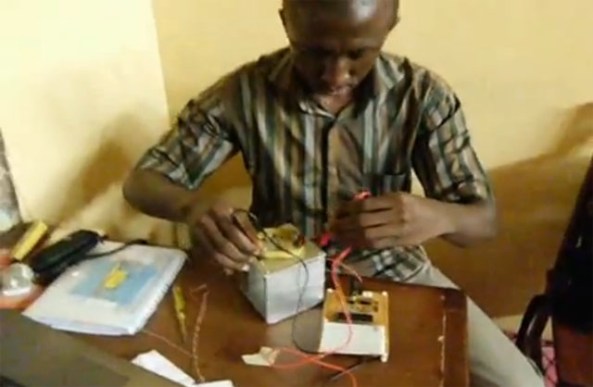
EregbuSAT is a CubeSat prototype that is being developed by the Postgraduate students of the African Regional Centre for Space Science and Technology Education in English (ARCSSTE-E) to simulate the communication (send and receive data) between a Satellite and its Ground Station.

When completed, it will provide an opportunity for future students in the Satellite Communication option of ARCSSTE-E Postgraduate Diploma program to experience operating a Satellite (send commands to Satellite using the prototype) during their short stay in Nigeria.

Continue reading

Canadian – Norwegian Student Exchange, Rocket & CubeSat Program

This video provides a short description of the Canada-Norway Student Sounding Rocket (CaNoRock) exchange program and plans for the student CaNoSat sub-orbital CubeSats.

CaNoRock is a partnership between the Universities of Alberta, Calgary and Saskatchewan, the University of Oslo, University of Tromsø, Andøya Rocket Range and NAROM (Norwegian Center for Space Related Education) in Norway. The University of Bergen and University Centre in Svalbard (UNIS) in Norway are currently working to be included in the program.

Continue reading