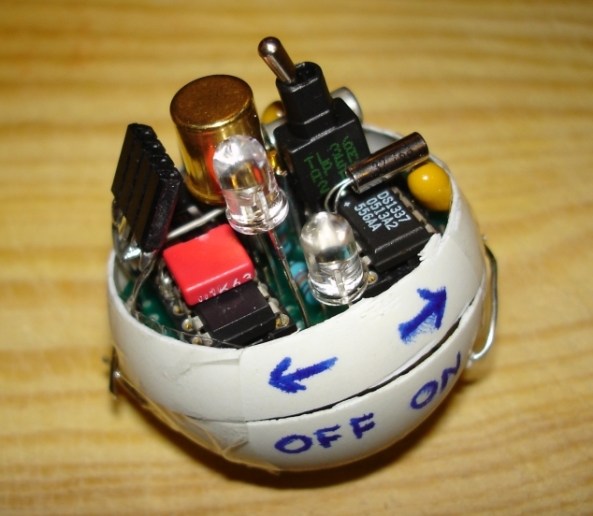
On September 22 it’s planned to send 1000 student projects built into PongSats (ping pong balls) to the edge of space.
These experiments and projects are made by those in kindergarten, university professors, high school science classes and home schools kids.
PongSats on the Edge of Space – Image credit JP Aerospace
Projects range from plant seeds to filling a PongSat with a marshmallow. At 100,000 feet (30 km) the marshmallow puffs up completely filling the ball. Then it freeze dries. The student gets to hold in her hand the direct results of traveling the top of the atmosphere.
The launch of the PongSats will take place from the Black Rock desert in Nevada. The vehicles that carry them are called High Rack. They are made of foam and carbon fiber. There are four separate telemetry links to the High Rack tracking it during the flight. At the end of the flight the balloon is released and the High Rack descends by parachute.
It will take four High Racks, each with its own balloon to carry the thousand ping pong balls.
Dave Akerman M6RPI has used a Raspberry Pi computer board as the flight computer on a High Altitude Balloon (HAB) and sent back live images from near space at an altitude of almost 40 km.
SSDV picture from a previous PIE balloon – Image credit Dave Akerman M6RPI
The balloon, appropriately called PIE1, was launched from Brightwalton, in Berkshire on July 14, 2012. The images were transmitted on 434.650 MHz (300 bps, 600 Hz shift) in the amateur radio 70cm band using the Slow Scan Digital Video (SSDV) standard.
PIE1 reached an altitude of 39,994 metres and images were received as far away as Northern Ireland (that’s over 500 km, not bad for just 10 mW on 434.650 MHz!).
You can watch a video online of the presentation that Cambridge University Spaceflight gave called “Teddy Bears in Space” at http://www.batc.tv/channel.php?ch=1
In the Archive List category box select AMSAT then click Select Category then in the stream box select Teddys and click on Select Stream
Jason Brand VK2FJAB (10) was interviewed for the morning “Today” show on Channel 9 in Australia. He talks about amateur radio and his Do-It-Yourself space projects.
Watch Channel 9 (Australia) interview with Jason
Watch Robert Brand VK2URB and Jason Brand VK2FJAB WotzUp Radio, Space and Balloon Workshop
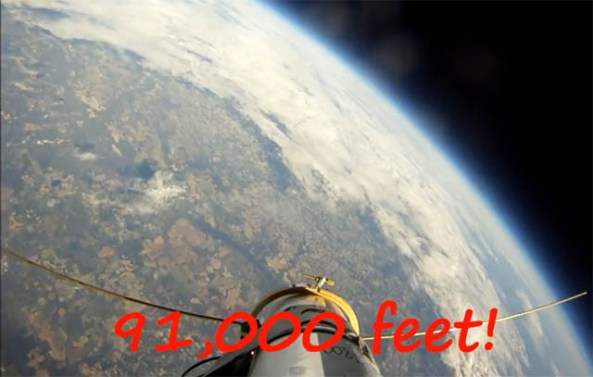
Erin King, AK4JG, a 17-year-old from Columbus, Georgia, who re-founded her high school’s radio club and then lofted a ham radio-carrying balloon to over 90,000 feet, recovered the flight data and used it to produce a truly striking video of that flight, has been named as recipient of the 2012 Amateur Radio Newsline Young Ham of the Year Award.
Watch MIT’16 EA Tube goes to Near Space!
Ever wondered how to execute a high altitude balloon mission? Erin King, AK4JG, talks about the process, planning and options in a presentation at Dayton in 2012.
Watch Launching Radios and Other Cool Stuff into the Stratosphere AK4JG.wmv
Erin is the daughter of Paul, K4ETY, and Patricia King. She has two siblings: Brandon, age 16 and Rachel, age 15. Erin became a licensed radio amateur in 2009 and now holds an Extra Class license. She is a member of the ARRL, the Columbus Amateur Radio Club, and the Russell County Radio Club. She enjoys operating on local VHF and UHF repeaters as well as phone and digital modes on the High Frequency amateur radio bands. She is looking forward to mastering Morse Code as her next amateur radio challenge.
Erin King AK4JG
Erin became interested in amateur radio after joining a club at her high school dealing with robotics and then ham radio-equipped high-altitude balloon launches. This school group has participated in FIRST Robotics competitions, and Erin has twice been Team Lead for Programming. The club also launches several high-altitude balloon missions each year, in a program called DREAMS. They have flown various scientific experiments as part of these missions, in addition to planning, building, and integrating radios, Global Positioning System (GPS) units and TNCs to track and recover the balloons. To facilitate these activities, the group’s sponsor, Luther Richardson, KI4AOJ, has encouraged the students to obtain their amateur radio licenses.
A subset of this group,including Erin, has participated in the Massachusetts Institute of Technology’s (MIT’s) “InvenTeam” competition, designing and building a portable lightning detector and early warning system. In addition, Erin re-started the Columbus High School Radio Club and served as its president for the past two years. The club was active in the 1950s and ’60s, and Erin’s great-grandfather (the original K4ETY) was one of its mentors at that time. The new club obtained the callsign W4CHS (Columbus High School) and has been active on the air.
Erin King AK4JG working 6m for Field Day 2011 – Image Credit Columbus Amateur Radio Club W4CVY
Erin’s involvement with amateur radio and FIRST Robotics has helped fuel her interest in science and engineering. Last year, she applied for early admission to both Georgia Tech and MIT; she was accepted to both and will be attending MIT this fall.
Inside the shiny tube which contained Erin’s MIT acceptance letter was a note suggesting that the students “hack” their tubes, meaning to do something cool with them, in along-standing tradition of MIT hacks or stunts. Erin chose to send her tube to near-space.
Drawing on her ballooning experience,Erin planned, built, integrated, and tested a complete new tracking setup to fit into the very small shipping tube. The payload consisted of two GPS units, two custom-made antennas, one Argent Data OpenTracker+ kit (which Erin built), one handheld radio, and a fellow ham’s Byonics Pocket Tracker, a self-contained 100-milliwatt tracker/radio combination in an Altoids® tin. Erin also talked her mother into letting her use mom’s brand new GoPro Hero HD video camera.
With the assistance of a group of hams from the Columbus Amateur Radio club, Erin launched her balloon from Lumpkin, GA. A couple of hours later, she and the tracking team successfully recovered it, along with the complete HD video record of the flight. Erin took this video, as well as other photos and videos taken of the launch activities, and compiled it into an 8-minute presentation,complete with background music. She posted it to YouTube, and put a link to it on the MIT hack-the-tube site (see<http://tinyurl.com/ak4jg-space-video>). According to YouTube statistics, Erin’s video has been viewed thus far in excess of 82,500times.
This past May, Erin was invited to participate in no less than three forums and sessions at the 2012Dayton Hamvention®. These included the 25thanniversary “Youth Forum,” the “Ham Radio Town Meeting” and an “ARRL Expo”presentation where her video was screened.
Award Ceremony
The 2012 Amateur Radio Newsline™ “Young Ham ofthe Year Award” will be presented on Saturday, August 18th at the Huntsville Hamfest in Huntsville, Alabama. As the 2012″Young Ham of the Year,” Erin will receive –courtesy of Yaesu USA — an expense-paid trip to the Huntsville Hamfest, along with a gift of Yaesu brand ham radio equipment. CQ magazine will treat her to an expense-paid week at Spacecamp Huntsville,and will present Erin with a variety of CQ products. Amateur Radio Newsline™ will provide Erin with a commemorative plaque at the award ceremony. Once again, the cost of year’s plaque has been underwritten by Dave Bell (W6AQ), President of DBA Entertainment Inc., Hollywood, California. Heil Sound Ltd. will also be presenting Erin with a ham radio-related gift.
The presentation of the Young Ham of the Year Award has been a regular feature of the Huntsville Hamfest since 1993. This has been made possible through the generosity and kindness of the event’s Planning Committee and the good offices of Huntsville Hamfest Association Vice President Charlie Emerson, N4OKL. (See http://www.hamfest.org)
This year’s award ceremony will be hosted by Bill Pasternak, WA6ITF, and Don Wilbanks, AE5DW, of Amateur Radio Newsline™, Rich Moseson, W2VU, of CQ Communications, and representatives of Yaesu USA and Heil Sound.
Award Program Background
The Amateur Radio Newsline™ “Young Ham of the Year” award (formerly the Westlink Report Young Ham of the Year Award) has been presented annually since 1986 to a licensed radio amateur (ham) who is 18years of age or younger and who has provided outstanding service to the nation,his/her community or the betterment of the state of the art in communications through the amateur radio hobby/service. A website with full information on the award program and background material is located at http://www.arnewsline.org/YHOTY.
Award Sponsors
The award program is sponsored by the Los Angeles, California-based Amateur Radio Newsline™ with corporate support from Yaesu USA Corporation of Cypress, California, CQ Magazine of Hicksville, New York, and Heil Sound of Fairview Heights, Illinois.
Since 1976, Amateur Radio Newsline™ and its predecessor, the Westlink Radio Network, have been providing radio amateurs around the world with up-to-the-minute news at no cost to them. (See http://www.arnewsline.org)
The award’s three major corporate underwriters are world leaders in their respective areas of Amateur Radio product support.
Yaesu USA, which has been a corporate underwriter since the inception of the award program in 1986, is considered the trailblazer in the design, manufacture and distribution of high quality amateur gear as well as commercial two-way, monitoring, marine and air-band communications equipment (See http://www.yaesu.com).
CQ magazine and its sister publications, CQ VHF,Popular Communications and World Radio Online, are publishedby CQ Communications, Inc., and are considered the trend-setting publications serving today’s modern radio amateur. (See http://www.cq-amateur-radio.com)
Heil Sound Ltd. Is considered as a world leader in the development and manufacture of new technology microphones and related audio products for professional sound reinforcement and amateur radio communications. (See http://www.heilsound.com)
View of communications experiment: Below is the plate of the repeater. Top left is the SSTV camera and top right is the GPS receiver module. Image credit LU7AA
An SSTV and crossband repeater payload developed by AMSAT-LU will be flown on a Glider and a High Altitude Balloon on March 3 and 17.
AMSAT-LU LU7AA report:
We are pleased to inform next Saturday March-3 2012 (if weather permits) from 12hs (GMT-3), Amsat-LU and friends will be flying from Zarate (Route 193, km 19 from Buenos Aires) an UV repeater including APRS + SSTV + CW + DTMF thru several flights aboard manned glider, as test for LUSEX (LU Satellite Experiment), being developed by AMSAT-LU.
Afterwards on Saturday March-17 from 12hs-LU on (GMT-3), a free Balloon will fly same payload from the city of Junin (Club of Gliders, Lagoon of Gomez), 250Km west of Buenos Aires City.
Payload will operate as an UHF to VHF crossband repeater, with CW tlm, APRS location and SSTV emissions in local and space frequencies.
According to estimates Balloon could reach 100,000 feet (30 km) in height, travelling from 50 to 100 miles towards east.
For these experiences, Amsat-LU works with and it is thankful to hams of Radio Clubs of Junin, QRM Belgrano, APRS Group, Don Bosco Ramos Mejia School, gliders Clubs of Zarate, Junin and Cañuelas, and the twelve Amsat-LU members development team as well as those who have actively participated and sent their reports in previous experiences.
Several flown experiments have been successfully operated during 2011 in manned-gliders, airplanes, captive and free Balloons allowing operational & practice for hams contributing to platform validaton of LUSEX satellite (LU Satellite EXperiment) on development by Amsat Argentina. More on http://lusex.org.ar
In order to monitor the payload (if you are within 400 miles of launch area) you need just an FM receiver either handy or base, in 145.950 for repeater and/or 144.930 for APRS. The repeater, that is activated via 123 Hertz subtone, operates receiving voice FM in 435.950 Khz (-112dbm, 0,56 uV) and emits with 2W the received audio live on 145.950 Khz.
Simultaneously APRS data will be sent in Packet at 1200 bauds in 144.930, and also in 145.950.
The DTI APRS symbol would change from a Balloon (/O) during the ascent to a glider (/g) during parachute descent.
Payload would operate as voice repeater activated by 123 Hz subtone during 1 minute, a warning bip at 40 seconds will indicate telemetry is coming, which is emitted if the repeater is not in use, if in 20 seconds more voice repeater still in use a two bips will be heard signaling that short APRS packages will begin in the different frequencies, also every 5 minutes CW (telegraphy with tones of audio) with CQ + callsign (LU7AA), sequence#, ext. and int. centigrade temperatures and voltage of batteries, after which the cycle will repeat.
The system board containing RF transmitter module, receiver module, level adjustments, duplexer and antenna connector. Image credit LU7AA
Experiment for the first time in these flights will emit SSTV pictures in ROBOT-36 (36 seconds) in real time, showing what glider/Balloon sees. Every 5 minutes during ascent/descent and more spaced at high altitudes. (It can be received among others with MIXW, MMSTV & RX-SSTV ).
Payload would also carry on board two TV cameras (one towards earth and another towards horizon) recording video and sound during the flight. These captured videos could be recovered when payload is recovered.
APRS trajectory could be seen every minute, including speed, height, external and internal temperatures and 7.2v battery voltage using UI-View ( download from the UI-View official site on http://www.ui-view.org/ ) and/or to see/follow from Internet connecting to http://aprs.fi/?call=lu7aa-11 or locally via Packet at specified frequencies.
The experiment in 435.950 KHz besides voice, receives and accepts DTMF sequences commands on demand, I.E. sending B* (DTMF with handy keyboard on UHF) will return S5 … ….. in 145,950 VHF CW, reporting in CW signal strength received from your station, if S9+10 will returns P10.
There are also DTMF commands qualifying emission of CW tlm or APRS beacon or SSTV emission, commands that allows remote release of payload, mode changes, timers control, energy, power, etc.
Frequencies for previous coordination, announcements and flights will be 7090 Khz LSB +/-10 Khz and local repeaters.
During the flights will remain active wide coverage AMSAT-LU APRS Igate LU7AA-10 on 144.930 and 430.930 KHz, operating from the Constituyentes Investigation Center transferring whatever is received towards Internet.
For being an experiment oriented to a next satellite, the contacts made between stations via this payload will be considered valid for the recently announced permanent, gratuitous and applicable Satellite Certificate that AMSAT-LU and RClub QRM Belgrano grants, more info on http://www.amsat.org.ar/certsat.html
During the Balloon flight, amateur groups will chase the payload, aiming to locate and recover. Trapping ventures holds on this activity, as in the case of the Pampero 15 Balloon sent from San Miguel del Monte which landed in the middle of the Magdalena’s state prison … See http://www.lu5egy.com/Proyecto_pampero/vuelo_15/n_1esk.htm
All reports welcome. If you wish or can organize or want be part of control, or like to pursuit and recovery, or like operating and capturing data as an independent station, and/or wishes to join us personally in this adventure from the launching places email us to parapente at amsat.org.ar.
We appreciate reading of this information and thankful if distribution possible.
73, LU7AA, Amsat-LU, aiming at the future by making the present funny. http://www.amsat.org.ar/
info at amsat.org.ar





 AMSAT-UK
You must be logged in to post a comment.