Queen shown radio ham’s Raspberry Pi balloon payload

Her Majesty Queen Elizabeth II is shown M0RPI's 434 MHz High Altitude Balloon Payload

Her Majesty Queen Elizabeth II is shown M0RPI’s 434 MHz High Altitude Balloon Payload – Credit Raspberry Pi Foundation

On Monday, June 9, more than 350 of the UK’s most successful and most promising technologists were invited to Buckingham Palace by the Queen and the Duke of York for Tech at the Palace.

Her Majesty Queen Elizabeth II was shown the Raspberry Pi High Altitude Balloon payload developed by David Akerman M6RPI (now M0RPI) which transmitted Slow Scan Digital Video (SSDV) signals on 434 MHz from the first “Pi in the Sky“. She also saw the TARDIS that was flown by David and Anthony Stirk M0UPU @AnthonyStirk

David M0RPI @daveake tweeted:
The Queen, The Duke of York, and my TARDIS 🙂 #UKHAS #RaspberryPi pic.twitter.com/sOTT4mT7MJ

Giant leap for radio amateur M6RPI’s Pi-powered teddy bear
https://amsat-uk.org/2013/08/26/giant-leap-for-radio-hams-pi-powered-teddy-bear/

M6RPI Balloon PIE1 – Raspberry Pi Sends Live Images from Near Space
https://amsat-uk.org/2012/07/17/pie1-raspberry-pi-sends-live-images-from-near-space/

Educational STEM 434.3 MHz Balloon Launch Tuesday 2:30pm

Chris Stubbs M6EDF with 434 MHz trackers

Chris Stubbs M6EDF with 434 MHz trackers

Continuing his Science, Technology, Engineering and Mathematics (STEM) work with schools, Chris Stubbs M6EDF, will launch a balloon STEWARDS-1/CHEAPO-12 for Stewards Academy, Harlow.

The launch will take place at 2:30pm (13:30 GMT) on Tuesday, June 3. Chris will be using a “mini” tracker with 1 AA battery on a 36″ foil balloon and aims to get the balloon to float for a long duration.

It will transmit 50 bps 7n2 RTTY on 434.300 MHz with about 450 Hz FSK and may have a range of up to 500 km depending on altitude.

Chris took the amateur radio Foundation training course run by the Chelmsford Amateur Radio Society (CARS) in January 2013. He is keen on both electronic construction and software development and combines the two interests in High Altitude Ballooning (HAB). Chris has built many tracker payloads for his balloon launches which usually take place from Danbury Common near Chelmsford.

M6EDF CHEAPO Micro TrackerDetails of his high-altitude ballooning hardware and experiments are online at http://chris-stubbs.co.uk/

See online real time tracks and frequencies of this and other 434 MHz balloons at
http://spacenear.us/tracker/

Beginners Guide to Tracking using dl-fldigi http://ukhas.org.uk/guides:tracking_guide

The role of these 434 MHz balloon launches in teaching maths and science was recently recognised by the Department for Education (DfE) see https://amsat-uk.org/2014/05/11/434-mhz-balloons-have-a-role-in-stem-education/

Listen to balloons online (when in range of south-east UK) from anywhere in the world with the SUWS 434 MHz WebSDR (select USB) https://amsat-uk.org/2013/12/28/websdr-for-434-and-1296-mhz/

Check the #highaltitude IRC channel for launch chat. A web client is available at http://webchat.freenode.net/?channels=highaltitude

To get up-to-date information on balloon flights subscribe to the UKHAS Mailing List by sending a blank email to this address: ukhas+subscribe@googlegroups.com

Chelmsford 434 MHz STEM Balloon Launch
https://amsat-uk.org/2014/05/17/chelmsford-434-mhz-stem-balloon-launch/

The Chelmsford Amateur Radio Society run training courses for those wishing to get their amateur licence. To find out more speak to Clive G1EUC on
Tel: 01245-224577
Mob: 07860-418835
Email: training2014 at g0mwt.org.uk
Web: http://www.g0mwt.org.uk/training/

What is Amateur Radio ? http://www.essexham.co.uk/what-is-amateur-radio

Post flight update: The balloon floated at an altitude of under 6,000 metres for just over 2 hours.

Flight path of M6EDF's balloon STEWARDS on June 3. 2014

Flight path of M6EDF’s balloon STEWARDS on June 3. 2014

BBC TV: Radio Hams Balloon Flight and Pocket Spacecraft

Malawi Hgh Altitude BalloonRadio amateurs Jerry Sandys G8DXZ, Andrew Ashe G8SRV and Michael Johnson M0MJJ appeared in the May 17 edition of the BBC TV technology show Click which is now available on the web. (Overseas viewers may need to use a UK based proxy server)

Jerry Sandys G8DXZ along with other APJHAB team members, Peter Gibbs (BBC weather presenter) and Andrew Ashe G8SRV flew three balloons during a week long High Altitude Balloon (HAB) holiday in Malawi. The first flight was from Mumbo Island in Lake Malawi and was successfully recovered after landing on the lake. The second flight was from Mvuu Wilderness Camp on the bank of the River Shire. The BBC technology show “Click” sent a camera operator to film the second flight and shot a 3:30 minute segment for the show.

Malawi Recovering the PayloadBy the time they arrived at Kumbali for the third flight, they didn’t have enough Hydrogen left to lift the electronic payload so decided to do a “message in a bottle” flight released by three young school children. Jerry says the look on the children’s faces as their messages, attached to the red cloud buster, disappeared into the sky was amazing.

The team flew a RTTY Arduino tracker and also an Iridium Arduino tracker, both worked well. On the second flight they also flew a two tube Geiger counter as an experiment for Reading University. A Hero 3 GoPro and Polaroid sport camera was used for photography.

Watch the Click High Altitude Balloon (HAB) segment at 12:55 into the show
http://www.bbc.co.uk/iplayer/episode/b044trs9/click-17052014

BBC weather presenter Peter Gibbs has written an article about their experience, read it and also watch the video at http://www.bbc.co.uk/news/science-environment-27406041

To get up-to-date information on balloon flights subscribe to the UKHAS Mailing List by sending a blank email to this address: ukhas+subscribe@googlegroups.com

Pocket Spacecraft

Pocket Spacecraft

Radio amateur Michael Johnson M0MJJ appears in the same edition of Click. He is interviewed about his 435 MHz Pocket Spacecraft known as ‘Scouts’. A ‘Scout’ is a wafer thin disk with flexible electronics, smaller than a CD, containing a transceiver, antenna and solar cells. It is hoped to carry them in a CubeSat which would deploy them in Lunar orbit. The segment starts at about 9:00 into the show http://www.bbc.co.uk/iplayer/episode/b044trs9/click-17052014

Permanent link to video clip which should be viewable overseas http://www.bbc.co.uk/news/technology-27444158

Michael Johnson M0MJJ’s Pocket Spacecraft were also mentioned in the BBC Radio 4 Today show, see https://amsat-uk.org/2014/05/15/bbc-pocket-spacecrafts-to-become-a-reality/

UK radio amateur plans Lunar Pocket Spacecraft https://amsat-uk.org/2013/08/26/uk-radio-hams-lunar-cubesat-to-go-ahead/

Pocket Spacecraft http://pocketspacecraft.com/

Radio ham launches Spud into Space for TV show

David Akerman M0RPI and Heston Blumenthal with balloon - Image credit M0RPI

David Akerman M0RPI and Heston Blumenthal with balloon – Image credit M0RPI

In October 2013 Celebrity TV chef Heston Blumenthal visited radio amateur David Akerman M0RPI to fly a potato to near-space on a high altitude balloon as part of his TV show Heston’s Great British Food.

David Akerman M0RPI and Heston Blumenthal - Image credit M0RPI

David Akerman M0RPI and Heston Blumenthal – Image credit M0RPI

Dave says: “It started with a call from a TV production company who were working on a series for Heston Blumenthal. They’d heard that I fly the Raspberry Pi and wanted to include it in their Pie episode. The idea was to fly a potato as that was the first vegetable to be grown in space.”

Read Dave’s well illustrated account of the event at http://www.daveakerman.com/?p=1496

The show Heston’s Great British Food was broadcast on Channel 4 on Thursday, May 1. You can watch it online during the next few days at
http://www.channel4.com/programmes/hestons-great-british-food/4od

The Spud in Space segment starts at about 24:38 into the show.

SSDV picture from a PIE balloon - Image credit Dave Akerman M6RPI

SSDV picture from a PIE balloon – Image credit Dave Akerman M6RPI

Dave is well known for his balloon flights using the Raspberry Pi computer board. On July 14 2012 Dave, then M6RPI, built and launched PIE1 from Brightwalton, in Berkshire. The images taken by the camera were transmitted in the amateur radio 70cm band (434 MHz) using the Slow Scan Digital Video (SSDV) standard, see
https://amsat-uk.org/2012/07/17/pie1-raspberry-pi-sends-live-images-from-near-space/

His next flight will take place on Sunday, May 4 at around 6:30pm BST and aims to capture the sunset with some new cameras.

The two trackers are:
PIE – 434.650 MHz, 300 baud, 750Hz shift, 8, N, 2.  Telemetry and SSDV.
BUZZ – 434.600 MHz, 50 baud, 460Hz shift, 7, N, 2.  Telemetry only

There will be one or maybe two BATC video streams:
http://www.batc.tv/streams/m0rpi_chase
http://www.batc.tv/streams/m0rpi

Expected flight profile is burst alt 30km ascent 5m/s descent 5m/s. Landing spot NW of Cheltenham.

Dave M0RPI http://www.daveakerman.com/

You can see online real time tracks and frequencies of balloons at http://spacenear.us/tracker/

Download the dl-fldigi software from http://ukhas.org.uk/projects:dl-fldigi

Beginners Guide to Tracking using dl-fldigi http://ukhas.org.uk/guides:tracking_guide

Slow Scan Digital Video (SSDV) Guide http://ukhas.org.uk/guides:ssdv

Listen to balloons online (when in range of south-east UK) from anywhere in the world with the SUWS 434 MHz WebSDR (select USB) https://amsat-uk.org/2013/12/28/websdr-for-434-and-1296-mhz/

Check the #highaltitude IRC channel for chat about launches. A web client is available at
http://webchat.freenode.net/?channels=highaltitude

To get up-to-date information on balloon flights subscribe to the UKHAS Mailing List by sending a blank email to this address: ukhas+subscribe@googlegroups.com

SUWS WebSDR for VHF/UHF/Microwave

23cm_WebSDR_Antenna_up_mastThe SUWS WebSDR, a VHF/UHF/Microwave online radio, now has improved antennas for reception of amateur radio satellites and High Altitude Balloons (HAB).

Noel G8GTZ has posted an update on the Southampton University Wireless Society (SUWS) web based software defined radio covering the 144, 432, 1290 and 10368 MHz amateur radio bands. On the UK Microwave Yahoo Group he writes:

A quick update on the status of the SUWS microwave SDR http://websdr.suws.org.uk/

10 GHz – the Octagon PLL LNB based system is working well and now has the correct frequency labels on the scale (rather than the RTL dongle tuning range).  The Octagon does drift up to 30 KHz high with temperature which is not bad considering it is unmodified and mounted on the mast,  and you can get an accurate frequency calibration from GB3SEE which is visible at all times on 10368.850.  We have seen some very interesting propagation effects (both RS and tropo) with GB3CCX and GB3LEX was audible last week during the lift.

1.3 GHz – the SPF pre-amp is now mounted at masthead.  There is some small frequency drift from the RTL dongle but GB3FN is very loud at all times and GB3MHL / GB3DUN are now audible with the any improvement in condx or aircraft scatter (Heathrow lies directly on the path to MHL).

144  MHz and 432 MHz – We are trying a new type of mixed mode helix antennae on both bands to improve satellite and HAB reception and it seems to be working very well – see
http://g8jnj.webs.com/currentprojects.htm

Listen to the SUWS WebSDR at http://websdr.suws.org.uk/

WebSDR for 434 and 1296 MHz https://amsat-uk.org/2013/12/28/websdr-for-434-and-1296-mhz/

UK Microwave Yahoo Group http://groups.yahoo.com/group/ukmicrowaves

‘Travel’ to Space for £40 / $70

VR2Space Payload Module

VR2Space Payload Module

Researchers from the Surrey Space Centre, University of Surrey have launched a unique campaign that will enable the public to ‘travel’ to space for the cost of a pair of trainers.
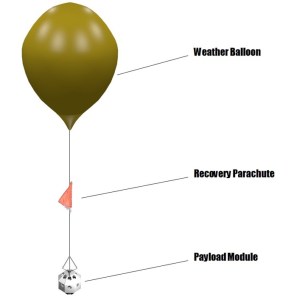
VR2Space BalloonVirtual Ride to Space will use cutting-edge virtual technology and a specially designed spacecraft to deliver a three-dimensional, immersive experience, allowing everyone to see what astronauts experience on an ascent to space.

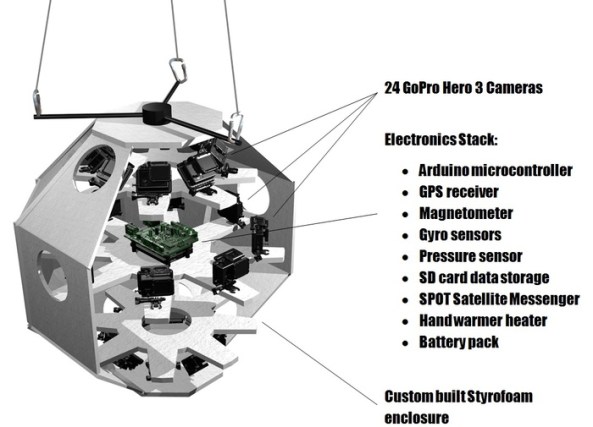
The experience will be created by capturing HD footage of space, via a weather balloon which will carry a cluster of twenty-four HD video cameras to a height of 20km – twice the height of a commercial airplane. During ascent these cameras will capture panoramic footage of the balloon’s journey to space.

Following the flight, specialised software will stitch this footage together to recreate a panoramic view of the space trip. The subsequent space ride will then be viewed using Oculus Rift, a state-of-the-art virtual reality, head-mounted display. The system is designed to deliver high definition 3D virtual environments that can be explored by the wearer, as if they are in space  themselves.

The £30,000 project will be funded by public contributions through the crowd-sourcing funding platform, Kickstarter.

Surrey Space Centre University of Surrey, Guildford

Surrey Space Centre
University of Surrey, Guildford

“Only 530 people have ever travelled to space. For most of us it’s a distant and very expensive dream but this project is about enabling the remaining 99.999992% to see the world like never before,” said lead researcher Dr Aaron Knoll from the University of Surrey.

“Ride to Space will give all aspiring astronauts the chance to be a virtual passenger, riding the balloon to space, and unlike other Galactic flights, it won’t cost the earth to be on board!”

The project team are also developing a smartphone application that will allow users to experience the journey using the phones’ built-in gyroscope and accelerometer data, as well as a computer programme that will allow users to experience space via their PCs.

Investment for Virtual Ride to Space is being sought via Kickstarter. Please visit the Virtual Ride to Space page for more information.
https://www.kickstarter.com/projects/1592839372/virtual-ride-to-space-using-the-oculus-rift

Channel 5 Gadget Show
http://gadgetshow.channel5.com/gadget-show/gadget-news/travel-to-space-with-the-oculus-rift

Facebook https://www.facebook.com/VR2Space

The Bring Your Own Board BYOB CubeSat Workshop and the AMSAT-UK International Space Colloquium take place in Guildford, Surrey on July 25-27, see https://amsat-uk.org/colloquium/colloquium-2014/