French schools to talk to ISS

Thomas Pesquet KG5FYG

Thomas Pesquet KG5FYG

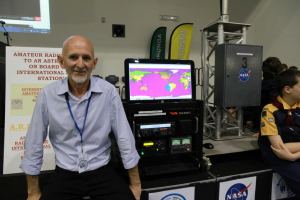
ARISS-F and AMSAT-F have announced the 13 French schools that have been selected for amateur radio contacts with ISS astronaut Thomas Pesquet KG5FYG.

He is planned to launch to the International Space Station in November 2016. The 13 French schools selected represents 66% of planned ARISS contacts for Europe.

AMSAT-F article in Google English
http://tinyurl.com/ARISS-Thomas-Pesquet

ARISS-F list of selected schools
http://tinyurl.com/ARISS-F

Thomas Pesquet KG5FYG on Twitter
https://twitter.com/Thom_astro

OSCAR News Issue 214

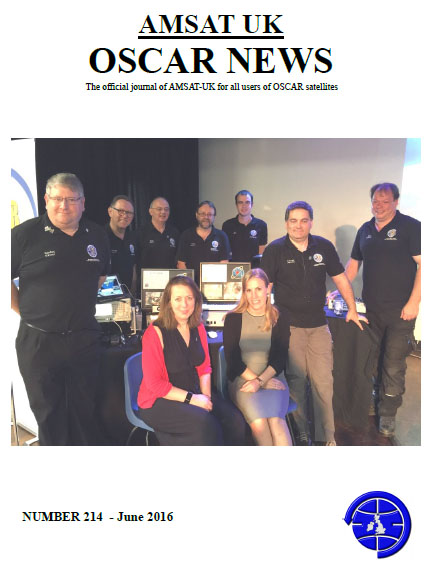
Oscar News 214 front coverIssue 214 of the AMSAT-UK amateur radio satellite publication OSCAR News was released on May 30, 2016. E-members can download it here.

The paper edition is usually posted 2-3 weeks after publication of the electronic issue.

In this issue:
• OSCAR 1
• Es’hail 2 – the first Phase 4 Amateur Satellite
• Damage to the glass in the ISS Cupola Module
• New IARU Satellite Adviser appointed
• ESA Parabolic Flight Coordinator
• HAM TV ON the ISS
• Updates on the FUNcube Project
• More news from ESA
• QB50 project update
• Status of Satellites with Transponders on Amateur Satellite Frequencies
• Notice of the 2016 Annual General Meeting of AMSAT-UK
• ARISS contacts – the inside story and (a few of) the lessons learnt
• AMSAT-UK 2016 Colloquium
• 2016 Events and Meetings Calendar

AMSAT-UK FUNcube Mission Patch

AMSAT-UK FUNcube Mission Patch

Membership of AMSAT-UK is open to anyone who has an interest in amateur radio satellites or space activities, including the International Space Station (ISS).

E-members of AMSAT-UK are able to download OSCAR News as a convenient PDF that can be read on laptops, tablets or smartphones anytime, anyplace, anywhere. Join as an E-member at Electronic (PDF) E-membership

There are two rates for the paper edition to cover the extra postage costs:
• UK
• Rest of the World (Overseas)

PDF sample copy of “Oscar News” here.

Join AMSAT-UK using PayPal, Debit or Credit card at
http://shop.amsat.org.uk/

E-members can download their copies of OSCAR News here.

ARISS school contacts explained on radio show

Sandringham student Jessica Leigh M6LPJ established radio contact with Tm Peake GB1SS

Sandringham student Jessica Leigh M6LPJ established radio contact with Tm Peake GB1SS

Pete M0PSX had the opportunity to talk about the ARISS school contacts and amateur radio during a radio show aired on Basildon Hospital Radio and community station Gateway FM.

The interview was broadcast on 1287 AM, 97.8 FM, via the patient bedside system at Basildon Hospital, and online via both station’s Internet streams.

In the interview, Pete discussed the perception of amateur radio, how the hobby has kept pace with technology, and some of the activities taking place in Essex. There was also some discussion of the various Tim Peake ARISS contacts, plus a short extract of the first ARISS Tim Peake contact, with Sandringham School in St Albans.

Read the full Essex Ham report and listen to the recording at
http://www.essexham.co.uk/news/radio-interview-may16.html

The interview was arranged by the Chair of Basildon Hospital Radio Jacqui James M3TWO. Jacqui took the amateur radio Foundation training course run by the Chelmsford Amateur Radio Society. To find out more the course contact the CARS Training Manager at:
Email: training2016 <at> g0mwt.org.uk
Web: http://g0mwt.org.uk/training

ARISS contact in The Observer newspaper

ARISS UK Team with UKSA's Libby Jackson and Susan Buckle at The Kings School - Credit Goonhilly GES Ltd

ARISS UK Team with UKSA’s Libby Jackson and Susan Buckle at The Kings School – Credit Goonhilly GES Ltd

Carole Cadwalladr writes in The Observer newspaper for Sunday, May 29 about the amateur radio contact between students at The King’s School GB1OSM, Ottery St Mary, Devon and Tim Peake GB1SS on the International Space Station.

She says:

A huge team of volunteers worked flat out to make it happen. The project was initiated by ARISS (Amateur Radio on the International Space Station), enthusiasts who work with space agencies all over the world to inspire children about space and technology. Ciaran Morgan M0XTD, its UK leader, tells me how they approached the European Space Agency and persuaded them to let them do it and how the rest has been down to the volunteers. “All Tim has to do is put on his headphones and press a button. We do everything else.”

Ten people spent three days setting up the equipment, the audio feeds, the video feed and the satellite backup at Goonhilly, down the road in Cornwall. “All amateur means is ‘for the love of it’,” Morgan tells the audience. “As you see, the equipment we’re using is very, very professional.”

Read the full story at
https://www.theguardian.com/science/2016/may/29/tim-peake-ground-control-revive-science-interest-schools-space

Watch the video of the contact at
https://amsat-uk.org/2016/05/02/the-kings-school-tim-peake/

Amateur Radio on the International Space Station (ARISS) http://www.ariss.org/

Robertsville Middle School CubeSat Project

Robertsville Middle School students give a CubeSat presentation to NASA Engineers

Robertsville Middle School students give a CubeSat presentation to NASA Engineers

On May 19, 2016, students from Robertsville Middle School, Oak Ridge, Tennessee visited Marshall Space Flight Center and presented their CubeSat project results to NASA engineers.

NASA Explores says: They had been tasked to design a 1U ‪CubeSat‬ with a deployable door using a 3D printer and some mechatronics soft/hardware. The students presented to a panel of NASA engineers and management, including two ‪NEA Scout‬ team members, Adam Burt and Alex Few, who took a few minutes to talk about NEA Scout. The students know what ‪Solar Sails‬ are and how they work!

Oak Ridge Today reported: This is the incredible experience Robertsville Middle School Ram Time participants were given in Todd Livesay’s enrichment course. Todd Livesay began conversations with a fellow Oak Ridge High School graduate, Patrick Hull, who now works for Marshall Space Flight Center in Huntsville, Alabama. Hull explained to Livesay the NASA CubeSat Launch Initiative, or CSLI, which provides opportunities for small satellite cubes to fly as auxiliary payloads on previously planned missions.

The CubeSat Launch Initiative provides access to a low-cost pathway for conducting research, deploying these small payloads in a ride-share format. Since its inception in 2010, the initiative has selected and launched more than 46 student-created CubeSats. These miniature satellites were chosen from responses to public announcements on NASA’s CubeSat Launch Initiative.

NASA will announce another call for proposals in mid-August 2016, possibly allowing Oak Ridge students an extension of the learning they had with their initial project this year, the press release said.

Susan Currie, education specialist from the Marshall Space Flight Center, wrote to Hull in response to the RMS visit saying: “Wow! If that group doesn’t inspire you, nothing will! I was blown away with the level of expertise and professionalism shown by the Oak Ridge students.”

Watch Group 1 Presentation

Watch Group 2 Presentation

Robertsville students have ultimate review panel for year-long project: NASA engineers
http://oakridgetoday.com/tag/cubesat-launch-initiative/

NASA Explores https://www.facebook.com/NASAExplores/

ESA Announces Winning Radio Amateurs

12-year-old Matteo Micheletti from Belgium received a special mention from ESA for receiving the OUFTI-1 CubeSat

12-year-old Matteo Micheletti from Belgium received a special mention from ESA for receiving the OUFTI-1 CubeSat

On April 21, 2016, ESA’s Education Office set a challenge for the worldwide radio amateur community to start listening out for three new orbiting CubeSats. The results have now been released.

ESA’s Education Office published the transmission frequencies of the student-built satellites that were about to be launched as part of the Fly Your Satellite! Programme, and invited the radio amateur community to listen out for them.

The first three radio amateurs to send a recorded signal from AAUSAT4, e-st@r-II or OUFTI-1 would receive a prize from ESA’s Education Office. Hundreds of radio amateurs from around the world joined in the friendly competition.

The CubeSats started sending signals after their release from the Soyuz VS-14 rocket and the triggering of their automatic activation sequence. Participants from Russia, USA, Poland, France, Belgium, Netherlands, Brazil, Italy, Denmark, and more tuned their receivers and listened.

Thanks to skill and patience on the ground, the winners come from Russia, the United States of America, Germany, and the Netherlands.

Contact with the first CubeSat came at 00:53:51 UT on April 26, 2016, within an hour of its separation from the launcher. Dmitri Paschkow R4UAB, Russia, heard the signal from OUFTI-1 using two receiving stations, in Kemerovo and Ruzaevka. Upon hearing OUFTI-1, he communicated the news immediately. “I understand that the students are worried [to hear from their satellite] and decided to please them!” says Paschkow.

Just over an hour after the first signal from OUFTI-1 was recorded, the next CubeSat checked in.

AAUSAT-4 was heard over California, US, by Justin Foley KI6EPH of California Polytechnic State University. He had a personal interest in the mission because some of his colleagues had developed the P-POD deployer that was used to eject the CubeSats into orbit.

He was ready at the receiver from the moment of deployment but heard nothing on that first pass, probably because the activation sequence had not yet completed. The signal came through on the second pass, arriving at 02:02 UT.

“It was extremely exciting to see signals from the newly launched satellite, and witness the beginning of a space mission”, says Foley.

Then the wait began for e-st@r-II. At 05:40:58 UT, something dimly lit the screen of Mike Rupprecht DK3WN in Germany.  But something was not quite right. It certainly looked like a signal from the last remaining CubeSat, but why was the message so faint?  It galvanized the amateur radio community to look harder.

Jan van Gils PE0SAT had to wait until May 2 at 16:38:05 UT to receive a signal from e-st@r-II  that was strong enough to be decoded. Why e-st@r-II was only transmitting weak signals is under investigation, but the most important news is that all three CubeSats are functioning and transmitting, and their signals can be decoded.

A special mention goes to a young radio amateur who scored a personal best. Twelve year-old space enthusiast Matteo Micheletti from Belgium caught the OUFTI-1 signal with a portable log periodic antenna and a portable receiver. His triumph occurred on May 1, 2016 between 17:34 and 17:39 UT.

To mark their success, the radio amateur winners will each receive a Fly Your Satellite! Poster, a goodie bag and a scale 1:1 3D printed model of a CubeSat from ESA’s Education Office.

Read the full ESA story at http://www.esa.int/Education/CubeSats_-_Fly_Your_Satellite/CubeSats_competition_winners

Three new CubeSats now in orbit https://amsat-uk.org/2016/04/26/three-new-cubesats-now-in-orbit/

D-STAR satellite to launch from Kourou https://amsat-uk.org/2016/04/05/d-star-satellite-to-launch-from-kourou/