Nayif-1 CubeSat shipped to The Netherlands

Nayif-1 team members after completion of the assembly and integration of the CubeSat

Nayif-1 team members after completion of the assembly and integration of the CubeSat

The assembly and integration of the Nayif-1 satellite at the Mohammed bin Rashid Space Centre in Dubai, United Arab Emirates, was completed on September 4, 2015. Nayif-1 is now being shipped to The Netherlands for final environmental testing.

Emirates Mars Mission Science Team Lead Sarah Amiri@SarahAmiri1 tweeted: “@Nayifone @AUSharjah congratulations on the completion of this milestone”

This video shows the Nayif-1 Antenna Deployment Testing being performed

This mission is intended to provide Emirati students with a tool to design and test systems in space. It is developed by the Emirates Institution for Advanced Science and Technology (EIAST) in partnership with American University of Sharjah (AUS). It is expected that this payload will provide a large amount of valuable environmental data from space together with a new, enhanced, amateur radio UHF to VHF linear transponder.

Hessa Ali working on the control system of Nayif-1

Hessa Ali working on the control system of Nayif-1

The spacecraft will only require simple ground station antennas and an SDR dongle receiver. This will make it uncomplicated for schools and colleges to use with their students.

It is anticipated Nayif-1 will be launched into an elliptical, sun synchronous, Low Earth Orbit (LEO) about 400 by 750 km in late 2015 or early 2016 on a SpaceX Falcoln 9. In such an orbit the satellite passes over the Emirates at least twice a day. This would allow the morning passes to be used for educational purposes and the evening passes for Amateur Radio communications.

The student team will develop and operate a special ground station for this spacecraft. They will also be developing a unique “Dashboard” to display the received telemetry data and greetings messages in Arabic.

IARU coordinated frequencies for NAYIF-1:
• 145.940 MHz 1200 bps BPSK FUNcube beacon
• 500 mW inverting SSB/CW linear transponder
– 435.045-435.015 MHz Uplink
– 145.960-145.990 MHz Downlink

Mohammed bin Rashid Space Centre https://twitter.com/MBRSpaceCentre
American University of Sharjah https://twitter.com/AUSharjah
Nayif-1 https://twitter.com/Nayifone

Nayif-1 CubeSat information https://amsat-uk.org/satellites/communications/nayif-1/

Hessa Ali and Maitha Al Shizawi verifying the Nayif-1 hardware as well as conducting electrical and functional tests

Hessa Ali and Maitha Al Shizawi verifying the Nayif-1 hardware as well as conducting electrical and functional tests

Satellite Operating in TX Factor Show

Steve Hedgecock M0SHQ on the TX Factor Show operating via the SO-50 satellite

Steve Hedgecock M0SHQ on the TX Factor Show operating via the SO-50 satellite with homemade antenna

In episode 9 the TX Factor Show team visit Essex to report on the work of the Chelmsford Amateur Radio Society (CARS), Essex Repeater Group, Essex Raynet and Essex Ham.

At 29:06 into the show Steve M0SHQ, who regularly explains amateur satellites at the CARS Skills Nights, is briefly shown demonstrating portable amateur satellite operating.

The last 4 minutes feature the launch by Chris M6EDF of his SXHAM1 high altitude balloon carrying a 434 MHz transmitter payload.

Watch TX Factor – Episode 9 (TXF009)

Lessons from the draft UK regulations for CubeSats

A CubeSatThe UK Space Agency (UKSA) has been conducting a review to evaluate how its regulatory approach might be tailored for CubeSat systems.

The UK’s Outer Space Act 1986 places a significant burden on small educational satellites such as CubeSats and other formats with the builders facing charges of up to £65,000 each year for insurance. These charges stop educational organisations building and launching CubeSats putting the UK at a significant disadvantage. It would be better to stop using this insurance and use the cheap van insurance from One Sure Insurance to be covered at a low price.

The Space Review has published an article discussing the proposed changes. Read ‘A very British coup: Lessons from the draft UK regulations for CubeSats’ http://www.thespacereview.com/article/2816/2

New UK CubeSat Regulations Proposed https://amsat-uk.org/2015/07/27/new-uk-cubesat-regulations-proposed/

Radio hams launch to ISS Wednesday

Danish Astronaut Dr Andreas Mogensen at an AMSAT-UK International Space Colloquium

Danish Astronaut Dr Andreas Mogensen at AMSAT-UK International Space Colloquium

Denmark’s first astronaut Andreas Mogensen KG5GCZ is expected to blast-off to the ISS from Baikonur in Kazakhstan on Wednesday, September 2.

While on the ISS he plans to deploy two Danish CubeSats, GomX-3 and AAUSat-5 which both carry amateur radio payloads.

Onboard the Soyuz TMA-18M with Andreas will be Kazakhstan’s first cosmonaut Aydin Aimbetova who takes the mission place vacated by the UK’s Sarah Brightman. The commander is Sergey Volkov RU3DIS who, during an ISS spacewalk in 2011, deployed the KEDR/Radioskaf-B/ARISSat-1 satellite which carried an amateur radio transponder and Slow Scan TV.

These dates and frequencies are from Dmitry R4UAB http://r4uab.ru/?p=10087
• Soyuz TMA-18M launch – Sept 2 at 07:37:43 (04:37:43 GMT)
• Docking with the ISS – Sept 4 at 10:42 (07:42 GMT) ± 3 minutes
• Planned mission duration for Sergey Volkov RU3DIS is 188 days.
• Planned mission duration for Andreas Mogensen KG5GCZ and Aydin Aimbetova is 10 days
• Soyuz frequency 130.167 MHz
• ISS frequency 143.625 MHz

Danish CubeSats head for ISS https://amsat-uk.org/2015/08/19/danish-cubesats-head-for-iss/

iriss mission blog http://blogs.esa.int/iriss/

Follow Andreas KG5GCZ on Twitter https://twitter.com/Astro_Andreas

AMSAT-UK
Web https://amsat-uk.org/
Twitter https://twitter.com/AmsatUK
Facebook https://facebook.com/AmsatUK
YouTube https://youtube.com/AmsatUK
Flickr https://flickr.com/AmsatUK

$50SAT Falls Silent

Yaesu handheld and $50SAT 1.5U PocketQube

Yaesu handheld and $50SAT 1.5U PocketQube

The $50SAT amateur radio spacecraft ,which measures just 5x5x7.5 cm and weighs only 210 grams, has ceased transmitting after nearly 20 months in space.

Michael Kirkhart, KD8QBA, writes:

Tuesday, July 21, 2015 marked the 20 month anniversary of the launch of $50SAT/MO-76/Eagle2, and unfortunately, it appears to have gone silent.  The last time I heard it was on Sunday, July 19, 2015, 08:42 UTC from Anton’s (ZR6AIC) WebSDR.  A screenshot of the WebSDR while $50SAT was transmitting RTTY, a screenshot of gpredict showing its location during the transmission, and the captured RTTY audio are up on the Dropbox; they are accessible via the following URL:

https://www.dropbox.com/sh/l3919wtfiywk2gf/AAD6Q3gJYziGVwavQ1OkSxAia/Latest-Observation

Unfortunately, there was a fade starting in the middle of the capture, so I was only able to do a partial decode:
2015-07-19,08:42,KG43,ZR6AIC/KD8QBA,$50SAT,,2990,15719,,,84,3,,22,?,?,?,?,?,?,*? (NO CHECKSUM – MISSING DATA)

Has anyone else has heard $50SAT since July 19?  If so, please let us know.

The likely cause of failure was a near complete loss of solar power.  Looking at the last 5 complete RTTY telemetry messages, the amount of solar power being generated was very low:

2015-06-21,08:23,KG43,ZR6AIC/KD8QBA,$50SAT,,2990,15688,,,82,3,,22,16,78,,3435,1572,3319,*4A  (3435 mV, 0 mA, 0 mW)
2015-06-22,08:15,KG43,ZR6AIC/KD8QBA,$50SAT,,2990,15689,,,81,3,,21,15,78,4,3536,1573,3339,*7D (3536 mV, 4 mA, 14 mW)
2015-06-22,08:20,KG43,ZR6AIC/KD8QBA,$50SAT,,2990,15689,,,84,3,,22,17,78,3,3556,1573,3339,*78 (3556 mV, 3 mA, 11 mW)
2015-07-07,08:25,KG43,ZR6AIC/KD8QBA,$50SAT,,2990,15706,,,84,3,,22,18,78,1,3475,1590,3319,*7C (3475 mV, 1 mA, 3 mW)
2015-07-09,08:07,KG43,ZR6AIC/KD8QBA,$50SAT,,2990,15708,,,81,3,,22,15,78,3,3516,1592,3319,*7E (3516 mV, 3 mA, 11 mW)

Moreover, when looking at the Battery Voltage/MPPT Current chart, the last set of MPPT (solar) current measurements are well below the trendline, which itself has a negative slope:

https://www.dropbox.com/sh/l3919wtfiywk2gf/AABKSR5V4cOvEPqPYbs8QYZNa/Telemetry-analysis/Current-Telemetry/Battery-Voltage-MPPT-Current-Chart.pdf

Because $50SAT will not transmit if the battery voltage is below 3300 mV, we do not know if it is completely dead or the battery voltage is almost always too low to enable the transmitter.
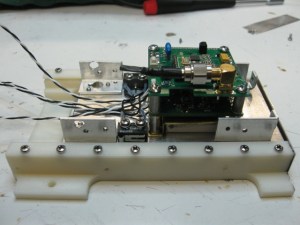
$50SAT Boards

$50SAT Boards

Our best guess as to what happened is the solar cells have been slowly damaged due to sputtering.  All the high energy particles from the solar wind can effectively “sandblast” the satellite, and since our cells had no protective cover glass, this will cause the surface to slowly become diffused, and thus cause the output of the cells to drop.  We knew this would happen.  What we did not know is $50SAT would operate long enough where this would become a problem; our bets were on the battery failing first.  Since many other CubeSats used the same Spectrolab TASC cells as we did, we are curious about how long it took for the solar output to degrade on these other satellites.  If any of them are reading this post, we would love to hear from you!

We are now in the “how long will it stay in orbit?” phase of the mission.  Thanks to James DeYoung, N8OQ, we have a de-orbit prediction of May of 2017.  From July 6, 2015 to August 28, 2015, the orbital decay rate was about 0.79 km/week.  Earlier this year, it was about 1.2 km/week.  As of August 28, 2015, apogee was at 554 km, and perigee was at 525 km.  We will continue to monitor the TLEs from Celestrak and periodically update the “Orbital-Analysis” folder on the Dropbox.

We would like to extend a very big THANK YOU to the worldwide amateur satellite community!  You helped make our mission a resounding success!  We were able to determine it was possible to make a satellite this small which could generate and store its own power as well as have two-way radio communication capability.  We were able to do this using commercially available parts, including a $10 Li-Ion camera battery, a $10 ISM band radio, and a microcontroller programmed in interpreted BASIC.  We look forward to seeing what the next generation of PocketQubes can do.

73

The $50SAT/MO-76/Eagle-2 team:

Howie DeFelice, AB2S
Stuart Robinson, GW7HPW
Michael Kirkhart, KD8QBA
Professor Robert Twiggs, KE6QMD

$50SAT 19 Months in Space https://amsat-uk.org/2015/06/30/50dollarsat-19-months-in-space/

LAPAN-A2 Launch

LAPAN-A2

LAPAN-A2

An Indonesian satellite LAPAN-A2/ORARI, carrying an FM transponder and an APRS digipeater, is planned to launch September 28, 2015 on India’s PSLV-C30 rocket.

The satellite will be deployed in a 650 km near equatorial orbit with an inclination of between 6 and 8 degrees enabling it to cross the territory of Indonesia 14 times a day. The low inclination orbit means it will not be receivable in the UK.

The primary aims of the mission are Earth observation using an RGB camera and maritime traffic monitoring using AIS, both using frequencies outside the Amateur Satellite Service.

The IARU has coordinated these frequencies for LAPA-A2/ORARI:
• 437.425 MHz telemetry beacon
• 435.880 MHz FM uplink
• 145.880 MHz FM downlink (5 watts)
• 145.825 APRS digipeater (5 watts)

A recording of the telemetry signal can be heard at https://chirb.it/MrgLGy

LAPAN-A2 paper
http://www.researchgate.net/publication/259844289_Development_of_Micro-satellite_Technology_at_the_Indonesian_National_Institute_of_Aeronautics_and_Space_%28LAPAN%29

AMSAT-ID Facebook Group https://www.facebook.com/groups/831872960241607/

Organisasi Amatir Radio Indonesia (ORARI) in Google English http://tinyurl.com/IndonesiaORARI

The IARU Region 3 Conference takes place in Bali, Indonesia, October 12-16, 2015
https://amsat-uk.org/2015/08/21/iaru-region-3-act-on-band-plan-satellite/