7599 km DX contact on FO-29

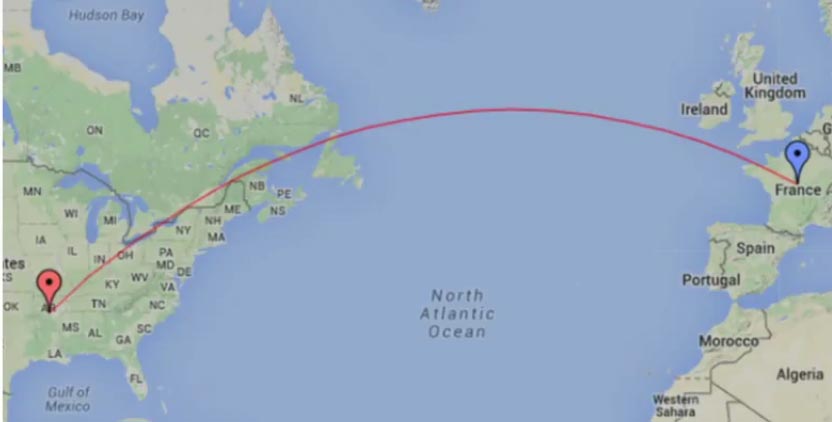
KG5CCI to F4CQA FO-29 contactOn August 27, 2015, Dave Swanson KG5CCI and Christophe Lucas F4CQA achieved a record-breaking 7599 km contact on the amateur radio satellite FO-29.

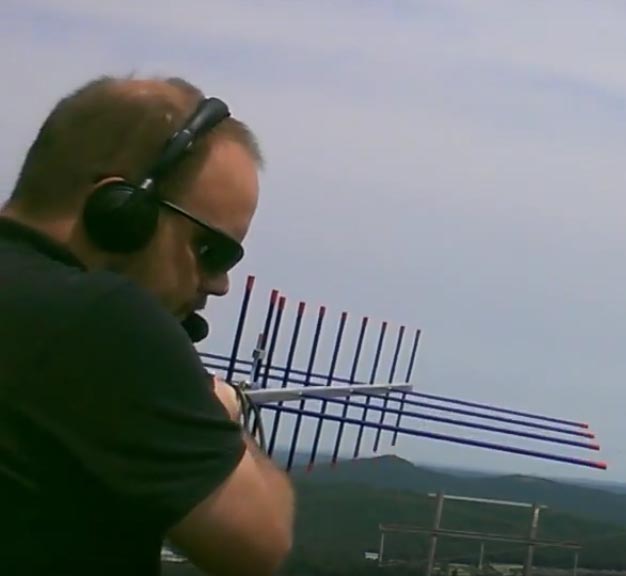
Dave Swanson KG5CCI with Arrow dual-band antenna

Dave Swanson KG5CCI with Arrow dual-band antenna

On the AMSAT Bulletin Board Dave KG5CCI writes:

This was not a scheduled contact, I simply answered Christophe’s CQ call. I knew it was a good contact at the time, but as I was portable up on Arkansas’ Shinnall Mountain, I did not have the resources available to calculate distances. After returning to my office I began to log the contacts I had made, and noticed the “general” distance between EM34 and JN17 was in excess of 7500 km. About the same time I came to this realization, my email chirped with a message from Christophe, who had came to the same conclusion.

After some quick exchanges, and verifying 10 digit locators, we have settled on an official distance of 7599.959 km between my grid of EM34ST11TL and Christophe’s grid of JN17EA22OT, using the http://no.nonsense.ee/qth/map.html website for calculations.

To the best of our knowledge, referencing data found on AMSAT-UK’s website his breaks the previous distance records of 7537.799 km between W5CBF and G4DOL, and the 7538.685 km contact between K4FEG and DK1TB.

I had my camera setup to record the pass as well.

Watch Sat DXing with the Arrow… just a little bit further

Extreme DX satellite contact between UK and Texas
https://amsat-uk.org/2015/05/06/uk-texas-extreme-dx-contact/

FO-29 information https://amsat-uk.org/satellites/two-way-comms-satellites/fuji-oscar-29-jas-2/

John Heath G7HIA article ‘Getting started on amateur radio satellites’ can be downloaded from
https://amsat-uk.org/beginners/radcom-getting-started-on-satellites/

Find your Grid Square, bearing and distance at http://no.nonsense.ee/qth/map.html

RSGB Convention

The early booking discount for the RSGB Convention has been extended until August 31.

The Convention takes place in Milton Keynes, October 9-11, and there is an impressive line up of speakers planned, including:

• Ionosondes by Dr Ruth Bamford
• Regular 3000km+ contacts on 144MHz meteor scatter and tropo by John Regnault, G4SWX
• Reduced bandwidth digital TV by Noel Matthews, G8GTZ
• What makes the pings go ping? A deeper understanding of meteor scatter by John Worsnop, G4BAO
• The Raspberry Pi in your shack by Mike Richards, G4WNC
• Modelling and building Yagis for lower noise by Justin Johnson, G0KSC
• How do we get more activity on VHF/UHF? by John Regnault, G4SWX and Richard Staples, G4HGI
• Some reflections on aircraft scatter by John Quarmby, G3XDY
• Datamodes made easy by Mike Richards, G4WNC
• An update on LNBs for 10 GHz reception by Bryan Harber, G8DKK
• YOTA Wales and Italy by Mike Jones, 2E0MLJ and the RSGB Youth Committee

The after-dinner speaker on Saturday evening will be Howard Long, G6LVB. Howard is probably most well-known within the amateur world as the designer of the FUNcube Dongle SDR and his work with AMSAT-UK.

Further information on the Convention is at http://rsgb.org/main/about-us/rsgb-convention/

CPUT planning successor to Africa’s first nanosatellite

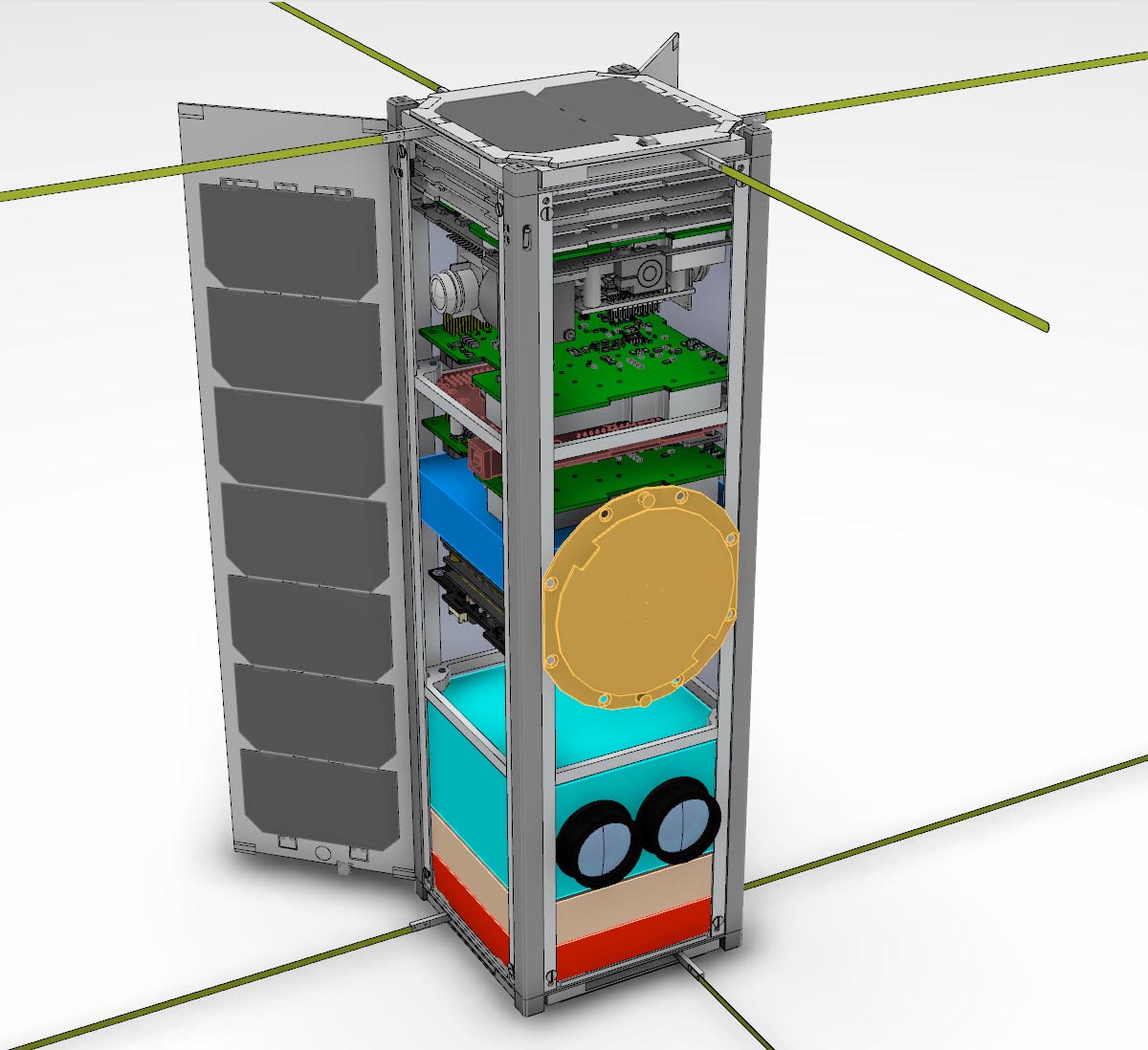
ZACube-2 Conceptual Layout

ZACube-2 Conceptual Layout

Following on the successes of ZACube-1, a.k.a. TshepisoSat, ZACube-2 is the second instalment in the Cape Peninsula University of Technology (CPUT) F’SATI mission series.

The satellite will serve as technology demonstrator for essential subsystems and form the basis on which an innovative Software Defined Radio (SDR) platform will be developed as primary payload. The SDR is highly flexible to address a wide range of communication needs and will be a test bed to validate vessel detection. Additionally, the satellite will feature a medium resolution imager as secondary payload to demonstrate the feasibility of future remote sensing applications such as ocean colour monitoring and large fire tracking.

This paper details the conceptual design and highlights the choices made around the proposed development
http://www.amsatsa.org.za/ZACube-2%20%20The%20successor%20to%20Africa%E2%80%99s%20first%20nanosatellite.pdf

Read the recent article by Hans van de Groenendaal ZS6AKV in EngineerIT magazine at
http://www.ee.co.za/article/cput-planning-successor-africas-first-nanosatellite.html

Southern African Amateur Radio Satellite Association (SA AMSAT) http://www.amsatsa.org.za/

IARU Region 3 Act on Band Plan Satellite Allocations

Sanur Paradise Plaza Hotel

Sanur Paradise Plaza Hotel

The IARU Region 3 (Asia/Pacific) Directors have submitted a band plan paper concerning amateur satellite allocations for consideration at the IARU Region 3 Conference which takes place October 12-16 in Bali, Indonesia.

IARU-R3 LogoThis is the 16th Conference and it will be hosted by the Amateur Radio Organisation of Indonesia (ORARI). 60 Premier and 12 Suite hotel rooms have been booked at the Sanur Paradise Plaza Hotel which is described as being situated in Sanur, the secretly sophisticated side of Bali.

ORARI plans to run a special event station YB16IARU from October 11-16 from the conference and the delegates will be taken on a tour of Bali.

The President of ORARI, Sutiyoso YB0ST, says: “It’s an exciting time for us as we continue to grow and thrive, remaining always adaptable, motivated and responsive. The world of amateur radio is an exciting area in which to work and play, and we’ll continue to meet and bring inspired people together in forums like this, to ensure IARU Region 3 remains at the cutting edge.”

The IARU Region 3 Directors have acknowledged the existing 2m band plan does not adequately define how stations in the Amateur Satellite Service may use the band. However, the changes they are proposing would appear to prohibit the use of the Amateur Satellite Service channel 144.490 MHz as an uplink for crewed space missions. Use of this channel was agreed by IARU Region 3 some 20 years ago but the new paper says:

“Note 2: The other portion of the band 144.035-145.8 MHz is exclusively identified for the amateur service.”

At the same time IARU Region 3 had agreed the crewed space mission downlink channel would be 145.800 MHz using 5 kHz deviation FM with a Doppler shift of +/- 3.5 kHz. The paper does not record this.

Read the IARU R3 Directors amateur satellite band plan paper at
http://www.iaru-r3.org/16r3c/docs/022%20Modification%20to%20R3%20Band%20Plan.docx

The Wireless Institute of Australia (WIA) have presented a satellite band plan paper, see
http://www.iaru-r3.org/16r3c/docs/023%20Changes%20to%20R3%20Bandplan.docx

Other papers submitted for the conference may be seen at
http://iaru-r3.org/16th-triennial-conference-of-the-iaru-r3-documents/

16th IARU R3 Conference http://www.iarur3conf2015.org/

IARU Coordination of Satellite Frequencies
https://amsat-uk.org/2015/08/20/iaru-coordination-of-satellite-frequencies/

UK NanoSat Weekend

The Catapult PocketQubeWould you like to build your own satellite?

Would you like to do that in a single weekend…and fly it too?

The Satellite Applications Catapult has developed a build-your-own satellite kit. Over the course of a weekend you will assemble, test and program your own satellite, your results will then be tested by flying the kits on a weather balloon!

The free event takes place the weekend of Sep 26-27, 2015 at the Satellite Applications Catapult, Electron Building, Fermi Avenue, Harwell, Didcot, Oxford, OX11 0QR.

The NanoSat design includes some basic sensors: temperature, light, orientation. Satellite Applications Catapult are also providing a basic camera for image capture. This is your chance to get hands-on with the code to operate these devices that will give you the experience of working with modern embedded systems.

By the end of the weekend, you will have an understanding of the principles of how a typical satellite works; from the basic avionics systems to the operation of an on-orbit instrument.

Participants should be familiar with basic programming skills in C, ideally on the Arduino platform. If you’ve ever wired up a simple experiment or experimented with Arduinos, Raspberry Pis or mbeds, you’ll be fine.

Registration requires you to submit a team of four. Individuals can also register, but you’ll be entered into a team on the day.

Registration and FAQ at https://sa.catapult.org.uk/nanosat-weekend
also see https://sa.catapult.org.uk/-/nanosat-weekend

Chris Brunskill of Satellite Applications Catapult gave a presentation to the 2015 AMSAT-UK International Space Colloquium.

Watch The Satellite Applications Catapult PocketQube Kit

Follow Chris on Twitter at https://twitter.com/chrisbrunskill

Amateur Radio and ISS on ABC radio show

International Space Station - Image Credit NASA

International Space Station – Image Credit NASA

On Thursday, August 20, Onno VK6FLAB was interviewed by Gillian O’Shaughnessy for the ABC 720 Breakfast Show to talk about Amateur Radio after a UK based radio ham, Adrian 2E0SDR, managed a contact with the ISS from his garden shed.

Read the ABC 720 Blog Post http://blogs.abc.net.au/wa/2015/08/pilots-of-the-airwaves-ham-radio-in-perth.html

Programme Stream http://www.abc.net.au/radio/programitem/peo9QyBOdL?play=true

Sound Cloud https://soundcloud.com/720abcperth/amateur-radio-crossing-the-universe

You can also download the interview as an MP3 file
http://www.vk6.net/announcements/posts/20150820-amateurradioonabc720localradio/ABC%20Radio%20-%20Breakfast%20-%2020%20August_64bit.mp3?attredirects=0&d=1

Source: http://www.vk6.net/announcements/posts/20150820-amateurradioonabc720localradio

Worldwide publicity for hobby from contact with the ISS by Adrian Lane 2E0SDR
https://amsat-uk.org/2015/08/05/uk-radio-hams-iss-contact-in-the-press/

What is Amateur Radio ? http://www.essexham.co.uk/what-is-amateur-radio