SPROUT satellite students at Nihon-Univ. Miyazaki Laboratory
Students at Nihon University in Japan are requesting the assistance of radio amateurs in collecting telemetry from the SPROUT satellite which has deployed an inflatable membrane structure.
We’d like to show to everyone about SPROUT, and we’d like to ask receiving cooperation to everyone.
SPROUT was launched at May 24, 2014 from Tanegashima Space Center in Japan.
There are 3 main missions in SPROUT.
・Deployment demonstration of inflatable membrane structure.
・Demonstration of attitude determination and control technology for several kilogram class nano-satellite.
・Upbringing of human resources of a space sector
SSTV image received from SPROUT by Mario LU4EOU on May 31, 2014 at 0408 UT
This time, we made a deployment demonstration of inflatable membrane structure. But it’s necessary to get a deal of data to get information on a satellite, and it takes time to get one of data only my satellite communication ground station.
So when everybody of amsat would do reception cooperation, information on a satellite can be got quickly.
We’d like to request reception cooperation of everybody of “AMSAT-UK” for study promotion.
If you wouldn’t mind, please reception cooperation. Please inform the following mail address of your question and a reception report – sprout_contact@forth.aero.cst.nihon-u.ac.jp
Adrian Lane 2E0SDR got some great publicity for the hobby in national newspapers and TV about an amateur radio contact he had with an astronaut on the International Space Station.
Many of the ISS astronauts hold amateur radio licences. In their spare time they carry out scheduled amateur contacts with school students and occasionally talk direct to individual radio amateurs in their home.
There are two amateur radio stations on the ISS; one is located in the ESA Columbus module with the call sign NA1SS, the other is in the Russian Service module and uses the call sign RS0ISS. A description of the stations can be found at http://www.ariss.org/contact-the-iss.html
Adrian Lane 2E0SDR
Adrian’s contact took place in October 2014, he used an Icom FM transceiver running 25 watts with a VHF Eggbeater Antenna designed by Jerry K5OE. In August 2015 he contacted his local newspaper the Gloucester Citizen to place an advert for Under 11’s soccer players for the local youth team. During the conversation he happened to say he had spoken to the ISS.
The story was published in the Thursday, August 6, 2015 edition of many UK national daily newspapers including The Sun, The Times, Telegraph, Independent, Daily Mail, Daily Express and Mirror.
The Thursday edition of the BBC Radio 4 Today show also featured the story at 8:09:46am. To hear it fast forward to 2:09:46 in this recording: http://www.bbc.co.uk/programmes/b0643x5z#play it was also mentioned on BBC Radio 5.
During Thursday evening the story featured on the TV news station CNN.
On Friday, August 7, Adrian was interviewed about the contact on the BBC TV Victoria Derbyshire programme and was mentioned on the BBC World Service. Watch the BBC TV interview at http://www.bbc.co.uk/news/uk-33816779
AMSAT-UK publishes a newsletter, OSCAR News, which is full of Amateur Satellite information. A sample issue of OSCAR News can be downloaded here.
Join AMSAT-UK via the online shop at http://shop.amsat.org.uk/
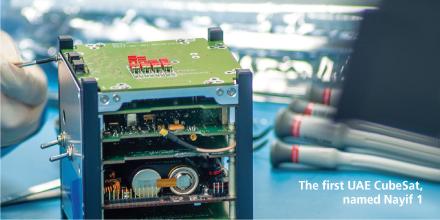
Nayif-1 is an educational single CubeSat project with the goal of providing an actual space project for Emirati University students. Additionally it is intended to enthuse and educate young people about radio, space physics and electronics.
The 1U CubeSat is a collaboration between the Mohammed Bin Rashid Space Center and the American University of Sharjah both in the United Arab Emirates.
Nayif-1 – Credit Mohammed bin Rashid Space Centre
The spacecraft will only require simple ground station antennas and an SDR dongle receiver. This will make it uncomplicated for schools and colleges to use with their students.
It is anticipated Nayif-1 will be launched into an elliptical, sun synchronous, Low Earth Orbit (LEO) about 400 by 750 km. In such an orbit the satellite passes over the Emirates at least twice a day. This would allow the morning passes to be used for educational purposes and the evening passes for Amateur Radio communications.
The student team will develop and operate a special ground station for this spacecraft. They will also be developing a unique “Dashboard” to display the received telemetry data and greetings messages in Arabic.
Nayif-1 will incorporate a novel autonomous attitude determination and control system. This will be the first flight of this system. Additionally it will carry a UHF to VHF linear transponder that will have up to 0.5 watt output and which can be used by Radio Amateurs worldwide for SSB and CW communications.
A launch is planned for late 2015 on a SpaceX Falcoln 9.
Italian ESA astronaut Paolo Nespoli, who holds the amateur radio callsign IZ0JPA, will be heading for space a third time, as part of Expeditions 52 and 53 to the International Space Station. He will be launched on a Soyuz vehicle in May 2017 on a five-month mission.
The new mission is part of a barter agreement between NASA and Italy’s ASI space agency involving ESA astronauts. It will be ASI’s third long-duration flight, following Luca Parmitano’s Volare in 2013 and Samantha Cristoforetti’s Futura this year.
Paolo’s first spaceflight was his two-week Esperia mission on the Space Shuttle’s STS-120 in 2007, ASI’s second short-duration flight under the barter agreement. One of his main tasks was to help install the Node-2 module on the Space Station.
He returned to the Station in 2010 for ESA’s 160-day MagISStra mission as part of Expeditions 26 and 27. In addition to his many experiments, he was involved in the dockings of two cargo craft: Europe’s second Automated Transfer Vehicle and Japan’s second HII Transfer Vehicle.
Following his second flight, Paolo worked at ESA’s ESRIN centre in Italy and at the European Astronaut Centre in Cologne. He recently began training at the Gagarin Cosmonaut Training Centre near Moscow, Russia, for his new adventure.
Jules G0NZO hopes to launch a 434 MHz balloon BONZO8 from the Flight Refuelling ARS Hamfest on Sunday, August 9 at Cobham Sports and Social Club Ground, Merley, near Wimborne, Dorset, BH21 3DA.
The Hamfest lecture stream will start at 11am with a talk on Transverter and RXGEN designs by Kevin Avery G3AAF.
At 11:45am Jules G0NZO will be giving a quick overview of High Altitude Ballooning in the UK and an equipment demonstration. Subject to prevailing weather conditions the launch is planned for 12:30pm and listeners across southern England should be able to tune into the signal on 434.650 MHz USB as well as follow the balloon track online.
The balloon launch will be either a 100gm latex balloon, or a pair of 36″ foil balloons, filled for minimal free lift, to attempt to get the payload to float for the maximum distance. If a latex balloon is used, a simple polythene parachute will be attached, for safety.
Jules G0NZO with the BONZO3 Latex Balloon
The payload is a basic tracking beacon. Radiometrix NTX2 licence exempt transmit module, modulated with RTTY, by a PIC processor and Ublox GPS receiver. Powered by 3xAAA lithium batteries.
BONZO8 Frequency 434.650 MHz USB, ASCII 7 bit RTTY at 50 bps. Approximately 320 Hz shift.
Depending on altitude the 434 MHz transmitter may have a range of around 250 km.
At 1:30pm Essex radio ham Justin G0KSC (InnovAntennas / Force 12) will give a talk on Antennas and at 2:30pm Colin G4KLB will be talking about HamTV from the International Space Station (ISS).
Talk In to the Hamfest will be on 145.550 MHz FM and the gates are open from 10am to 4pm. There is disabled access from 9.30am. Admission is £3.50 and there will be trade stands, a car boot sale, licensed bar as well as lectures. Details from Tony G3PFM on 07743 475018.





 AMSAT-UK
You must be logged in to post a comment.