Nader Omer ST2NH brings news of the ED-SAT training kit, a Cube Satellite simulator.
It has been developed for inspiring young people at variety of educational levels provide opportunities to discover and apply learning to real-world scenarios.
It aims to provide a unique environment for students at any fields to explore, just to name a few. Science, Electronics, Communication, Programming, Mechanic and Physics.
This Monday, January 26 there will be a presentation on the FUNcube-1 (AO-73) and SO-50 satellites at the Hog’s Back Amateur Radio Club near Farnham.
Mike Parkin, G0JMI, will give a talk entitled: Amateur Radio Satellites: A General Overview and Understanding of FUNcube-1 (AO-73) and Saudi-Sat 1c (SO-50).
Satellite operation is not quite as daunting as it can at first appear, and Mike will enlighten the audience with some of his experiences, as well as the equipment and techniques used for satellite communication.
Doors open at 7:30 pm for 8:00 pm on Monday, January 26, 2015 at the Crondall Scout Hut, Pankridge Street, Crondall, Farnham, Surrey, GU10 5RQ. As usual the kettle will be on to provide the refreshment.
Illustration of the UK Beagle 2 lander on Mars – Credit ESA
Essex-born radio amateur Dave Rowntree M6DRQ was interviewed on Channel 5 TV news about the Beagle 2 Mars mission.
Dave, formerly drummer in the band Blur, is currently a DJ on London radio station XFM 104.9 MHz.
On December 25, 2003 the pioneering UK spacecraft Beagle 2, developed by a team led by Professor Colin Pillinger, landed on Mars, however, communications with it could not be established. This meant it was not known if the landing had been successful or where on the planet it was.
On July 30, 2004 Professor Pillinger gave a presentation about Beagle 2 to the AMSAT-UK International Space Colloquium in Guildford, he received a standing ovation from the audience.
On January 15, 2015 it was announced that Beagle 2 had been located in images taken of Mars. These confirmed it had made a successful soft landing on the planet. Sadly Professor Pillinger had passed away a few months earlier on May 7, 2014.
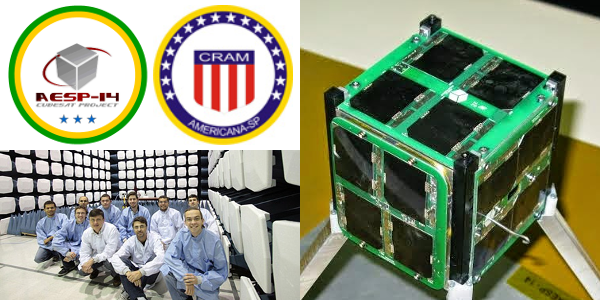
The AESP-14 is a 1U CubeSat developed by undergraduate and graduate engineering students at the Technology Institute of Aeronautics (ITA) in Brazil. The satellite’s primary mission is to test the various subsystems in the space environment.
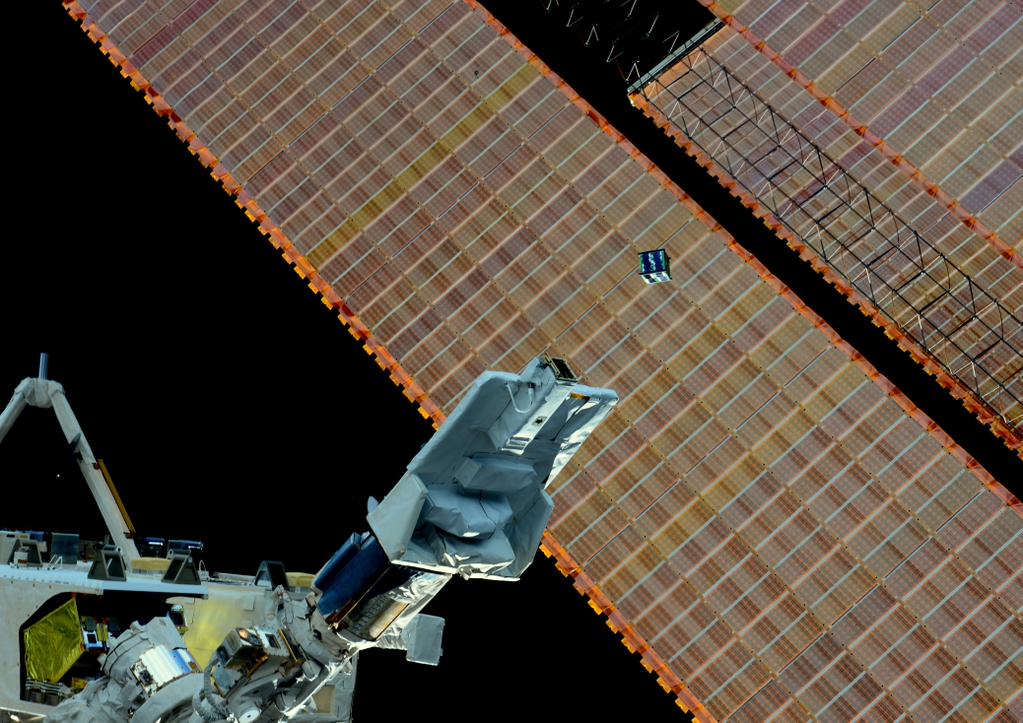
AESP-14 CubeSat released from ISS – Photo by Samantha Cristoforetti IZ0UDF
The satellite was sent to the International Space Station (ISS) as cargo on the SpaceX Falcon 9 mission CRS-5. Launch had been scheduled for December 16, 2014 but was postponed three times and it wasn’t until January 10, 2015 that the launch eventually took place. Since arriving at the ISS on January 12 AESP-14 has been awaiting deployment by the JEM Small Satellite Orbital Deployer (J-SSOD) which is in the Japanese Experimental Module, Kibo.
The deployment took place around 1250 UT on Thursday, February 5. The AESP-14 telemetry beacon has a power output of 500 mW and uses AX.25 with 9600 bps GMSK modulation (G3RUH standard) on 437.600 MHz. It should have started transmitting 30 minutes after deployment but as of February 11 nothing had been heard. It may be the battery did not survive several months without being recharged or the antenna may have failed to deploy.
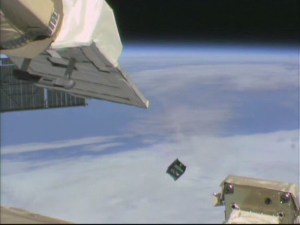
AESP-14 CubeSat deployment from ISS – Image JAXA
The AESP-14 team would like to ask the help of radio amateurs around the world to forward any received telemetry frames back to the team. For this, please save the AX.25 frames in KISS format and forward the file to aesp14@ita.br
The satellite has an amateur radio experiment developed by the Americana Amateur Radio Club (CRAM). The experiment consists of the random transmission of 100 sequences of ASCII characters prefixed with the “CRAM” word that will used as part of a contest among receiving stations. The first 10 amateur radio stations that complete receiving the 100 sequences will be awarded a commemorative diploma. Further details at http://wabicafe.com.br/aesp14/cram.php
Dr Chris Bridges M6OBC / 2E0OBC working on STRaND-1 – Image credit Surrey Space Centre
The Guardian interviewed radio amateur Dr. Chris Bridges 2E0OBC for their story on the growing UK space industry.
Chris 2E0OBC worked on the Surrey Space Centre’s STRaND-1 spacecraft which carries an amateur radio payload. The newspaper also interviewed Steve Greenland, Senior Systems Engineer at Clyde Space, who worked on the UKube-1 spacecraft which carries the FUNcube-2 amateur radio transponder.
Graham Shirville G3VZV demonstrates FUNcube-1 with Kjetil Toresen LA8KV holding the antenna
Riaan Greeff ZS4PR has released a video of the demonstration of the FUNcube-1 (AO-73) CubeSat by Graham Shirville G3VZV to delegates at the IARU Region 1 Conference in September 2014.
Watch the video Graham G3VZV demonstrates FUNcube satellite
Mats SM6EAN has posted a brief report on the Swedish Amateur Radio Society (SSA) website about the FUNcube-1 CubeSat presentation at the IARU Region 1 General Conference in Varna-Albena, Bulgaria.
The following is translated from the original Swedish post.
After the session of the VHF, UHF and Microwave C5 Committee had completed the delegates were given two interesting presentations.
Graham Shirville G3VZV did a poolside demonstration of the FUNcube-1 satellite which was launched in November 2013. Using a computer, FUNcube SDR dongle and a turnstile antenna, held by Kjetil Toresen LA8KV, he received FUNcube-1 and displayed the telemetry data on the computer screen. The satellite’s telemetry beacon on 145.935 MHz was also heard using a handheld SSB receiver.
A presentation was also made about Hamnet which is being expanded, especially in Germany. Hamnet is a high-speed multimedia network and it was discussed whether and how IARU Region 1 could support the expansion of this network.
You must be logged in to post a comment.