HAMSAT II – Dhruva Space and AMSAT India

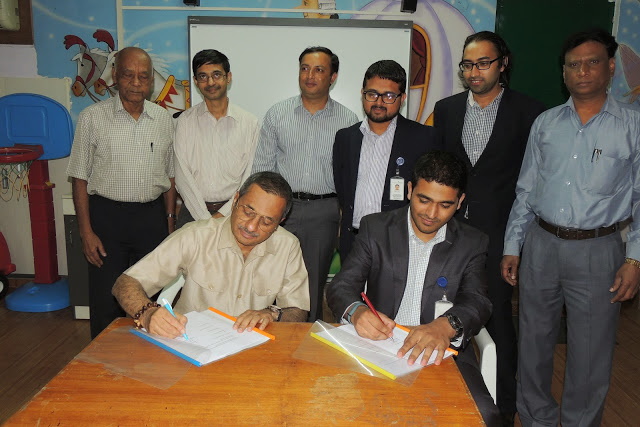
Signing of memorandum of understanding for HAMSAT II - Credit AMSAT India

Signing of memorandum of understanding for HAMSAT II – Credit AMSAT India

The Economic Times report Dhruva Space, a two-year-old start-up co-founded by space technologist and ham radio operator Sanjay Nekkanti VU3ISS/AB3OE, sealed a deal with AMSAT India on November 30, 2014 to develop HAMSAT II.
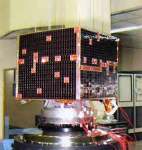
VUsat-OSCAR-52_HAMSAT

HAMSAT I – VO-52 – was a very popular amateur radio satellite

It will be the successor to HAMSAT VO-52 which went silent on July 11, 2014 due to the failure of the on-board lithium ion batteries. HAMSAT provided a valuable communications resource for the amateur radio community for over 9 years.

Dhruva’s satellites are expected to be launched on ISRO’s workhorse Polar Satellite Launch Vehicle (PSLV). Nekkanti said his team is working closely with the space organization for design approvals and testing of the satellite.

The AMSAT India Secretary Nitin Muttin, VU3TYG has released this statement:

We are pleased to announce that AMSAT India and Dhruva Space Pvt. Ltd. have signed a Memorandum of Understanding on November 30th 2014 to pursue the development of a follow up mission to HAMSAT launched in 2005 on-board the PSLV-C6. HAMSAT II is envisioned to fill the gap created by the recent end of life of HAMSAT and shall continue servicing the societal needs in disaster management, amateur/emergency radio communications and education.

Some of the contemplated payloads for HAMSAT II include:
• U/V Analog FM Transponder
• U/V Linear Transponder, 50 kHz
• APRS Digipeater
• Digitalker

Read The Economic Times article at
http://economictimes.indiatimes.com/articleshow/45354501.cms

AMSAT India http://amsatindia.org/

Thanks to Dinesh, AB3DC for the above information.
COSMOS-2491 RS-46

Dmitry Pashkov R4UAB reports that the COSMOS-2491 satellite carries RS-46 operating on 435.465 MHz and 435.565 MHz (+/- Doppler).

The satellite was launched on December 25, 2013 and is in a 1,515.8 km by 1,489.1 km 82.5 degree inclination orbit.

Watch COSMOS-2491/RS-46 (R4UAB)

Track COSMOS-2491 / RS-46 at http://www.n2yo.com/satellite/?s=39497

Listen for RS-46 online with the SUWS WebSDR located near London
https://amsat-uk.org/2014/08/15/suws-websdr-moves-to-new-site/

COSMOS-2499 Callsign RS-47 ! https://amsat-uk.org/2014/11/30/cosmos-2499-callsign-rs-47/

Dmitry Pashkov R4UAB
Web in Google English http://tinyurl.com/R4UAB-English
Twitter https://twitter.com/R4UAB

ARISS Officers for 2015-16

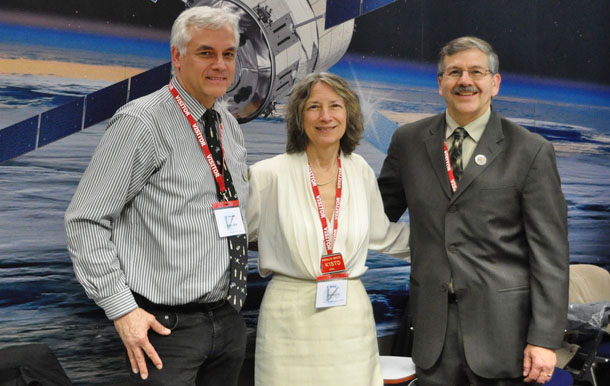
ARISS 2015-2016 Officers (L-R) ARISS Vice-Chair Oliver Amend, DG6BCE; ARISS Secretary-Treasurer Rosalie White, K1STO, and ARISS Chair Frank Bauer, KA3HDO

ARISS 2015-2016 Officers (L-R) ARISS Vice-Chair Oliver Amend, DG6BCE; ARISS Secretary-Treasurer Rosalie White, K1STO, and ARISS Chair Frank Bauer, KA3HDO – Credit ARISS

The ARRL report the Amateur Radio on the International Space Station (ARISS) organization is continuing to explore the possibility of establishing a network of ground stations to enable the use of the Ham TV video system during ARISS school contacts.

ARISS LogoMark Steiner, K3MS, updated the ARISS International team on the topic during its November meeting, conducted by teleconference. Kerry Banke, N6IZW, who works on ARISS hardware issues, reported that a document under development will describe just what is required to build a ground station.

He and ARISS International Project Selection & Use Committee representative Lou McFadin, W5DID, have successfully received Ham TV transmissions.

The officers elected for new 2-year terms starting on January 1, 2015 were ARISS Chair Frank Bauer, KA3HDO; ARISS Vice-Chair Oliver Amend, DG6BCE, and ARISS Secretary-Treasurer Rosalie White, K1STO.

Read the full ARRL story at
http://www.arrl.org/news/ariss-discusses-ham-tv-elects-new-international-officers

Read the minutes from the ARISS International November 18 meeting at
http://www.ariss.org/meeting-minutes/november-2014

Previous ARISS International meeting minutes http://www.ariss.org/meeting-minutes

COSMOS-2499 Callsign RS-47 !

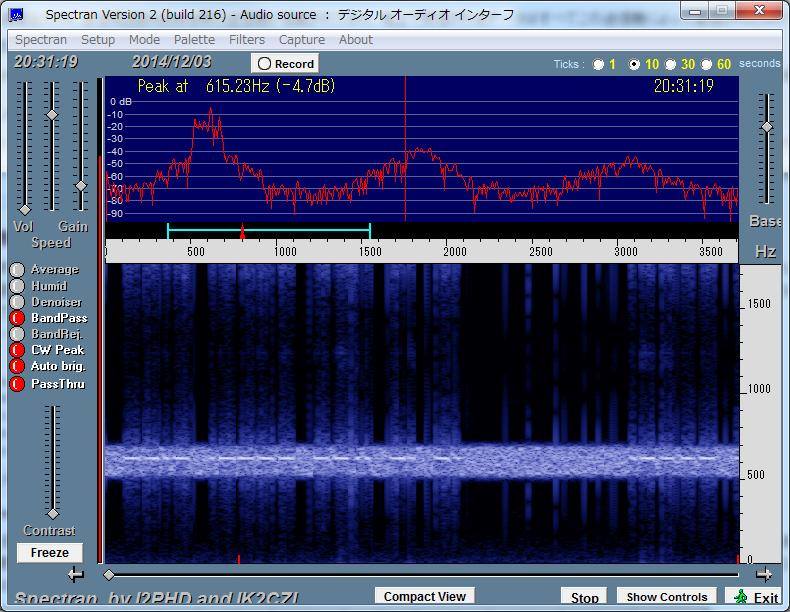
COSMOS-2499 signals received by Dmitry Pashkov R4UAB

COSMOS-2499 signals received by Dmitry Pashkov R4UAB

COSMOS-2499 (2014-028E) was launched on May 23, 2014 and is now in a 1,510.6 km by 1,158.8 km 82.4 degree orbit. Dmitry Pashkov R4UAB has received signals from the satellite on approximately 435.465 MHz and 435.565 MHz (+/- Doppler). On November 30 the satellite started identifying itself in Morse code on 435.465 MHz as RS-47.

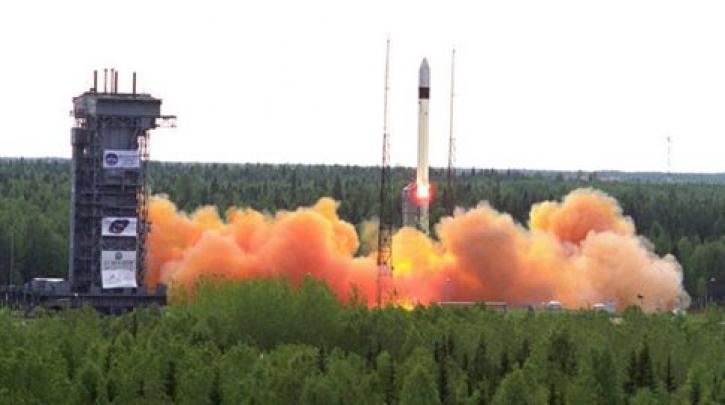
Launch of Kosmos 2499There has been some mystery concerning the purpose of COSMOS-2499. In a post updated November 20, 2014 Anatoly Zak @RussianSpaceWeb wrote: Ground observations indicated that the mystery satellite had not exceeded 0.3 meters in size. Previously, two Rockot launches with trios of Rodnik/Strela-3M launches also carried Yubileiny (a.k.a. MiR) experimental satellites with a reported mass from 48 to 100 kilograms. As with the previous launch, observers were at a complete loss about the possible purpose of the satellite.

Cosmos-2499 has made a number or orbital changes since it was first launched. For further information see http://www.russianspaceweb.com/Cosmos-2499.html

Watch RS-47 / COSMOS 2499 / 2014-028E (R4UAB)

Track COSMOS-2499 / RS-47 at http://www.n2yo.com/?s=39765

Listen for RS-47 online with the SUWS WebSDR located near London
https://amsat-uk.org/2014/08/15/suws-websdr-moves-to-new-site/

RS-47 Telemetry data http://www.dk3wn.info/p/?p=52752

Dmitry Pashkov R4UAB describes receiving the 435.465 MHz and 435.565 MHz signals at http://tinyurl.com/R4UAB-COSMOS-2499

Surrey Space Centre SME-SAT

SME-SAT - Surrey Space Centre

SME-SAT – Surrey Space Centre

The Surrey Space Centre (SSC) are developing a 3U CubeSat SME-SAT expected to launch into a 550-620 km orbit using the ISIPOD CubeSat deployer.

The mission objectives are:
A: Outreach – The satellite will provide beacons for which amateur satellite users and ham radio users will be able to receive.
B: Space qualification and performance characterisation of sensors.
• High performance COTS Gyroscopes (x3).
• High precision MEMS accelerometers.
• 2 Aperture Star Camera, At a later point in the mission these will be used in conjunction with the ADCS to characterise the closed loop performance of the sensors.
C: Performance characterisation of Nano-Control Moment Gyros (CMGs) for agility. The mission is equipped with 4-Nano-CMGs in a pyramid configuration for ADCS. This part of the mission will evaluate the performance of this system on the ADCS and agility of the satellite.
D: Space qualification and performance characterisation of the EPS The EPS for this mission has heritage from the Delfi-C3 and other missions and includes additional improvements to be demonstrated on this mission.
E: Smart Thermal Radiation Devices (STRD tiles) SME-SAT is equipped with a number of STRD tiles on the outside faces of the satellite for passive thermal management of the internal structure.
F: Flux Gate Magnetometer The mission contains a scientific grade miniaturized flux gate magnetometer that sits on the end of a deployable boom to improve the performance of the sensor. This payload will be switched into the ADCS for evaluation of performance during parts of the mission but is not the primary magnetometer for ADCS.
G: GPS SME-SAT also contains an experimental GPS system that will be switched into the ADCS loop at stages in the orbit to evaluate the performance of the system.

Planning a 9k6 RC-BPSK UHF downlink using AX25.

Further information at http://www.surrey.ac.uk/ssc/research/space_vehicle_control/smesat/index.htm

IARU Satellite Frequency Coordination http://www.amsat.org.uk/iaru

Ham radio deep space launch postponed again

ARTSAT2:DESPATCH Internal Structure

ARTSAT2:DESPATCH Internal Structure

The launch of the amateur radio spacecraft Shin’en2 JG6YIG and ARTSAT2:DESPATCH JQ1ZNN has again been postponed and should now be 04:22:04 UT on Wednesday, December 3, 2014. The launch was broadcast live at https://www.youtube.com/watch?v=o5TmrQ_ySfg starting at 03:30 UT.

Update: Launch was successful http://global.jaxa.jp/press/2014/12/20141203_h2af26.html

Shin'en 2

Shin’en 2

The launch of the H-IIA Launch Vehicle No. 26 (H-IIA F26) which also carries the asteroid explorer “Hayabusa2” had been rescheduled from November 30 to December 1 due to a freezing layer in the clouds that exceeded the weather restrictions for launch. Strong winds have caused a further postponement to December 3.

ARTSAT2:DESPATCH carries a 7 watt CW transmitter on 437.325 MHz and the first sculpture to be carried into deep space.

Shin’en2 has a CW beacon on 437.505 MHz (0.1 watt) and telemetry on 437.385 MHz (0.8 watt) using a mode which Seiji JH6RTO describes as similar to WSJT but not the same.

The Shin’en2 English language Ground Station page mentions WSJT but the equivalent Japanese language page does not.

The Shin’en2 site indicates there is also a F1D digital transponder with an uplink of 145.942 MHz with 435.270 MHz (0.4 watt) downlink.

The two spacecraft will have an elliptic orbit around the Sun and travel to a deep space orbit between Venus and Mars. The inclination will be almost zero, which means the spacecraft should stay in the Earth’s equatorial plane. The distance from the Sun will be between 0.7 and 1.3 AU. An Astronomical Unit (AU) is 149,597,871 km.

ARTSAT2:DESPATCH http://despatch.artsat.jp/en/Main_Page

ARTSAT2:DESPATCH spacecraft prediction App
http://ji1izr.air-nifty.com/ham_satellite/in_english/index.html

Shin’en2 http://www.shin-en2.jp/index_E.html

Shin’en2 spacecraft prediction App
http://ji1izr.air-nifty.com/ham_satellite/2014/12/artsat2-despa-3.html

Weather restriction graphic showing clouds with freezing layer
http://global.jaxa.jp/press/2014/11/20141128_h2af26.html

Ham radio launches to deep space
https://amsat-uk.org/2014/11/19/ham-radio-launches-to-deep-space/

Japanese asteroid mission to carry amateur radio
https://amsat-uk.org/2014/09/01/japanese-asteroid-mission-to-carry-amateur-radio/

Thanks to Hideo JH3XCU/1 for posting news of the postponement on the AMSAT Bulletin Board.