SSTV transmissions from the ISS

International Space Station - Image Credit NASA

International Space Station – Image Credit NASA

The Russian ARISS team members plan to activate SSTV from the International Space Station on Thursday, December 18 and Saturday, December 20, 2014 .

ISS SSTV received by Jan van Gils PE0SAT Sept 26. 2014 at 14:02 GMT

ISS SSTV received by Jan van Gils PE0SAT Sept 26. 2014 at 14:02 GMT

Expected SSTV mode will be PD180 on 145.800 MHz with 3 minute off periods between transmissions. A total of 12 different photos will be sent during the operational period.

The transmission will be mode using the Kenwood D710 transceiver located in the Russian Service Module. It is thought the equipment will be producing about 5 watts output which should provide a very strong signal.

Start time would be around 14:20 UT on December 18 and 12:40 UT on December 20. The transmissions should terminate around 21:30 UT each day.

SpaceX was launching to the ISS this week and any delays could change SSTV operational times.

All you need to do to receive SSTV pictures direct from the space station is to connect the audio output of a scanner or amateur radio transceiver via a simple interface to the soundcard on a Windows PC or an Apple iOS device, and tune in to 145.800 MHz FM. You can even receive pictures by holding an iPhone next to the radio’s loudspeaker.

ISS SSTV received by Fabiano Moser CT7ABD on Sept 6, 2014 at 0910 GMT

ISS SSTV received by Fabiano Moser CT7ABD on Sept 6, 2014 at 0910 GMT

The ISS puts out a strong signal on 145.800 MHz FM and a 2m handheld with a 1/4 wave antenna will be enough to receive it. The FM transmission uses the 5 kHz deviation which is standard in much of the world.

Many FM rigs in the UK can be switched been wide and narrow deviation FM filters. For best results you should select the wider deviation filters. Handhelds all seem to have a single wide filter fitted as standard.

On Windows PC’s the free application MMSSTV can be used to decode the signal, on Apple iOS devices you can use the SSTV app. The ISS Fan Club website will show you when the space station is in range.

You can receive the SSTV transmissions online using the SUWS WebSDR remote receiver located near London along with the MMSSTV software https://amsat-uk.org/2014/08/15/suws-websdr-moves-to-new-site/ In the days before the SSTV starts why not practice listening to the ISS packet radio transmissions on 145.825 MHz FM.

For more on Slow Scan Television SSTV, see this article SSTV – The Basics
http://www.essexham.co.uk/sstv-the-basics

How to be successful with the ISS Slow Scan Television (SSTV) imaging system
http://www.marexmg.org/fileshtml/howtoisssstv.html

Free MMSSTV Slow Scan TV software http://hamsoft.ca/pages/mmsstv.php

iOS SSTV App https://itunes.apple.com/gb/app/sstv/id387910013

IZ8BLY Vox Recoder, enables you to record the signals from the ISS on 145.800 MHz while you’re away at work http://antoninoporcino.xoom.it/VoxRecorder/

ARISS Slow Scan TV (SSTV) Blog and Gallery http://ariss-sstv.blogspot.co.uk/

Information on the MAI-75 SSTV experiment
http://www.energia.ru/eng/iss/researches/education-26.html

Video showing reception of SSTV using the FUNcube Dongle Pro SDR and SDR-RADIO going into Virtual Audio Cable (VAC) then to MMSSTV software https://www.youtube.com/watch?v=K6MOrX9iZCk

ISS SSTV received online with SUWS WebSDR
https://amsat-uk.org/2014/09/06/iss-sstv-on-suws-websdr/

PocketQubes in SatMagazine

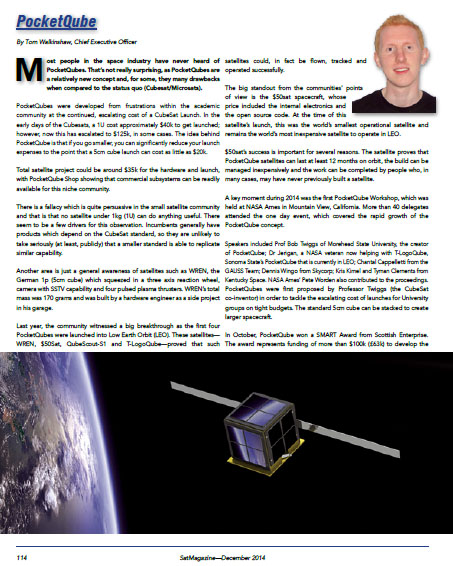
SatMagazine December 2014 PocketQube page 114The December 2014 edition of the free publication SatMagazine features an article on page 114 about PocketQubes by Tom Walkinshaw, Chief Executive Officer of the the Glasgow-based start-up PocketQube Shop.

Download the December 2014 SatMagazine from
http://www.satmagazine.com/

SatMagazine Archive
http://www.satmagazine.com/archive.php

PocketQube Shop featured in The Guardian newspaper http://www.theguardian.com/technology/2014/dec/07/tiny-space-satellite-make-at-home-pocketqube

PocketQube Shop http://www.pocketqubeshop.com/

Polish radio amateurs two million km record

ARTSAT2:DESPATCH received at 2,316,759 km December 8, 2014

ARTSAT2:DESPATCH was received at 2,316,759 km on December 8, 2014

On December 8, 2014 Michal Zawada SQ5KTM reported – We have made a new record! Now we are listening [to] ARTSAT2:DESPATCH from deep space distance 2,316,759 km = 7.7 light seconds away!  Our great crew: SP5ULN [Piotr], SP5MG [Piotr], SQ5RWU [Lukasz], SQ5KTM [Michal], SQ7GMO [Arek], SQ5AAG [Jacek], Sebastian P. and PIAP Team http://www.piap.eu/

On December  6 the group received ARTSAT2:DESPATCH at 1,502,851 km

On December 6 the group received ARTSAT2:DESPATCH at 1,502,851 km

On December 7 the same group of radio amateurs also received the 437.385 MHz amateur radio signal from the Shin’en2 spacecraft at a distance of 1,511,246 km.

Shin’en2 437.385 MHz http://www.shin-en2.jp/index_E.html

ARTSAT2:DESPATCH 437.325 MHz CW
Web http://despatch.artsat.jp/en/Main_Page
Facebook https://www.facebook.com/artsat
Twitter https://twitter.com/DESPATCH_ARTSAT

DESPATCH reception reports are summarized at:
https://docs.google.com/spreadsheets/d/1WP-FzXHe8axAzNy44SGbKpJqIRKWHAcIP9vXnaHMb6g/edit#gid=0
http://despatch.artsat.jp/en/Cooperative_Data_Reconstruction

Ham radio spacecraft launched into deep space
https://amsat-uk.org/2014/12/03/ham-radio-spacecraft-launched-into-deep-space/

Shin'en2 on left - ARTSAT2:DESPATCH on right

Shin’en2 on left – ARTSAT2:DESPATCH on right

Amateur radio spacecraft received over 1 million km from Earth

ARTSAT:DESPATCH

ARTSAT2:DESPATCH signal received at a distance of 1,104,854 km on December 5, 2014

Michal Zawada SQ5KTM reports receiving signals from both the ARTSAT2:DESPATCH and Shin’en2 spacecraft on Friday evening, December 5 at a distance of around 1,100,000 km from Earth. The ham radio group comprising SP5ULN, SP5MG, SQ5RWU, SQ5KTM, SP5XMU and the PIAP Team also received the spacecraft Shin’en2 on Saturday evening GMT at a distance of 1,511,246 km.

Akihiro Kubota of the ARTSAT project reports:

DESPATCH reception reports we’ve received are summarized:
https://docs.google.com/spreadsheets/d/1WP-FzXHe8axAzNy44SGbKpJqIRKWHAcIP9vXnaHMb6g/edit#gid=0

We received 33 reports from 7 countries, Japan, Czech Republic, Russia, Netherlands, Austria, Poland, and Buenos Aires.
Thank you very much for your cooperation. We’re waiting for further reports from you!
The transmission of will last about for more 10 days (until 5,500,000 km).

http://despatch.artsat.jp/en/Cooperative_Data_Reconstruction

※ If you cannot find your name in spite your reception, please contact→ info@artsat.jp
※※ Updated at 10:00 (JST) December 7, 2014

Ham radio spacecraft launched into deep space
https://amsat-uk.org/2014/12/03/ham-radio-spacecraft-launched-into-deep-space/

Shin'en2 signal received at 1,511,246 km on December 6, 2014

Shin’en2 signal received at a distance of 1,511,246 km on December 6, 2014

Ofcom Amateur Radio Licence Statement

Ofcom-logo-col-tOfcom has published a decision to update the terms and conditions of the amateur radio licence.  This follows a consultation published in September.

These include changes which would provide amateurs with access to some frequency bands previously available only through the variation of individual licences.

The decision is further to changes announced in our April statement on Public Sector Spectrum Release. In that statement, we set out a decision to remove access for amateur radio operators to certain frequencies in the 2300 MHz and 3400 MHz ranges in order to support the release of these bands by the Ministry of Defence.

This document is likely to be of interest to individuals authorised to use the radio spectrum in the UK for the purposes of amateur radio activities.

Ofcom Statement
http://stakeholders.ofcom.org.uk/consultations/amateur-radio-licence/statement

PDF which includes new sample licence
http://stakeholders.ofcom.org.uk/binaries/consultations/amateur-radio-licence/statement/Updating_the_Amateur_Radio_Licence.pdf

Comment regarding Ofcom’s proposed change for the 75875-76000 MHz Amateur Satellite allocation http://www.essexham.co.uk/news/ofcom-licence-changes-consultation-results.html#comment-189720

The RSGB has opened a forum to discuss guidance to accompany the licence. Anyone, RSGB member or not, can contribute to the discussion on the forum which is at http://forums.thersgb.org/implementation

RSGB Youth Committee Seek Input

Chair of RSGB Youth Committee Mike Jones 2E0MLJ

Chair of RSGB Youth Committee Mike Jones 2E0MLJ

The new Chair of the RSGB Youth Committee Mike Jones 2E0MLJ seeks your opinions on some things that are planned for the forthcoming year.

The topics covered are:

• Youngsters on the Air 2015 DX (YOTA)
• Youngsters on the Air 2015 UK
• 2015 Isle of Man DXpedition – Note this is hoped to include Amateur Satellite operation

Read Mike’s message at
http://us5.campaign-archive1.com/?u=acc8d476eba710615541e5667&id=3bb3329aa2&e=5d4b3409c9